The global axial flow pump market was valued at USD 34.5 billion in 2021 and it is predicted to surpass around USD 46.93 billion by 2030 with a CAGR of 3.48% from 2022 to 2030
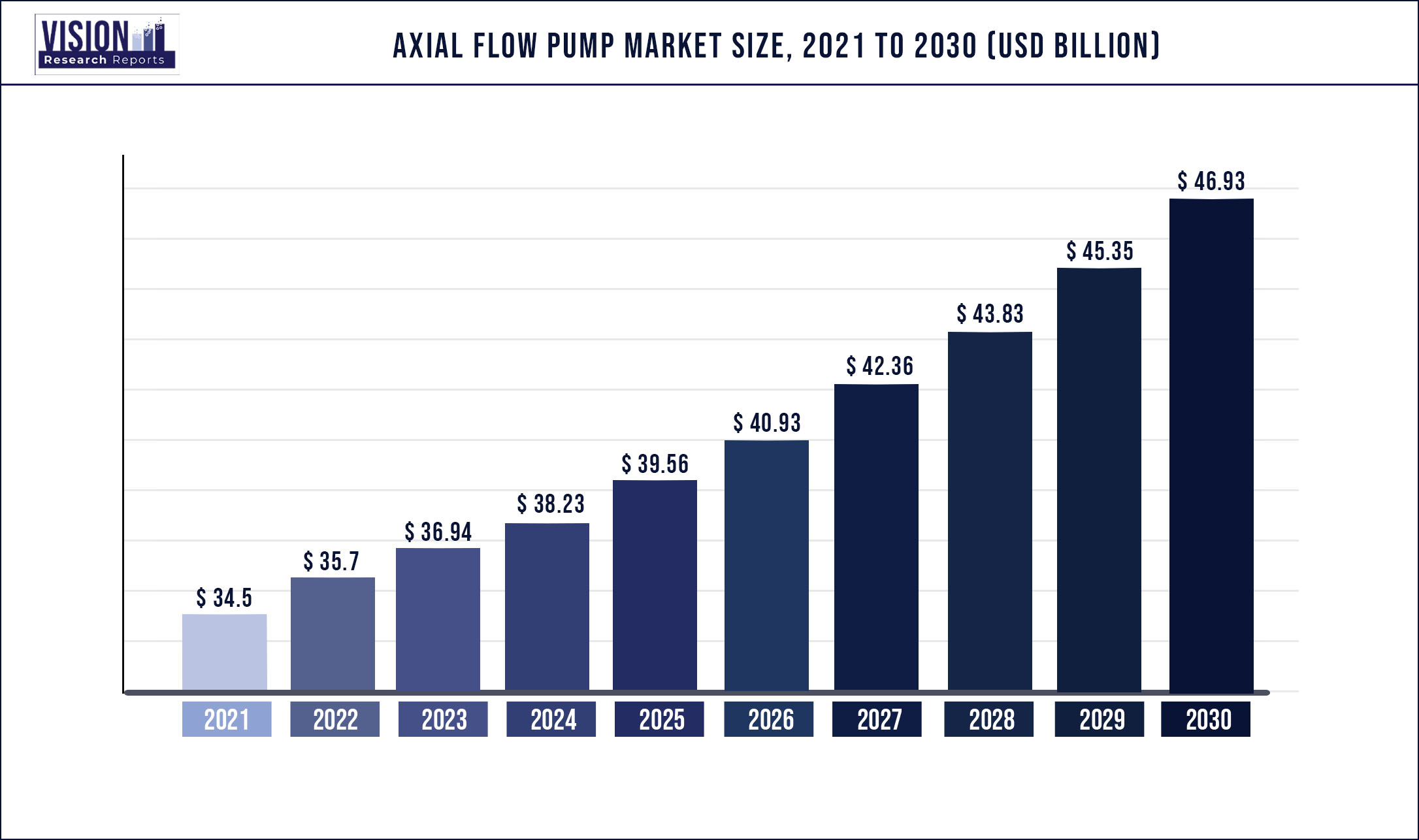
Report Highlights
Increasing demand for energy fuels in countries, such as the U.S., China, India, and Germany, due to rapid industrialization and urbanization is anticipated to drive the market.
The global market is driven by technological innovation and capacity expansion strategies adopted by the oil & gas companies in the Middle East, thus generating demand for efficient axial flow pumps with enhanced discharge rates. In addition, the government is investing significantly in expanding their businesses to other regions, thus increasing the demand for axial flow pumps.
As per a report published by the Organization for Economic Co-operation and Development (OECD), more than USD 600 billion is invested annually for water treatment operations. The market for axial flow pumps is likely to grow as governments across various countries are investing significantly in the development of water treatment and wastewater management facilities.
In June 2016, the U.S. Department of Energy (DOE) released new energy conservation standards for pumps that govern the product's energy efficiency. This is expected to compel players in various application industries to replace their old pumps with new standards, thereby leading to market growth over the coming years.
Scope of The Report
| Report Coverage | Details |
| Market Size in 2021 | USD 34.5 billion |
| Revenue Forecast by 2030 | USD 46.93 billion |
| Growth rate from 2022 to 2030 | CAGR of 3.48% |
| Base Year | 2021 |
| Forecast Period | 2022 to 2030 |
| Segmentation | Type, application, region |
| Companies Covered | Xylem; Grundfos; Sulzer Ltd.; KSB SE & Co. KGaA; Pentair; Weir Group PLC; Wilo SE; Ebara Corporation; ITT Inc.; Leo Group Co., Ltd. |
Type Insights
The high power axial flow pump segment led the market and accounted for 52.7% share of the global revenue in 2021 due to increased demand for high power pumps in applications, such as flood dewatering and water and wastewater treatment. The rapid advancements in the power generation sector in the countries of Central and South America are expected to boost the demand for high power axial flow pumps.
The demand for high power axial pumps is expected to be driven by the well-developed oil & gas and petroleum sectors in the Middle East and Africa. In addition, companies such as Qatar Projects Oil & Gas Services and Saudi Aramco are investing significantly in their business expansion in other regions, thereby increasing the demand for these pumps.
The miniwatt axial flow pump segment is likely to expand at a CAGR of 3.3% from 2022 to 2030. The increasing adoption of new industrialization practices, coupled with technological development in the Asia Pacific and Central and South America, is likely to drive demand for miniwatt axial flow pumps over the forecast period.
A high discharge rate at a less vertical distance is a key advantage of using high-power axial pumps. For instance, these products have the ability to pump up more than three times of water and other liquids at less than 4 meters vertical distance than commonly used centrifugal pumps. This minimizes aerodynamic losses at high efficiency, thus leading to increased product demand.
Application Insights
The others application segment accounted for the largest share of 29.5% in 2021. The food and beverage application segment accounted for the second-largest share in 2021. This is attributed to investments by food and beverage manufacturers for buying new pumps and other machinery as per the recent regulations set by the Department of Energy (DOE) and the U.S. Food & Drug Administration (USFDA).
Axial flow pumps are used for handling flammable, vicious, aggressive, and abrasive fluids with ease. Chemicals are used in various end-use industries, including automotive, manufacturing, and construction. The growth of the aforementioned industries is likely to augment the demand for various chemicals, thereby impacting the penetration of axial flow pumps for chemical handling.
Rising demand for crude oil for the facilitation of overseas logistics, production centers, and domestic transports is expected to boost the onshore and offshore exploration activities. The petroleum segment is likely to expand at a CAGR of 4.2% over the forecast period owing to the increasing investment in the sector to meet the growing demand for energy fuel in developing countries, such as China, India, South Korea, and Brazil.
The rapid development of residential and commercial buildings has resulted in an increased need for proper sewage systems. The municipal authorities are expected to invest significantly in pumping solutions to provide consistent water supply across residential locations. The rapid expansion of cities is expected to have a positive impact on the demand for axial flow pumps in the domestic water and wastewater industry.
Regional Insights
Asia Pacific led the market and accounted for a 41.8% share of the global revenue in 2021. The growing demand for axial flow pumps in the region is attributed to the tremendous growth of the end-use industries, including domestic water and wastewater and petroleum. In addition, rapid investments in the manufacturing sector to cater to the demand of a rapidly growing population are expected to fuel the market growth over the forecast period.
The adoption of axial flow pumps in Europe is attributed to favorable government initiatives on setting up water and wastewater management facilities in countries, such as Italy, Germany, France, and the U.K. However, the demand is expected to decline in the near term owing to the recent outbreak of COVID-19, which resulted in the temporary closure of several manufacturing facilities.
North America is expected to expand at a CAGR of 2.44% over the forecast period. The presence of advanced processing capabilities in the U.S., coupled with continuous R&D activities for manufacturing pumps, is expected to drive the market in the region. Furthermore, rising water scarcity has resulted in innovations that are likely to promote product demand in the region.
The demand for axial power pumps in Central and South Africa is expected to be driven by the rapidly expanding power generation sector in Brazil and Argentina. Furthermore, the replacement of commonly used centrifugal pumps with axial flow pumps owing to their ability to increase workplace efficiency at power plants and water management plants is anticipated to augment the product demand in the region.
Key Players
Market Segmentation
Chapter 1. Introduction
1.1. Research Objective
1.2. Scope of the Study
1.3. Definition
Chapter 2. Research Methodology
2.1. Research Approach
2.2. Data Sources
2.3. Assumptions & Limitations
Chapter 3. Executive Summary
3.1. Market Snapshot
Chapter 4. Market Variables and Scope
4.1. Introduction
4.2. Market Classification and Scope
4.3. Industry Value Chain Analysis
4.3.1. Raw Material Procurement Analysis
4.3.2. Sales and Distribution Channel Analysis
4.3.3. Downstream Buyer Analysis
Chapter 5. COVID 19 Impact on Axial Flow Pump Market
5.1. COVID-19 Landscape: Axial Flow Pump Industry Impact
5.2. COVID 19 - Impact Assessment for the Industry
5.3. COVID 19 Impact: Global Major Government Policy
5.4. Market Trends and Opportunities in the COVID-19 Landscape
Chapter 6. Market Dynamics Analysis and Trends
6.1. Market Dynamics
6.1.1. Market Drivers
6.1.2. Market Restraints
6.1.3. Market Opportunities
6.2. Porter’s Five Forces Analysis
6.2.1. Bargaining power of suppliers
6.2.2. Bargaining power of buyers
6.2.3. Threat of substitute
6.2.4. Threat of new entrants
6.2.5. Degree of competition
Chapter 7. Competitive Landscape
7.1.1. Company Market Share/Positioning Analysis
7.1.2. Key Strategies Adopted by Players
7.1.3. Vendor Landscape
7.1.3.1. List of Suppliers
7.1.3.2. List of Buyers
Chapter 8. Global Axial Flow Pump Market, By Type
8.1. Axial Flow Pump Market, by Type, 2022-2030
8.1.1. Miniwatt
8.1.1.1. Market Revenue and Forecast (2017-2030)
8.1.2. High Power
8.1.2.1. Market Revenue and Forecast (2017-2030)
Chapter 9. Global Axial Flow Pump Market, By Application
9.1. Axial Flow Pump Market, by Application, 2022-2030
9.1.1. Domestic Water & Wastewater
9.1.1.1. Market Revenue and Forecast (2017-2030)
9.1.2. Petroleum
9.1.2.1. Market Revenue and Forecast (2017-2030)
9.1.3. Chemical
9.1.3.1. Market Revenue and Forecast (2017-2030)
9.1.4. Food & Beverage
9.1.4.1. Market Revenue and Forecast (2017-2030)
9.1.5. Others
9.1.5.1. Market Revenue and Forecast (2017-2030)
Chapter 10. Global Axial Flow Pump Market, Regional Estimates and Trend Forecast
10.1. North America
10.1.1. Market Revenue and Forecast, by Type (2017-2030)
10.1.2. Market Revenue and Forecast, by Application (2017-2030)
10.1.3. U.S.
10.1.3.1. Market Revenue and Forecast, by Type (2017-2030)
10.1.3.2. Market Revenue and Forecast, by Application (2017-2030)
10.1.4. Rest of North America
10.1.4.1. Market Revenue and Forecast, by Type (2017-2030)
10.1.4.2. Market Revenue and Forecast, by Application (2017-2030)
10.2. Europe
10.2.1. Market Revenue and Forecast, by Type (2017-2030)
10.2.2. Market Revenue and Forecast, by Application (2017-2030)
10.2.3. UK
10.2.3.1. Market Revenue and Forecast, by Type (2017-2030)
10.2.3.2. Market Revenue and Forecast, by Application (2017-2030)
10.2.4. Germany
10.2.4.1. Market Revenue and Forecast, by Type (2017-2030)
10.2.4.2. Market Revenue and Forecast, by Application (2017-2030)
10.2.5. France
10.2.5.1. Market Revenue and Forecast, by Type (2017-2030)
10.2.5.2. Market Revenue and Forecast, by Application (2017-2030)
10.2.6. Rest of Europe
10.2.6.1. Market Revenue and Forecast, by Type (2017-2030)
10.2.6.2. Market Revenue and Forecast, by Application (2017-2030)
10.3. APAC
10.3.1. Market Revenue and Forecast, by Type (2017-2030)
10.3.2. Market Revenue and Forecast, by Application (2017-2030)
10.3.3. India
10.3.3.1. Market Revenue and Forecast, by Type (2017-2030)
10.3.3.2. Market Revenue and Forecast, by Application (2017-2030)
10.3.4. China
10.3.4.1. Market Revenue and Forecast, by Type (2017-2030)
10.3.4.2. Market Revenue and Forecast, by Application (2017-2030)
10.3.5. Japan
10.3.5.1. Market Revenue and Forecast, by Type (2017-2030)
10.3.5.2. Market Revenue and Forecast, by Application (2017-2030)
10.3.6. Rest of APAC
10.3.6.1. Market Revenue and Forecast, by Type (2017-2030)
10.3.6.2. Market Revenue and Forecast, by Application (2017-2030)
10.4. MEA
10.4.1. Market Revenue and Forecast, by Type (2017-2030)
10.4.2. Market Revenue and Forecast, by Application (2017-2030)
10.4.3. GCC
10.4.3.1. Market Revenue and Forecast, by Type (2017-2030)
10.4.3.2. Market Revenue and Forecast, by Application (2017-2030)
10.4.4. North Africa
10.4.4.1. Market Revenue and Forecast, by Type (2017-2030)
10.4.4.2. Market Revenue and Forecast, by Application (2017-2030)
10.4.5. South Africa
10.4.5.1. Market Revenue and Forecast, by Type (2017-2030)
10.4.5.2. Market Revenue and Forecast, by Application (2017-2030)
10.4.6. Rest of MEA
10.4.6.1. Market Revenue and Forecast, by Type (2017-2030)
10.4.6.2. Market Revenue and Forecast, by Application (2017-2030)
10.5. Latin America
10.5.1. Market Revenue and Forecast, by Type (2017-2030)
10.5.2. Market Revenue and Forecast, by Application (2017-2030)
10.5.3. Brazil
10.5.3.1. Market Revenue and Forecast, by Type (2017-2030)
10.5.3.2. Market Revenue and Forecast, by Application (2017-2030)
10.5.4. Rest of LATAM
10.5.4.1. Market Revenue and Forecast, by Type (2017-2030)
10.5.4.2. Market Revenue and Forecast, by Application (2017-2030)
Chapter 11. Company Profiles
11.1. Xylem
11.1.1. Company Overview
11.1.2. Product Offerings
11.1.3. Financial Performance
11.1.4. Recent Initiatives
11.2. Grundfos
11.2.1. Company Overview
11.2.2. Product Offerings
11.2.3. Financial Performance
11.2.4. Recent Initiatives
11.3. KSB SE & Co. KGaA
11.3.1. Company Overview
11.3.2. Product Offerings
11.3.3. Financial Performance
11.3.4. Recent Initiatives
11.4. Sulzer Ltd.
11.4.1. Company Overview
11.4.2. Product Offerings
11.4.3. Financial Performance
11.4.4. LTE Scientific
11.5. Pentair
11.5.1. Company Overview
11.5.2. Product Offerings
11.5.3. Financial Performance
11.5.4. Recent Initiatives
11.6. Weir Group PLC
11.6.1. Company Overview
11.6.2. Product Offerings
11.6.3. Financial Performance
11.6.4. Recent Initiatives
Chapter 12. Research Methodology
12.1. Primary Research
12.2. Secondary Research
12.3. Assumptions
Chapter 13. Appendix
13.1. About Us
13.2. Glossary of Terms
 Cross-segment Market Size and Analysis for
Mentioned Segments
Additional Company Profiles (Upto 5 With No Cost)
Additional Countries (Apart From Mentioned Countries)
Country/Region-specific Report
Go To Market Strategy
Region Specific Market DynamicsRegion Level Market Share Import Export AnalysisProduction AnalysisOthers
Cross-segment Market Size and Analysis for
Mentioned Segments
Additional Company Profiles (Upto 5 With No Cost)
Additional Countries (Apart From Mentioned Countries)
Country/Region-specific Report
Go To Market Strategy
Region Specific Market DynamicsRegion Level Market Share Import Export AnalysisProduction AnalysisOthers