
Breast Shells Market Size, Growth, Trends | Report 2022-2030
The global breast shells market was surpassed at USD 71.4 million in 2021 and is expected to hit around USD 92.77 million by 2030, growing at a CAGR of 2.95% from 2022 to 2030.
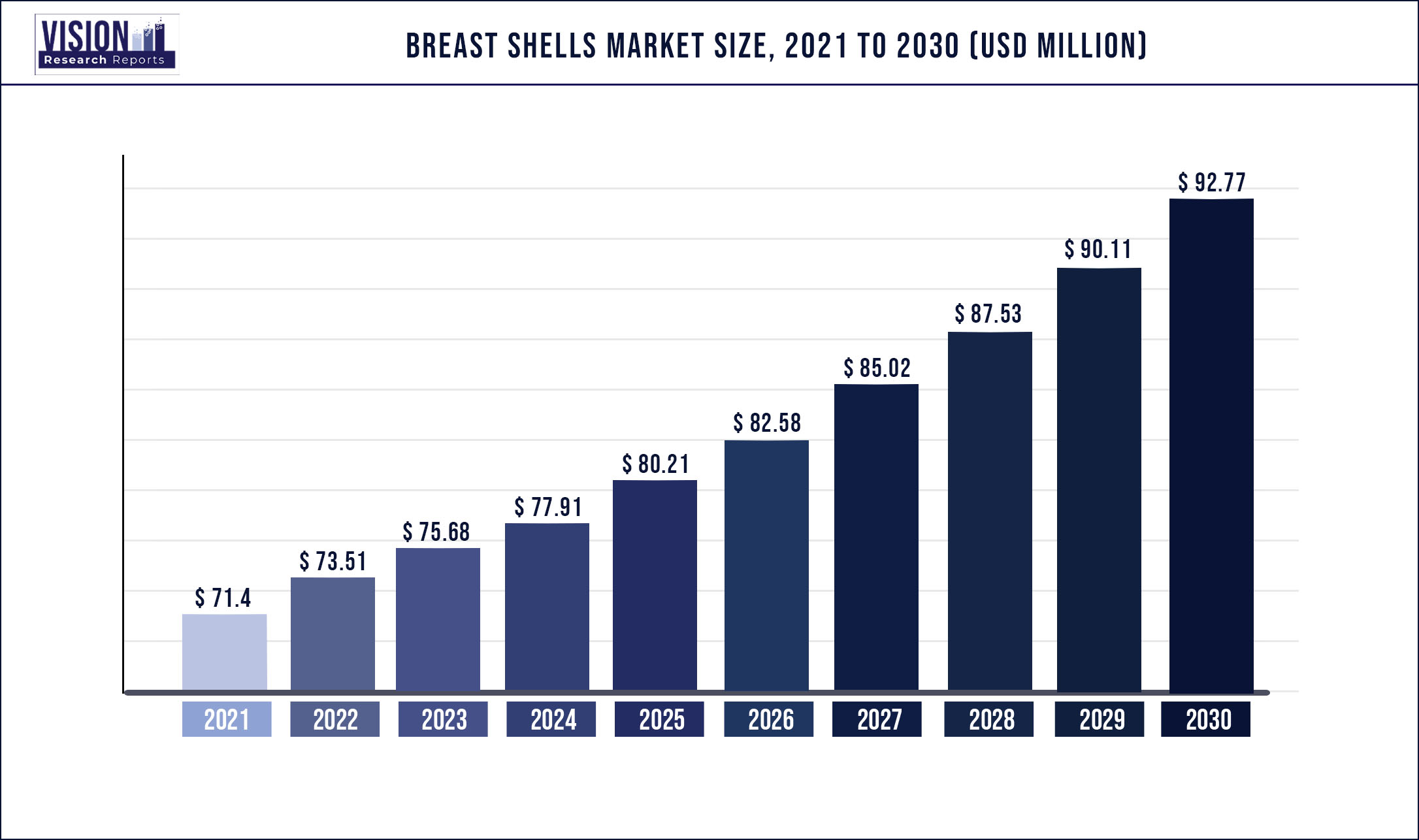
Report Highlights
Rising breastfeeding rates are fueling the market growth. These products help pregnant women manage the leaking issues that arise during nursing. Additionally, rising levels of employment for women worldwide have increased the demand for easily accessible baby care items such as nursing breast shells. The surge in the number of working women across the globe has resulted in an escalation in the number of dual-income homes. This has resulted in an upsurge in average family income, which is expected to fuel the expansion of post-partum care products.
Since the majority of consumers choose new technologies and products with improved features, the market's leading competitors are focusing on upgrading their product portfolios in order to expand their consumer base. Prominent manufacturers are focusing on the development of more hygienic and user-friendly nursing breast shells as sanitation and comfort are the two key features that customers evaluate when buying products that come into direct contact with the skin.
Women's ongoing quest for comfort has encouraged manufacturers to create customizable breastfeeding accessories that fit breast shapes and prevent stains from leaking. Tech-savvy women have been gravitating toward breast shells with plenty of features, which has opened up lucrative potential for companies in terms of technological improvements, thereby leading to market expansion. For instance, the Ameda DuoShell Breast Shells shield uncomfortable or sensitive nipples from clothing pressure and friction, and they can also be utilized to draw out flat or inverted nipples. Hence, such developments are fueling the market growth.
Scope of The Report
| Report Coverage | Details |
| Market Size in 2021 | USD 71.4 million |
| Revenue Forecast by 2030 | USD 92.77 million |
| Growth rate from 2022 to 2030 | CAGR of 2.95% |
| Base Year | 2021 |
| Forecast Period | 2022 to 2030 |
| Segmentation | Sales channel, region |
| Companies Covered |
Koninklijke Philips N.V.; Medela, LLC; Magento, Inc. (Ameda); Ardo Medical, Ltd.; Chicco Australia |
Sales Channel Insights
The hospital pharmacy (inpatient) segment held the largest share of over 35.03% in 2021. The dominance of this segment can be attributed to the expected increase in demand for breast shells among new moms due to rising pregnancy rates around the world. Moreover, increasing births and number of hospitals worldwide are expected to drive the market. For instance, according to the American Association of Birth Centers, in the U.S., around 98.8% of births take place in a hospital setting. Births at hospital setting are considered to be low-risk, moreover, around 85% of women giving birth in hospitals are eligible for care at birth centers. Thus, many women prefer delivering at a hospital setting. In addition, due to safety concerns, people trust hospital pharmacies for such postpartum products. Therefore, there is a high level of parental trust in medical professionals, which supports the expansion of the hospital pharmacy.
The e-commerce segment is anticipated to expand at the fastest rate of 4.6% over the forecast period. This can be accredited to a shift in the preference from retail sellers to e-commerce settings, which offer such products at low cost. The segment is projected to grow as breast shells are more widely available online through e-commerce. With the help of the e-commerce channel, customers can compare and choose the best products based on their brand, type, point of sale, and price. Some of the top online retailers that sell to consumers are Amazon, Belly Bandit, Walmart, Motherhood Maternity, and The Moms Co. These platforms use sales techniques such as buy one, get one deals, discounts, and freebies, which further draw in more customers. This is likely to foster the segment growth over the forecast period.
Regional Insights
North America dominated the market with a revenue share of over 35.12% in 2021 and is expected to witness considerable growth over the forecast period. This can be accredited to the increasing awareness regarding the importance of breastfeeding. Breastfeeding awareness campaigns such as the breastfeeding promotion program by the County Health Ranking Organization focused on providing information and education regarding practices of breastfeeding to women throughout their pre-natal and post-natal periods are facilitating the growth. The organization is expected to increase the number of breastfeeding and hygienic breastfeeding practices. Hence, as a result of such campaigns organized by various government and non-governmental organizations, the breastfeeding rate is expected to increase, thereby expanding the use of breast shells.
Moreover, constant birth in this region is expected to fuel the market growth. According to Statistics Canada, in Canada, 358,604 newborns were reported in the year 2020. Similarly, according to the Centers for Disease Control and Prevention, in 2021, the general fertility rate in the U.S. was calculated to be 56.6% per 1,000 women, which was up by 1% from 2020. Rise in the fertility rate is expected to increase the number of births in this region. Thus, growth in the number of births in this region may indirectly support the growth of the market.
Asia Pacific is estimated to register the highest CAGR of 4.7% over the forecast period. The market is steadily increasing, offering several opportunities for the introduction of new products. Furthermore, rising birth rates in the region is can be accredited to its growth. For instance, according to Work Bank, China's birth rate climbed from 1.60 births per woman in 2000 to 1.70 births per woman in 2019, whereas, as per, The Australian Bureau of Statistics reports, in 2020, 294,369 births were reported in Australia.
In addition, according to Cone Health Women’s & Children’s Center, breast shells can also be used to treat breast engorgement. The number of women suffering from breast engorgement in this region is increasing. A study conducted by the Journal of Reproductive Medicine Gynaecology & Obstetrics revealed that in India, around 65% to 75% of lactating women suffer from breast engorgement. Thus, as a result of the above-mentioned factors, the market for breast shells is projected to grow in this region.
Key Players
Market Segmentation
Chapter 1. Introduction
1.1.Research Objective
1.2.Scope of the Study
1.3.Definition
Chapter 2. Research Methodology
2.1.Research Approach
2.2.Data Sources
2.3.Assumptions & Limitations
Chapter 3. Executive Summary
3.1.Market Snapshot
Chapter 4. Market Variables and Scope
4.1.Introduction
4.2.Market Classification and Scope
4.3.Industry Value Chain Analysis
4.3.1. Raw Material Procurement Analysis
4.3.2. Sales and Distribution Channel Analysis
4.3.3. Downstream Buyer Analysis
Chapter 5.COVID 19 Impact on Breast Shells Market
5.1. COVID-19 Landscape: Breast Shells Industry Impact
5.2. COVID 19 - Impact Assessment for the Industry
5.3. COVID 19 Impact: Global Major Government Policy
5.4.Market Trends and Opportunities in the COVID-19 Landscape
Chapter 6. Market Dynamics Analysis and Trends
6.1.Market Dynamics
6.1.1. Market Drivers
6.1.2. Market Restraints
6.1.3. Market Opportunities
6.2.Porter’s Five Forces Analysis
6.2.1. Bargaining power of suppliers
6.2.2. Bargaining power of buyers
6.2.3. Threat of substitute
6.2.4. Threat of new entrants
6.2.5. Degree of competition
Chapter 7. Competitive Landscape
7.1.1. Company Market Share/Positioning Analysis
7.1.2. Key Strategies Adopted by Players
7.1.3. Vendor Landscape
7.1.3.1.List of Suppliers
7.1.3.2.List of Buyers
Chapter 8. Global Breast Shells Market, By Sales Channel
8.1.Breast Shells Market, by Sales Channel Type, 2020-2030
8.1.1. Hospital Pharmacy (Inpatient)
8.1.1.1.Market Revenue and Forecast (2017-2030)
8.1.2. Retail Store
8.1.2.1.Market Revenue and Forecast (2017-2030)
8.1.3. E-commerce
8.1.3.1.Market Revenue and Forecast (2017-2030)
8.1.4. Wholesaler/Distributor
8.1.4.1.Market Revenue and Forecast (2017-2030)
8.1.5. Direct Purchase
8.1.5.1.Market Revenue and Forecast (2017-2030)
Chapter 9. Global Breast Shells Market, Regional Estimates and Trend Forecast
9.1. North America
9.1.1. Market Revenue and Forecast, by Product type (2017-2030)
9.1.2. Market Revenue and Forecast, by Formulations (2017-2030)
9.1.3. Market Revenue and Forecast, by Sales Channel (2017-2030)
9.1.4. U.S.
9.1.4.1. Market Revenue and Forecast, by Product type (2017-2030)
9.1.4.2. Market Revenue and Forecast, by Formulations (2017-2030)
9.1.4.3. Market Revenue and Forecast, by Sales Channel (2017-2030)
9.1.5. Rest of North America
9.1.5.1. Market Revenue and Forecast, by Product type (2017-2030)
9.1.5.2. Market Revenue and Forecast, by Formulations (2017-2030)
9.1.5.3. Market Revenue and Forecast, by Sales Channel (2017-2030)
9.2. Europe
9.2.1. Market Revenue and Forecast, by Product type (2017-2030)
9.2.2. Market Revenue and Forecast, by Formulations (2017-2030)
9.2.3. Market Revenue and Forecast, by Sales Channel (2017-2030)
9.2.4. UK
9.2.4.1. Market Revenue and Forecast, by Product type (2017-2030)
9.2.4.2. Market Revenue and Forecast, by Formulations (2017-2030)
9.2.4.3. Market Revenue and Forecast, by Sales Channel (2017-2030)
9.2.5. Germany
9.2.5.1. Market Revenue and Forecast, by Product type (2017-2030)
9.2.5.2. Market Revenue and Forecast, by Formulations (2017-2030)
9.2.5.3. Market Revenue and Forecast, by Sales Channel (2017-2030)
9.2.6. France
9.2.6.1. Market Revenue and Forecast, by Product type (2017-2030)
9.2.6.2. Market Revenue and Forecast, by Formulations (2017-2030)
9.2.6.3. Market Revenue and Forecast, by Sales Channel (2017-2030)
9.2.7. Rest of Europe
9.2.7.1. Market Revenue and Forecast, by Product type (2017-2030)
9.2.7.2. Market Revenue and Forecast, by Formulations (2017-2030)
9.2.7.3. Market Revenue and Forecast, by Sales Channel (2017-2030)
9.3. APAC
9.3.1. Market Revenue and Forecast, by Product type (2017-2030)
9.3.2. Market Revenue and Forecast, by Formulations (2017-2030)
9.3.3. Market Revenue and Forecast, by Sales Channel (2017-2030)
9.3.4. India
9.3.4.1. Market Revenue and Forecast, by Product type (2017-2030)
9.3.4.2. Market Revenue and Forecast, by Formulations (2017-2030)
9.3.4.3. Market Revenue and Forecast, by Sales Channel (2017-2030)
9.3.5. China
9.3.5.1. Market Revenue and Forecast, by Product type (2017-2030)
9.3.5.2. Market Revenue and Forecast, by Formulations (2017-2030)
9.3.5.3. Market Revenue and Forecast, by Sales Channel (2017-2030)
9.3.6. Japan
9.3.6.1. Market Revenue and Forecast, by Product type (2017-2030)
9.3.6.2. Market Revenue and Forecast, by Formulations (2017-2030)
9.3.6.3. Market Revenue and Forecast, by Sales Channel (2017-2030)
9.3.7. Rest of APAC
9.3.7.1. Market Revenue and Forecast, by Product type (2017-2030)
9.3.7.2. Market Revenue and Forecast, by Formulations (2017-2030)
9.3.7.3. Market Revenue and Forecast, by Sales Channel (2017-2030)
9.4. MEA
9.4.1. Market Revenue and Forecast, by Product type (2017-2030)
9.4.2. Market Revenue and Forecast, by Formulations (2017-2030)
9.4.3. Market Revenue and Forecast, by Sales Channel (2017-2030)
9.4.4. GCC
9.4.4.1. Market Revenue and Forecast, by Product type (2017-2030)
9.4.4.2. Market Revenue and Forecast, by Formulations (2017-2030)
9.4.4.3. Market Revenue and Forecast, by Sales Channel (2017-2030)
9.4.5. North Africa
9.4.5.1. Market Revenue and Forecast, by Product type (2017-2030)
9.4.5.2. Market Revenue and Forecast, by Formulations (2017-2030)
9.4.5.3. Market Revenue and Forecast, by Sales Channel (2017-2030)
9.4.6. South Africa
9.4.6.1. Market Revenue and Forecast, by Product type (2017-2030)
9.4.6.2. Market Revenue and Forecast, by Formulations (2017-2030)
9.4.6.3. Market Revenue and Forecast, by Sales Channel (2017-2030)
9.4.7. Rest of MEA
9.4.7.1. Market Revenue and Forecast, by Product type (2017-2030)
9.4.7.2. Market Revenue and Forecast, by Formulations (2017-2030)
9.4.7.3. Market Revenue and Forecast, by Sales Channel (2017-2030)
9.5. Latin America
9.5.1. Market Revenue and Forecast, by Product type (2017-2030)
9.5.2. Market Revenue and Forecast, by Formulations (2017-2030)
9.5.3. Market Revenue and Forecast, by Sales Channel (2017-2030)
9.5.4. Brazil
9.5.4.1. Market Revenue and Forecast, by Product type (2017-2030)
9.5.4.2. Market Revenue and Forecast, by Formulations (2017-2030)
9.5.4.3. Market Revenue and Forecast, by Sales Channel (2017-2030)
9.5.5. Rest of LATAM
9.5.5.1. Market Revenue and Forecast, by Product type (2017-2030)
9.5.5.2. Market Revenue and Forecast, by Formulations (2017-2030)
9.5.5.3. Market Revenue and Forecast, by Sales Channel (2017-2030)
Chapter 10.Company Profiles
10.1.Koninklijke Philips N.V
10.1.1.Company Overview
10.1.2.Product Offerings
10.1.3.Financial Performance
10.1.4.Recent Initiatives
10.2.Medela, LLC
10.2.1.Company Overview
10.2.2.Product Offerings
10.2.3.Financial Performance
10.2.4.Recent Initiatives
10.3.Magento, Inc. (Ameda)
10.3.1.Company Overview
10.3.2.Product Offerings
10.3.3.Financial Performance
10.3.4.Recent Initiatives
10.4.Ardo Medical, Ltd.
10.4.1.Company Overview
10.4.2.Product Offerings
10.4.3.Financial Performance
10.4.4.Recent Initiatives
10.5.Chicco Australia
10.5.1.Company Overview
10.5.2.Product Offerings
10.5.3.Financial Performance
10.5.4.Recent Initiatives
Chapter 11.Research Methodology
11.1.Primary Research
11.2.Secondary Research
11.3.Assumptions
Chapter 12.Appendix
12.1.About Us
12.2.Glossary of Terms
 Cross-segment Market Size and Analysis for
Mentioned Segments
Additional Company Profiles (Upto 5 With No Cost)
Additional Countries (Apart From Mentioned Countries)
Country/Region-specific Report
Go To Market Strategy
Region Specific Market DynamicsRegion Level Market Share Import Export AnalysisProduction AnalysisOthers
Cross-segment Market Size and Analysis for
Mentioned Segments
Additional Company Profiles (Upto 5 With No Cost)
Additional Countries (Apart From Mentioned Countries)
Country/Region-specific Report
Go To Market Strategy
Region Specific Market DynamicsRegion Level Market Share Import Export AnalysisProduction AnalysisOthers