
CRISPR And Cas Genes Market Size, Share | Report 2022-2030
The global CRISPR and Cas genes market was valued at USD 2.11 billion in 2021 and it is predicted to surpass around USD 9.87 billion by 2030 with a CAGR of 18.7% from 2022 to 2030.
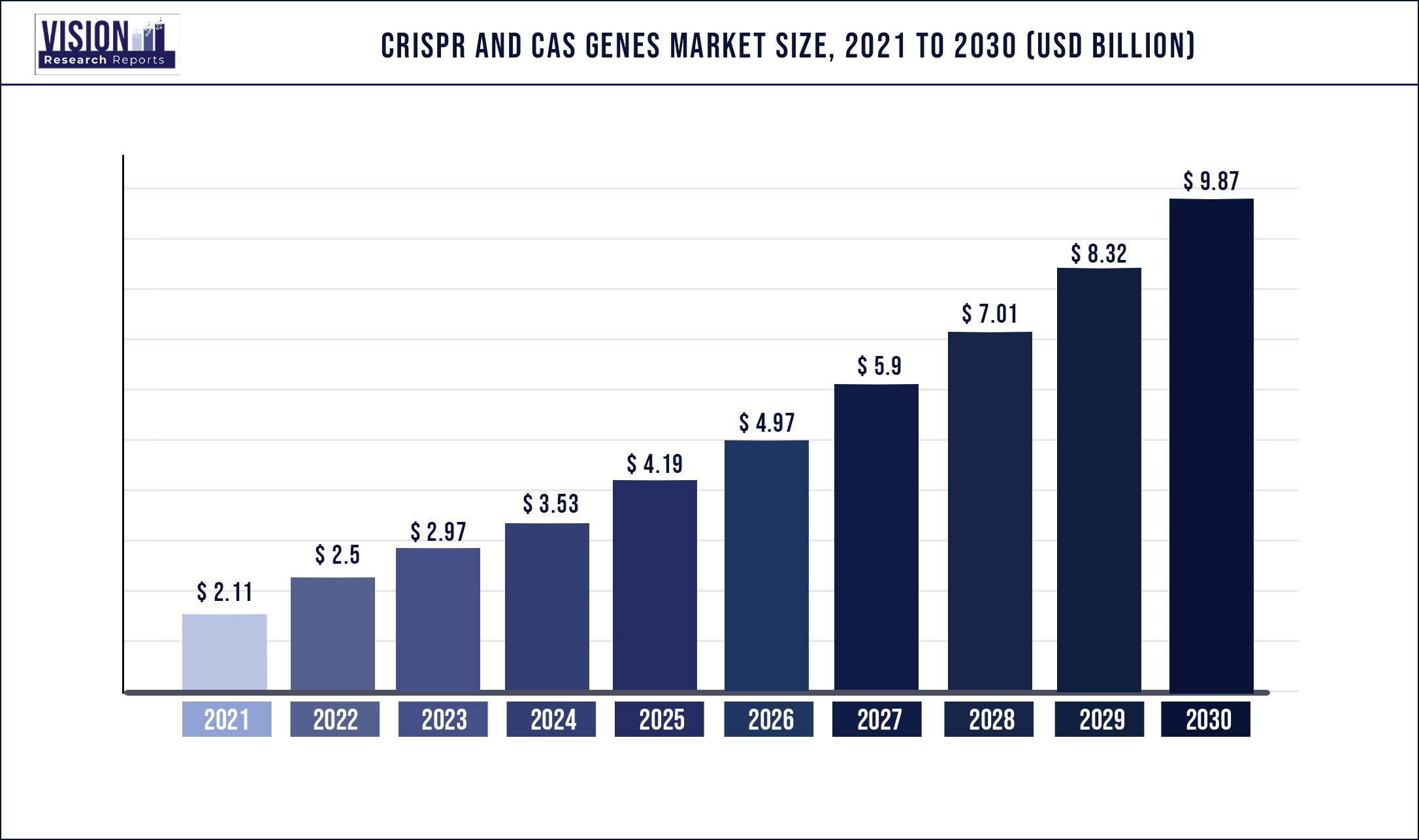
Report Highlights
The use of CRISPR-Cas systems in diagnostics and the assessment of evolutionary analysis in prokaryotes has significantly increased, owing to the developments in the field of genome editing. The application of this technology enables easy and cost-efficient editing of genes. Genome editing has made a significant advancement in biomedical research, with the present trend of cutting-edge techniques paving the way for the future treatment of different genetic and non-genetic disorders.
The development and implementation of more effective ways for gene targeting and the generation of gene-edited avian species have been facilitated by the availability of the CRISPR/Cas9-mediated gene and genome editing technology. According to an article published on Frontiers, in February 2021, CRISPR/Cas9 has become a robust and important tool for gene editing in the poultry industry. Potential applications in several fields would further boost the demand for this technology. The COVID-19 outbreak shifted the researcher’s emphasis to the development of COVID-19 molecular diagnostic tools based on this technology. For instance, in March 2021, Nanyang Technological University researchers in Singapore created a COVID-19 test based on CRISPR that provides results in 30 minutes.
Even after the virus has mutated, this test still discovers it. This would further encourage the other key players to leverage this technique, thereby driving the industry's growth. This technology is increasingly being used for several medical and other applications. Competition over patents for such a gene-editing technology is expected to grow, as more academic institutions and biotech companies attempt to develop new commercial applications of this technology. In addition, there is a lot of potentials for this technique to advance with the use of machine learning technologies. For instance, in August 2022, Synthego launched engineered cell libraries, a cutting-edge service that expands access to CRISPR by giving arrayed CRISPR-edited cells for use directly in functional screening experiments.
It has potential applications in disease research. Key players offer tools and solutions for each step of the gene editing workflow. Integrating several tools, services, and improved processes makes it possible to complete research experiments rapidly and with little effort. Moreover, key players have raised significant funding to support the R&D of the CRISPR & Cas9 gene-editing approach. For instance, in April 2021, Vertex Pharmaceuticals collaborated with CRISPR Therapeutics to develop and manufacture a new CRISPR/Cas9-based gene editing therapy called CTX001. A potentially therapeutic option for transfusion-dependent beta-thalassemia and Sickle Cell Disease (SCD). In January 2020,Mammoth Biosciences raised USD 45 million to develop next-gen CRISPR products for therapeutics & diagnostics purposes. This would further be used to develop the company’s CRISPR genes-driven diagnostics portfolio.
Scope of The Report
| Report Coverage | Details |
| Market Size in 2021 | USD 2.11 billion |
| Revenue Forecast by 2030 | USD 9.87 billion |
| Growth rate from 2022 to 2030 | CAGR of 18.7% |
| Base Year | 2021 |
| Forecast Period | 2022 to 2030 |
| Segmentation | Product & service, application, end-use, region |
| Companies Covered |
AstraZeneca; Addgene; Caribou Biosciences, Inc.; Cellectis; CRISPR Therapeutics; Editas Medicine, Inc.; eGenesis; F. Hoffmann-La Roche Ltd.; Horizon Discovery Group plc; GenScript; Danaher Corp.; Intellia Therapeutics, Inc.; Lonza; Merck KGaA; Intellia Therapeutics, Inc.; Takara Bio Inc.; Thermo Fisher Scientific, Inc.; Synthego; Mammoth Biosciences; Inscripta, Inc.; Cibus; Beam Therapeutics; PLANTeDIT; Vertex Pharmaceuticals Incorporated; Hera BioLabs; OriGene Technologies, Inc.; Recombinetics, Inc. |
Product & Service Insights
On the basis of product & service, the global industry has been further categorized into products and services. The product segment dominated the global industry in 2021 and accounted for the highest share of more than 79.02% of the overall revenue. Several cutting-edge technologies, such as CRISPR gene editing kits, have been developed to meet the growing demands for genome editing solutions. The maximum revenue share can be attributed to the availability of enhanced individual products that can be used to achieve a variety of goals, including simple gene knockouts, selective genome cleavage, reduced off-target cutting, genome engineering, and higher specificity.
Furthermore, increased investments in gene editing-based R&D along with the introduction of several applications are anticipated to drive the growth of the service segment over the forecast period. For instance, in July 2022, U.K. charity (The British Heart Foundation) provided USD 36 million to an international team to develop innovative gene-editing treatments for inherited heart diseases. Recent gene editing techniques, particularly the CRISPR technology has offered several opportunities to combat cardiovascular disease.
Application Insights
On the basis of applications, the global industry has been further categorized into biomedical and agricultural. The biomedical application segment dominated the global industry in 2021 and accounted for the largest share of more than 92.7% of the total revenue. The increasing utilization of CRISPR gene-editing technologies in a number of biological sciences fields has significantly contributed to the segment’s high revenue share. The effectiveness and specificity of this technology have been enhanced by better delivery methods and the introduction of nanocarriers. The number of studies and publications that used this method to modify the genomes of human somatic cells and induced pluripotent stem cells has significantly increased.
In addition, some companies provide commercial kits and services to help researchers who are working in this domain. On the other hand, the agriculture application segment is anticipated to register the fastest growth rate during the forecast period. Improvements in agricultural production through the incorporation of innovative breeding technology have increased access to nutrition-rich foods globally. For instance, in June 2019, researchers at the Cold Spring Harbor Laboratory implemented CRISPR/Cas9 technology to induce mutations in the flowering suppressor of tomatoes, which resulted in rapid flowering and improved compact growth of tomatoes, finally an early yield.
End-use Insights
On the basis of end-uses, the global industry has been further categorized into biotechnology & pharmaceutical companies, academics & government research institutes, and Contract Research Organizations (CROs). The biotechnology and pharmaceutical companies end-use segment dominated the global industry in 2021 and accounted for the maximum share of more than 49.41% of the overall revenue. Pharmaceutical companies are utilizing these technologies more frequently to quickly identify and validate new therapeutic targets and to produce better biological models for human diseases in less time.
The segment is also anticipated to be further driven by the rising number of biotechnology companies using gene modification for both research and commercial purposes. In addition, there is a huge demand for CRISPR-based gene-editing methods for the creation of innovative medicines as cell and gene therapies. CRISPR’s core architecture has been modified by extending its reach into the epigenome and granting control over an epigenetic inheritance. For instance, in April 2021, researchers from the Massachusetts Institute of Technology and the University of California created a CRISPR on-off switch to regulate gene expression.
Regional Insights
On the basis of geographies, the global industry has been further categorized into North America, Europe, Latin America, Middle East & Africa, and Asia Pacific. The North America region dominated the global industry in 2021 and accounted for the maximum share of more than 38.62% of the overall revenue. The growing biopharmaceutical R&D as well as the involvement of several pharmaceutical corporations in the creation of novel therapeutics has contributed to the region’s growth. For instance, in May 2020, Merck KGaA receivedU.S. approval for two of its CRISPR Cas9-driven gene-editing patents.
Asia Pacific, on the other hand, is anticipated to witness the fastest growth rate during the forecast period. The increasing government investment in R&D to develop novel treatments is aiding in market expansion in Japan and China. For instance, in March 2021, Japanese biotech company Setsuro Tech received a patent for CRISPR-Cas9 technology from Dublin-based ERS Genomics. The company is creating animal and cell models using these advanced technologies. Such initiatives are predicted to enhance CRISPR technology adoption in the region, further contributing to revenue generation.
Key Players
Market Segmentation
Chapter 1. Introduction
1.1. Research Objective
1.2. Scope of the Study
1.3. Definition
Chapter 2. Research Methodology
2.1. Research Approach
2.2. Data Sources
2.3. Assumptions & Limitations
Chapter 3. Executive Summary
3.1. Market Snapshot
Chapter 4. Market Variables and Scope
4.1. Introduction
4.2. Market Classification and Scope
4.3. Industry Value Chain Analysis
4.3.1. Raw Material Procurement Analysis
4.3.2. Sales and Distribution Channel Analysis
4.3.3. Downstream Buyer Analysis
Chapter 5. COVID 19 Impact on CRISPR And Cas Genes Market
5.1. COVID-19 Landscape: CRISPR And Cas Genes Industry Impact
5.2. COVID 19 - Impact Assessment for the Industry
5.3. COVID 19 Impact: Global Major Government Policy
5.4. Market Trends and Opportunities in the COVID-19 Landscape
Chapter 6. Market Dynamics Analysis and Trends
6.1. Market Dynamics
6.1.1. Market Drivers
6.1.2. Market Restraints
6.1.3. Market Opportunities
6.2. Porter’s Five Forces Analysis
6.2.1. Bargaining power of suppliers
6.2.2. Bargaining power of buyers
6.2.3. Threat of substitute
6.2.4. Threat of new entrants
6.2.5. Degree of competition
Chapter 7. Competitive Landscape
7.1.1. Company Market Share/Positioning Analysis
7.1.2. Key Strategies Adopted by Players
7.1.3. Vendor Landscape
7.1.3.1. List of Suppliers
7.1.3.2. List of Buyers
Chapter 8. Global CRISPR And Cas Genes Market, By Product & Service
8.1. CRISPR And Cas Genes Market, by Product & Service, 2022-2030
8.1.1 By Product
8.1.1.1. Market Revenue and Forecast (2017-2030)
8.1.2. By Service
8.1.2.1. Market Revenue and Forecast (2017-2030)
Chapter 9. Global CRISPR And Cas Genes Market, By Application
9.1. CRISPR And Cas Genes Market, by Application, 2022-2030
9.1.1. Biomedical
9.1.1.1. Market Revenue and Forecast (2017-2030)
9.1.2. Agricultural
9.1.2.1. Market Revenue and Forecast (2017-2030)
Chapter 10. Global CRISPR And Cas Genes Market, By End-use
10.1. CRISPR And Cas Genes Market, by End-use, 2022-2030
10.1.1. Biotechnology & Pharmaceutical Companies
10.1.1.1. Market Revenue and Forecast (2017-2030)
10.1.2. Academics & Government Research Institutes
10.1.2.1. Market Revenue and Forecast (2017-2030)
10.1.3. Contract Research Organizations (CROs)
10.1.3.1. Market Revenue and Forecast (2017-2030)
Chapter 11. Global CRISPR And Cas Genes Market, Regional Estimates and Trend Forecast
11.1. North America
11.1.1. Market Revenue and Forecast, by Product & Service (2017-2030)
11.1.2. Market Revenue and Forecast, by Application (2017-2030)
11.1.3. Market Revenue and Forecast, by End-use (2017-2030)
11.1.4. U.S.
11.1.4.1. Market Revenue and Forecast, by Product & Service (2017-2030)
11.1.4.2. Market Revenue and Forecast, by Application (2017-2030)
11.1.4.3. Market Revenue and Forecast, by End-use (2017-2030)
11.1.5. Rest of North America
11.1.5.1. Market Revenue and Forecast, by Product & Service (2017-2030)
11.1.5.2. Market Revenue and Forecast, by Application (2017-2030)
11.1.5.3. Market Revenue and Forecast, by End-use (2017-2030)
11.2. Europe
11.2.1. Market Revenue and Forecast, by Product & Service (2017-2030)
11.2.2. Market Revenue and Forecast, by Application (2017-2030)
11.2.3. Market Revenue and Forecast, by End-use (2017-2030)
11.2.4. UK
11.2.4.1. Market Revenue and Forecast, by Product & Service (2017-2030)
11.2.4.2. Market Revenue and Forecast, by Application (2017-2030)
11.2.4.3. Market Revenue and Forecast, by End-use (2017-2030)
11.2.5. Germany
11.2.5.1. Market Revenue and Forecast, by Product & Service (2017-2030)
11.2.5.2. Market Revenue and Forecast, by Application (2017-2030)
11.2.5.3. Market Revenue and Forecast, by End-use (2017-2030)
11.2.6. France
11.2.6.1. Market Revenue and Forecast, by Product & Service (2017-2030)
11.2.6.2. Market Revenue and Forecast, by Application (2017-2030)
11.2.6.3. Market Revenue and Forecast, by End-use (2017-2030)
11.2.7. Rest of Europe
11.2.7.1. Market Revenue and Forecast, by Product & Service (2017-2030)
11.2.7.2. Market Revenue and Forecast, by Application (2017-2030)
11.2.7.3. Market Revenue and Forecast, by End-use (2017-2030)
11.3. APAC
11.3.1. Market Revenue and Forecast, by Product & Service (2017-2030)
11.3.2. Market Revenue and Forecast, by Application (2017-2030)
11.3.3. Market Revenue and Forecast, by End-use (2017-2030)
11.3.4. India
11.3.4.1. Market Revenue and Forecast, by Product & Service (2017-2030)
11.3.4.2. Market Revenue and Forecast, by Application (2017-2030)
11.3.4.3. Market Revenue and Forecast, by End-use (2017-2030)
11.3.5. China
11.3.5.1. Market Revenue and Forecast, by Product & Service (2017-2030)
11.3.5.2. Market Revenue and Forecast, by Application (2017-2030)
11.3.5.3. Market Revenue and Forecast, by End-use (2017-2030)
11.3.6. Japan
11.3.6.1. Market Revenue and Forecast, by Product & Service (2017-2030)
11.3.6.2. Market Revenue and Forecast, by Application (2017-2030)
11.3.6.3. Market Revenue and Forecast, by End-use (2017-2030)
11.3.7. Rest of APAC
11.3.7.1. Market Revenue and Forecast, by Product & Service (2017-2030)
11.3.7.2. Market Revenue and Forecast, by Application (2017-2030)
11.3.7.3. Market Revenue and Forecast, by End-use (2017-2030)
11.4. MEA
11.4.1. Market Revenue and Forecast, by Product & Service (2017-2030)
11.4.2. Market Revenue and Forecast, by Application (2017-2030)
11.4.3. Market Revenue and Forecast, by End-use (2017-2030)
11.4.4. GCC
11.4.4.1. Market Revenue and Forecast, by Product & Service (2017-2030)
11.4.4.2. Market Revenue and Forecast, by Application (2017-2030)
11.4.4.3. Market Revenue and Forecast, by End-use (2017-2030)
11.4.5. North Africa
11.4.5.1. Market Revenue and Forecast, by Product & Service (2017-2030)
11.4.5.2. Market Revenue and Forecast, by Application (2017-2030)
11.4.5.3. Market Revenue and Forecast, by End-use (2017-2030)
11.4.6. South Africa
11.4.6.1. Market Revenue and Forecast, by Product & Service (2017-2030)
11.4.6.2. Market Revenue and Forecast, by Application (2017-2030)
11.4.6.3. Market Revenue and Forecast, by End-use (2017-2030)
11.4.7. Rest of MEA
11.4.7.1. Market Revenue and Forecast, by Product & Service (2017-2030)
11.4.7.2. Market Revenue and Forecast, by Application (2017-2030)
11.4.7.3. Market Revenue and Forecast, by End-use (2017-2030)
11.5. Latin America
11.5.1. Market Revenue and Forecast, by Product & Service (2017-2030)
11.5.2. Market Revenue and Forecast, by Application (2017-2030)
11.5.3. Market Revenue and Forecast, by End-use (2017-2030)
11.5.4. Brazil
11.5.4.1. Market Revenue and Forecast, by Product & Service (2017-2030)
11.5.4.2. Market Revenue and Forecast, by Application (2017-2030)
11.5.4.3. Market Revenue and Forecast, by End-use (2017-2030)
11.5.5. Rest of LATAM
11.5.5.1. Market Revenue and Forecast, by Product & Service (2017-2030)
11.5.5.2. Market Revenue and Forecast, by Application (2017-2030)
11.5.5.3. Market Revenue and Forecast, by End-use (2017-2030)
Chapter 12. Company Profiles
12.1. AstraZeneca plc
12.1.1. Company Overview
12.1.2. Product Offerings
12.1.3. Financial Performance
12.1.4. Recent Initiatives
12.2. Addgene
12.2.1. Company Overview
12.2.2. Product Offerings
12.2.3. Financial Performance
12.2.4. Recent Initiatives
12.3. Caribou Biosciences, Inc.
12.3.1. Company Overview
12.3.2. Product Offerings
12.3.3. Financial Performance
12.3.4. Recent Initiatives
12.4. Cellectis, CRISPR Therapeutics
12.4.1. Company Overview
12.4.2. Product Offerings
12.4.3. Financial Performance
12.4.4. Recent Initiatives
12.5. Editas Medicine, Inc.
12.5.1. Company Overview
12.5.2. Product Offerings
12.5.3. Financial Performance
12.5.4. Recent Initiatives
12.6. eGenesis
12.6.1. Company Overview
12.6.2. Product Offerings
12.6.3. Financial Performance
12.6.4. Recent Initiatives
12.7. F. Hoffmann-La Roche Ltd.
12.7.1. Company Overview
12.7.2. Product Offerings
12.7.3. Financial Performance
12.7.4. Recent Initiatives
12.8. Horizon Discovery Group plc
12.8.1. Company Overview
12.8.2. Product Offerings
12.8.3. Financial Performance
12.8.4. Recent Initiatives
12.9. GenScript
12.9.1. Company Overview
12.9.2. Product Offerings
12.9.3. Financial Performance
12.9.4. Recent Initiatives
12.10. Danaher Corp.
12.10.1. Company Overview
12.10.2. Product Offerings
12.10.3. Financial Performance
12.10.4. Recent Initiatives
Chapter 13. Research Methodology
13.1. Primary Research
13.2. Secondary Research
13.3. Assumptions
Chapter 14. Appendix
14.1. About Us
14.2. Glossary of Terms
 Cross-segment Market Size and Analysis for
Mentioned Segments
Additional Company Profiles (Upto 5 With No Cost)
Additional Countries (Apart From Mentioned Countries)
Country/Region-specific Report
Go To Market Strategy
Region Specific Market DynamicsRegion Level Market Share Import Export AnalysisProduction AnalysisOthers
Cross-segment Market Size and Analysis for
Mentioned Segments
Additional Company Profiles (Upto 5 With No Cost)
Additional Countries (Apart From Mentioned Countries)
Country/Region-specific Report
Go To Market Strategy
Region Specific Market DynamicsRegion Level Market Share Import Export AnalysisProduction AnalysisOthers