
Food Traceability Market Size, Growth, Trends, Report 2024-2033
The global food traceability market size was estimated at around USD 16.92 billion in 2023 and it is projected to hit around USD 39.44 billion by 2033, growing at a CAGR of 8.83% from 2024 to 2033.
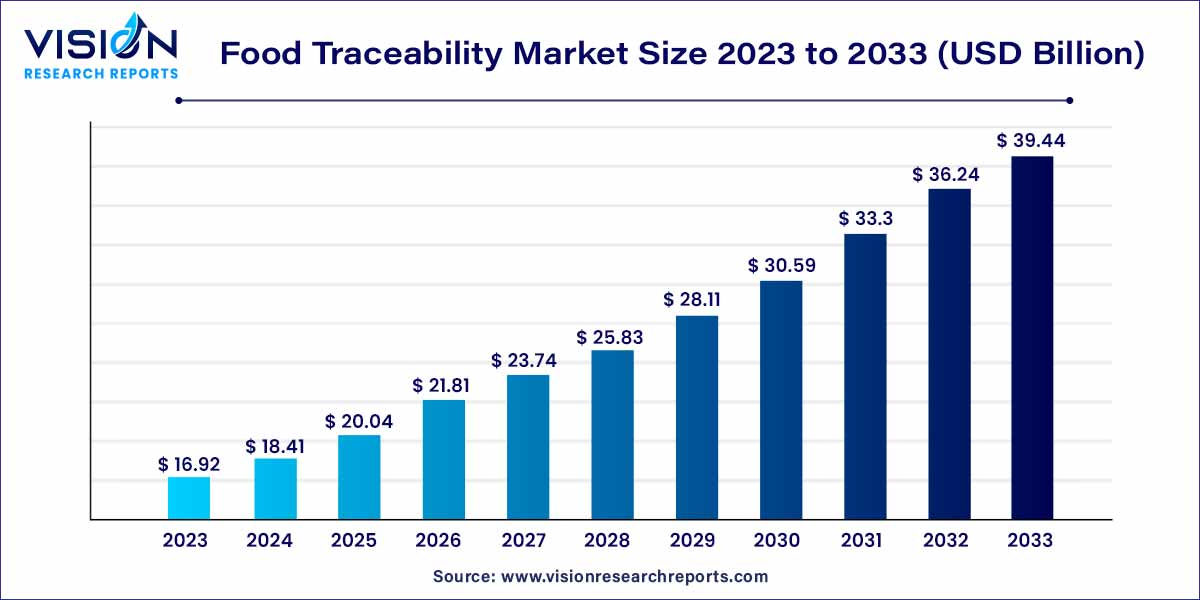
The global food traceability market has witnessed substantial growth in recent years, driven by increasing consumer awareness, regulatory initiatives, and advancements in technology. This overview aims to shed light on the key aspects defining this market and the factors contributing to its expansion.
The Food Traceability Market is experiencing robust growth, fueled by a convergence of key factors driving its expansion. Consumer demand for transparency in the food supply chain has emerged as a pivotal force, prompting the adoption of traceability solutions. With heightened awareness about food safety and sourcing, consumers increasingly seek information about the origin and journey of their food. Concurrently, stringent regulatory standards imposed by authorities worldwide have propelled the integration of traceability systems, ensuring compliance with quality and safety measures. Moreover, technological advancements, including the widespread adoption of blockchain, RFID, and IoT, have revolutionized traceability, enhancing accuracy and efficiency. As businesses recognize the strategic importance of transparent supply chains in gaining a competitive edge, the Food Traceability Market is poised for sustained growth, offering opportunities for innovation and collaboration across the industry.
| Report Coverage | Details |
| Market Revenue by 2033 | USD 39.44 billion |
| Growth Rate from 2024 to 2033 | CAGR of 8.83% |
| Revenue Share of North America in 2023 | 32% |
| CAGR of Asia Pacific from 2024 to 2033 | 11.18% |
| Base Year | 2022 |
| Forecast Period | 2024 to 2033 |
| Market Analysis (Terms Used) | Value (US$ Million/Billion) or (Volume/Units) |
In terms of technology type, the market is classified into radio frequency identification (RFID), barcodes, infrared, biometrics, global positioning systems (GPS), and others. The barcodes segment dominated the market, with a market share of over 35% in 2023. It is expected to grow at a CAGR of 9.2% throughout the forecast period. The segment’s growth can be attributed to the cost-effectiveness of the barcode technology to implement compared to some other traceability technologies. The simplicity of barcodes makes them accessible to a wide range of businesses, including small and medium-sized enterprises in the food industry. While other technologies, such as RFID and blockchain, also play important roles in food traceability, the widespread acceptance, simplicity, and cost-effectiveness of barcodes make them a dominant and preferred choice for many businesses operating in the dynamic and complex food supply chain.
The RFID segment is anticipated to grow at a considerable CAGR of 9.83% throughout the forecast period. The growth is driven by its ability to deliver advanced functionalities, improve operational efficiency, and meet the evolving demands of the industry for more sophisticated traceability solutions. The unique features and capabilities of RFID position it as a technology with substantial growth potential in the dynamic landscape of the market. RFID enables real-time monitoring of food products at each stage of the supply chain. This capability allows for instant updates on the location, condition, and status of products, facilitating quick decision-making and response to any issues that may arise.
In terms of software, the market is classified into enterprise resources planning (ERP), friction welding, laboratory information systems, warehouse software, supply chain management (SCM), and others. Supply chain management (SCM) dominated the market with a market share of 36% in 2023. It is expected to grow at a CAGR of 8.1% throughout the forecast period. The dominance of supply chain management (SCM) software in the market is driven by its ability to provide end-to-end visibility, integrate seamlessly with traceability solutions, ensure regulatory compliance, and optimize various aspects of supply chain operations.
The comprehensive features of SCM software position it as a central and crucial element in achieving effective and reliable traceability within the dynamic and complex food supply chain. SCM software contributes to overall operational efficiency by streamlining supply chain processes, reducing delays, and optimizing resource utilization. This efficiency extends to traceability efforts, where a well-orchestrated supply chain enhances the accuracy and reliability of traceability data.
Enterprise resource planning (ERP) is expected to grow at the highest CAGR of 10.05% throughout the forecast period. ERP systems offer comprehensive end-to-end integration across various business functions within an organization. This includes modules for inventory management, production planning, distribution, and quality control. The ability to seamlessly integrate traceability processes with these core functions makes ERP a powerful solution for managing the entire food supply chain.
The ability to provide end-to-end integration, ensure regulatory compliance, offer real-time visibility, and support efficient recall management. The comprehensive features and functionalities of ERP systems make them a central component in the pursuit of effective and reliable traceability within the complex and dynamic food supply chain and are the factors responsible for the growth of the ERP software across the market.
In terms of end user, the market is classified into fish, meat, and seafood, fruit pulp & concentrates, fruits & vegetables, dairy products, processed food, bakery & confectionary, others. The fish, meat, and seafood segment has led the market with the revenue share of 26% in 2023 and is expected to witness a CAGR of 7.58% during the forecast period. The dominance of fish, meat, and seafood in the market is driven by a combination of regulatory pressures, consumer demands, complex supply chains, and the need to address specific challenges related to safety, quality, and integrity in these perishable food industries. The adoption of traceability solutions in these sectors is essential for meeting regulatory requirements, ensuring consumer confidence, and managing the complexities inherent in the production and distribution of fish, meat, and seafood products.
The processed food segment is anticipated to grow at a considerable CAGR of 10.5% throughout the forecast period. A combination of consumer trends, regulatory requirements, supply chain complexities, and the need for quality and safety assurance in an evolving and dynamic industry landscape drives the growth of the segment. The adoption of advanced traceability solutions is poised to play a pivotal role in meeting these challenges and supporting the continued growth of the processed food sector.
North America dominated the market with a share of over 32% in 2023. It is expected to grow at a CAGR of 7.2% throughout the forecast period. North America's dominance in the food traceability market is a result of a combination of regulatory initiatives, consumer demands, technological infrastructure, collaborative industry efforts, and a strong focus on food safety and quality. The region's proactive approach to adopting and advancing traceability solutions positions it as a leader in ensuring transparency and accountability throughout the food supply chain. North American businesses have been at the forefront of adopting technological innovations in traceability. The region's companies often leverage emerging technologies to enhance the efficiency, accuracy, and overall effectiveness of their traceability systems.
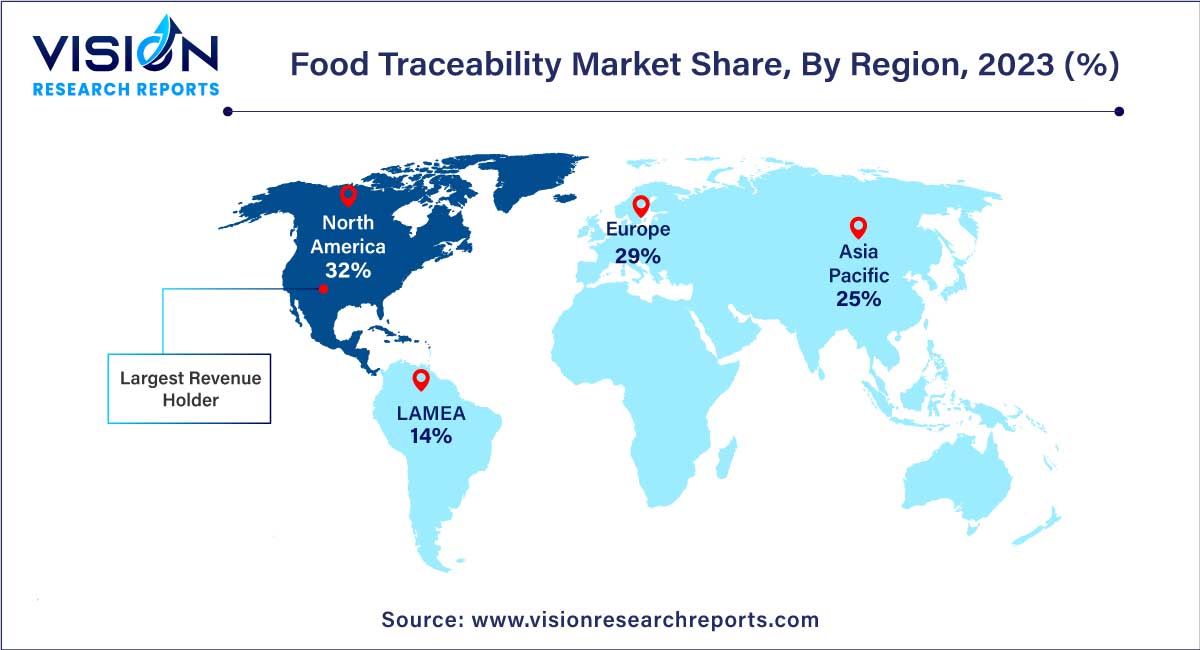
Asia Pacific is expected to grow at a considerable CAGR of 11.18% during forecast period. The highest growth of the region is influenced by a combination of regulatory trends, industry dynamics, technological advancements, consumer expectations, and the region's growing role in the global food supply chain. The proactive adoption of traceability solutions is anticipated to be a pivotal factor in addressing the evolving challenges and ensuring the safety and transparency of the food ecosystem in Asia Pacific. For instance, in December 2020, Walmart China introduced a blockchain traceability platform as part of its product traceability strategy. Through scanning the QR code, consumers gain access to comprehensive details about the product, including location changes, transportation processes, shipping times, test reports, and other relevant information at every stage of the supply chain. This initiative significantly enhances consumer confidence and trust in the transparency of the product's journey from origin to destination.
By Technology Type
By Software
By End User
By Region
Chapter 1. Introduction
1.1. Research Objective
1.2. Scope of the Study
1.3. Definition
Chapter 2. Research Methodology
2.1. Research Approach
2.2. Data Sources
2.3. Assumptions & Limitations
Chapter 3. Executive Summary
3.1. Market Snapshot
Chapter 4. Market Variables and Scope
4.1. Introduction
4.2. Market Classification and Scope
4.3. Industry Value Chain Analysis
4.3.1. Raw Material Procurement Analysis
4.3.2. Sales and Distribution Technology Type Analysis
4.3.3. Downstream Buyer Analysis
Chapter 5. COVID 19 Impact on Food Traceability Market
5.1. COVID-19 Landscape: Food Traceability Industry Impact
5.2. COVID 19 - Impact Assessment for the Industry
5.3. COVID 19 Impact: Global Major Government Policy
5.4. Market Trends and Opportunities in the COVID-19 Landscape
Chapter 6. Market Dynamics Analysis and Trends
6.1. Market Dynamics
6.1.1. Market Drivers
6.1.2. Market Restraints
6.1.3. Market Opportunities
6.2. Porter’s Five Forces Analysis
6.2.1. Bargaining power of suppliers
6.2.2. Bargaining power of buyers
6.2.3. Threat of substitute
6.2.4. Threat of new entrants
6.2.5. Degree of competition
Chapter 7. Competitive Landscape
7.1.1. Company Market Share/Positioning Analysis
7.1.2. Key Strategies Adopted by Players
7.1.3. Vendor Landscape
7.1.3.1. List of Suppliers
7.1.3.2. List of Buyers
Chapter 8. Global Food Traceability Market, By Technology Type
8.1. Food Traceability Market, by Technology Type, 2024-2033
8.1.1 Radio Frequency Identification
8.1.1.1. Market Revenue and Forecast (2021-2033)
8.1.2. Barcodes
8.1.2.1. Market Revenue and Forecast (2021-2033)
8.1.3. Infrared
8.1.3.1. Market Revenue and Forecast (2021-2033)
8.1.4. Biometrics
8.1.4.1. Market Revenue and Forecast (2021-2033)
8.1.5. Global Positioning Systems
8.1.5.1. Market Revenue and Forecast (2021-2033)
8.1.6. Others
8.1.6.1. Market Revenue and Forecast (2021-2033)
Chapter 9. Global Food Traceability Market, By Software
9.1. Food Traceability Market, by Software, 2024-2033
9.1.1. Enterprise Resources Planning (ERP)
9.1.1.1. Market Revenue and Forecast (2021-2033)
9.1.2. Friction Welding
9.1.2.1. Market Revenue and Forecast (2021-2033)
9.1.3. Laboratory Information Systems
9.1.3.1. Market Revenue and Forecast (2021-2033)
9.1.4. Warehouse Software
9.1.4.1. Market Revenue and Forecast (2021-2033)
9.1.5. Supply Chain Management (SCM)
9.1.5.1. Market Revenue and Forecast (2021-2033)
9.1.6. Others
9.1.6.1. Market Revenue and Forecast (2021-2033)
Chapter 10. Global Food Traceability Market, By End User
10.1. Food Traceability Market, by End User, 2024-2033
10.1.1. Fruits & Vegetables
10.1.1.1. Market Revenue and Forecast (2021-2033)
10.1.2. Fruit Pulp & Concentrates
10.1.2.1. Market Revenue and Forecast (2021-2033)
10.1.3. Dairy Products
10.1.3.1. Market Revenue and Forecast (2021-2033)
10.1.4. Fish, Meat, and Seafood
10.1.4.1. Market Revenue and Forecast (2021-2033)
10.1.5. Processed Food
10.1.5.1. Market Revenue and Forecast (2021-2033)
10.1.6. Bakery & Confectionary
10.1.6.1. Market Revenue and Forecast (2021-2033)
Chapter 11. Global Food Traceability Market, Regional Estimates and Trend Forecast
11.1. North America
11.1.1. Market Revenue and Forecast, by Technology Type (2021-2033)
11.1.2. Market Revenue and Forecast, by Software (2021-2033)
11.1.3. Market Revenue and Forecast, by End User (2021-2033)
11.1.4. U.S.
11.1.4.1. Market Revenue and Forecast, by Technology Type (2021-2033)
11.1.4.2. Market Revenue and Forecast, by Software (2021-2033)
11.1.4.3. Market Revenue and Forecast, by End User (2021-2033)
11.1.5. Rest of North America
11.1.5.1. Market Revenue and Forecast, by Technology Type (2021-2033)
11.1.5.2. Market Revenue and Forecast, by Software (2021-2033)
11.1.5.3. Market Revenue and Forecast, by End User (2021-2033)
11.2. Europe
11.2.1. Market Revenue and Forecast, by Technology Type (2021-2033)
11.2.2. Market Revenue and Forecast, by Software (2021-2033)
11.2.3. Market Revenue and Forecast, by End User (2021-2033)
11.2.4. UK
11.2.4.1. Market Revenue and Forecast, by Technology Type (2021-2033)
11.2.4.2. Market Revenue and Forecast, by Software (2021-2033)
11.2.4.3. Market Revenue and Forecast, by End User (2021-2033)
11.2.5. Germany
11.2.5.1. Market Revenue and Forecast, by Technology Type (2021-2033)
11.2.5.2. Market Revenue and Forecast, by Software (2021-2033)
11.2.5.3. Market Revenue and Forecast, by End User (2021-2033)
11.2.6. France
11.2.6.1. Market Revenue and Forecast, by Technology Type (2021-2033)
11.2.6.2. Market Revenue and Forecast, by Software (2021-2033)
11.2.6.3. Market Revenue and Forecast, by End User (2021-2033)
11.2.7. Rest of Europe
11.2.7.1. Market Revenue and Forecast, by Technology Type (2021-2033)
11.2.7.2. Market Revenue and Forecast, by Software (2021-2033)
11.2.7.3. Market Revenue and Forecast, by End User (2021-2033)
11.3. APAC
11.3.1. Market Revenue and Forecast, by Technology Type (2021-2033)
11.3.2. Market Revenue and Forecast, by Software (2021-2033)
11.3.3. Market Revenue and Forecast, by End User (2021-2033)
11.3.4. India
11.3.4.1. Market Revenue and Forecast, by Technology Type (2021-2033)
11.3.4.2. Market Revenue and Forecast, by Software (2021-2033)
11.3.4.3. Market Revenue and Forecast, by End User (2021-2033)
11.3.5. China
11.3.5.1. Market Revenue and Forecast, by Technology Type (2021-2033)
11.3.5.2. Market Revenue and Forecast, by Software (2021-2033)
11.3.5.3. Market Revenue and Forecast, by End User (2021-2033)
11.3.6. Japan
11.3.6.1. Market Revenue and Forecast, by Technology Type (2021-2033)
11.3.6.2. Market Revenue and Forecast, by Software (2021-2033)
11.3.6.3. Market Revenue and Forecast, by End User (2021-2033)
11.3.7. Rest of APAC
11.3.7.1. Market Revenue and Forecast, by Technology Type (2021-2033)
11.3.7.2. Market Revenue and Forecast, by Software (2021-2033)
11.3.7.3. Market Revenue and Forecast, by End User (2021-2033)
11.4. MEA
11.4.1. Market Revenue and Forecast, by Technology Type (2021-2033)
11.4.2. Market Revenue and Forecast, by Software (2021-2033)
11.4.3. Market Revenue and Forecast, by End User (2021-2033)
11.4.4. GCC
11.4.4.1. Market Revenue and Forecast, by Technology Type (2021-2033)
11.4.4.2. Market Revenue and Forecast, by Software (2021-2033)
11.4.4.3. Market Revenue and Forecast, by End User (2021-2033)
11.4.5. North Africa
11.4.5.1. Market Revenue and Forecast, by Technology Type (2021-2033)
11.4.5.2. Market Revenue and Forecast, by Software (2021-2033)
11.4.5.3. Market Revenue and Forecast, by End User (2021-2033)
11.4.6. South Africa
11.4.6.1. Market Revenue and Forecast, by Technology Type (2021-2033)
11.4.6.2. Market Revenue and Forecast, by Software (2021-2033)
11.4.6.3. Market Revenue and Forecast, by End User (2021-2033)
11.4.7. Rest of MEA
11.4.7.1. Market Revenue and Forecast, by Technology Type (2021-2033)
11.4.7.2. Market Revenue and Forecast, by Software (2021-2033)
11.4.7.3. Market Revenue and Forecast, by End User (2021-2033)
11.5. Latin America
11.5.1. Market Revenue and Forecast, by Technology Type (2021-2033)
11.5.2. Market Revenue and Forecast, by Software (2021-2033)
11.5.3. Market Revenue and Forecast, by End User (2021-2033)
11.5.4. Brazil
11.5.4.1. Market Revenue and Forecast, by Technology Type (2021-2033)
11.5.4.2. Market Revenue and Forecast, by Software (2021-2033)
11.5.4.3. Market Revenue and Forecast, by End User (2021-2033)
11.5.5. Rest of LATAM
11.5.5.1. Market Revenue and Forecast, by Technology Type (2021-2033)
11.5.5.2. Market Revenue and Forecast, by Software (2021-2033)
11.5.5.3. Market Revenue and Forecast, by End User (2021-2033)
Chapter 12. Company Profiles
12.1. C.H. Robinson.
12.1.1. Company Overview
12.1.2. Product Offerings
12.1.3. Financial Performance
12.1.4. Recent Initiatives
12.2. Cognex.
12.2.1. Company Overview
12.2.2. Product Offerings
12.2.3. Financial Performance
12.2.4. Recent Initiatives
12.3. Honeywell International Inc.
12.3.1. Company Overview
12.3.2. Product Offerings
12.3.3. Financial Performance
12.3.4. Recent Initiatives
12.4. SGS SA.
12.4.1. Company Overview
12.4.2. Product Offerings
12.4.3. Financial Performance
12.4.4. Recent Initiatives
12.5. Zebra Technologies.
12.5.1. Company Overview
12.5.2. Product Offerings
12.5.3. Financial Performance
12.5.4. Recent Initiatives
12.6. Carlisle
12.6.1. Company Overview
12.6.2. Product Offerings
12.6.3. Financial Performance
12.6.4. Recent Initiatives
12.7. Merit-Trax.
12.7.1. Company Overview
12.7.2. Product Offerings
12.7.3. Financial Performance
12.7.4. Recent Initiatives
12.8. FoodLogiQ
12.8.1. Company Overview
12.8.2. Product Offerings
12.8.3. Financial Performance
12.8.4. Recent Initiatives
12.9. Safe Traces.
12.9.1. Company Overview
12.9.2. Product Offerings
12.9.3. Financial Performance
12.9.4. Recent Initiatives
12.10. Food Forensics
12.10.1. Company Overview
12.10.2. Product Offerings
12.10.3. Financial Performance
12.10.4. Recent Initiatives
Chapter 13. Research Methodology
13.1. Primary Research
13.2. Secondary Research
13.3. Assumptions
Chapter 14. Appendix
14.1. About Us
14.2. Glossary of Terms
 Cross-segment Market Size and Analysis for
Mentioned Segments
Additional Company Profiles (Upto 5 With No Cost)
Additional Countries (Apart From Mentioned Countries)
Country/Region-specific Report
Go To Market Strategy
Region Specific Market DynamicsRegion Level Market Share Import Export AnalysisProduction AnalysisOthers
Cross-segment Market Size and Analysis for
Mentioned Segments
Additional Company Profiles (Upto 5 With No Cost)
Additional Countries (Apart From Mentioned Countries)
Country/Region-specific Report
Go To Market Strategy
Region Specific Market DynamicsRegion Level Market Share Import Export AnalysisProduction AnalysisOthers