The global high purity calcium sulfate narket was size reached at USD 11.26 billion in 2024 and it is expected to surpass around USD 20.74 billion by 2034, poised to grow at a CAGR of 6.30% from 2025 to 2034.
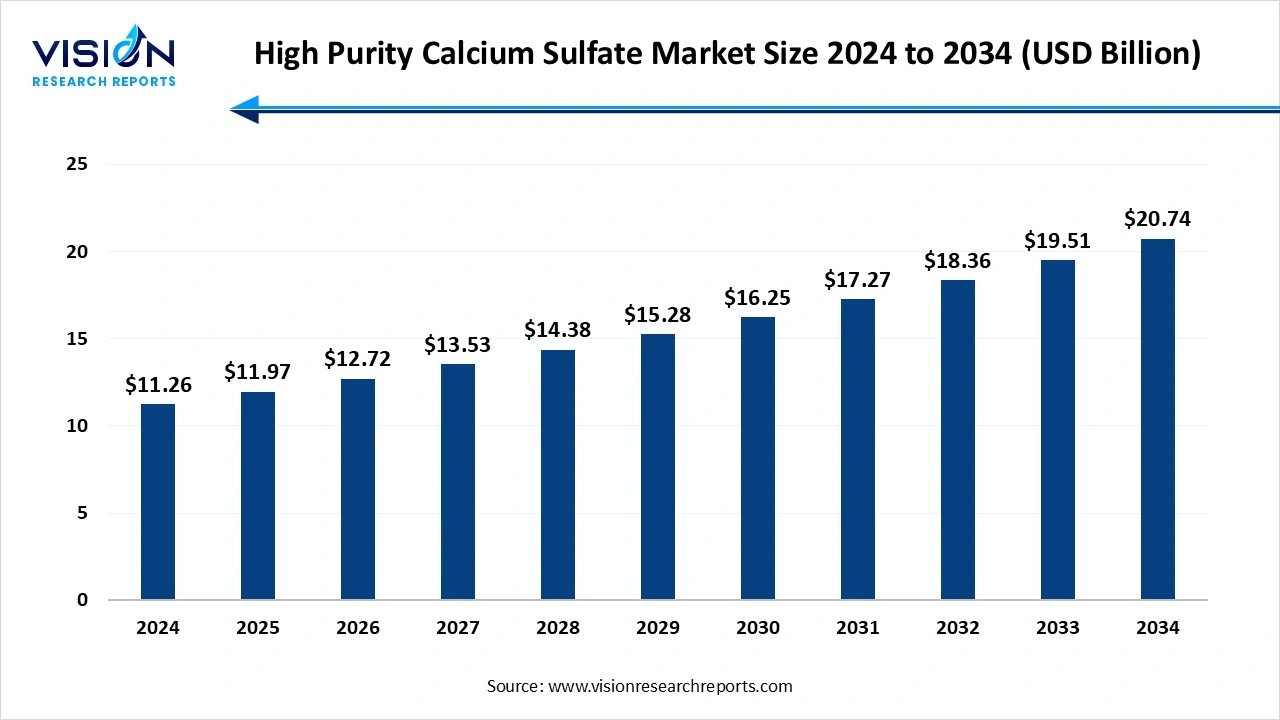
The global high purity calcium Sulfate market is witnessing steady growth, driven by increasing demand across diverse sectors such as pharmaceuticals, food & beverage, construction, and laboratory applications. Known for its superior purity and consistent performance, high purity calcium sulfate is widely utilized as a diluent in tablets, a coagulant in tofu processing, and as a specialty additive in plasters and cements. The market is further propelled by advancements in manufacturing technologies, stringent quality standards, and rising awareness regarding product traceability and regulatory compliance. Asia-Pacific holds a significant share due to industrial expansion and healthcare growth, while North America and Europe follow closely with strong pharmaceutical and food processing industries.
One of the primary growth drivers of the high purity calcium sulfate market is its expanding application base across industries that demand stringent quality and safety standards. In the pharmaceutical sector, it is extensively used as an excipient due to its inert nature and chemical stability, contributing to its increased adoption in drug formulation. Similarly, in the food and beverage industry, the material serves as a coagulant and additive, particularly in health-conscious and organic food products. As consumers increasingly prioritize product safety and regulatory compliance, the demand for high-purity ingredients is rising a trend that favors the growth of this market.
The construction and industrial sectors are contributing significantly to market expansion, particularly with the growing emphasis on sustainable and high-performance building materials. High purity calcium sulfate is used in specialty plasters, dental molds, and precision casting, all of which require consistent chemical properties. The rise in infrastructure development, technological advancements in material processing, and the global shift toward eco-friendly building solutions have amplified the relevance of high-purity mineral compounds. Combined with supportive regulations and increased R&D investments, these factors are expected to sustain long-term growth in the market.
The Asia Pacific region dominated the market, capturing a revenue share of 49% in 2024. Asia-Pacific holds a dominant position, driven largely by rapid industrialization, expanding pharmaceutical and food processing sectors, and increasing infrastructure development in countries such as China, India, and Japan. The region benefits from a growing population and rising healthcare awareness, which collectively fuel demand for high-quality pharmaceutical excipients and food additives. Additionally, cost advantages and government initiatives to support manufacturing and exports further strengthen the region’s market presence.
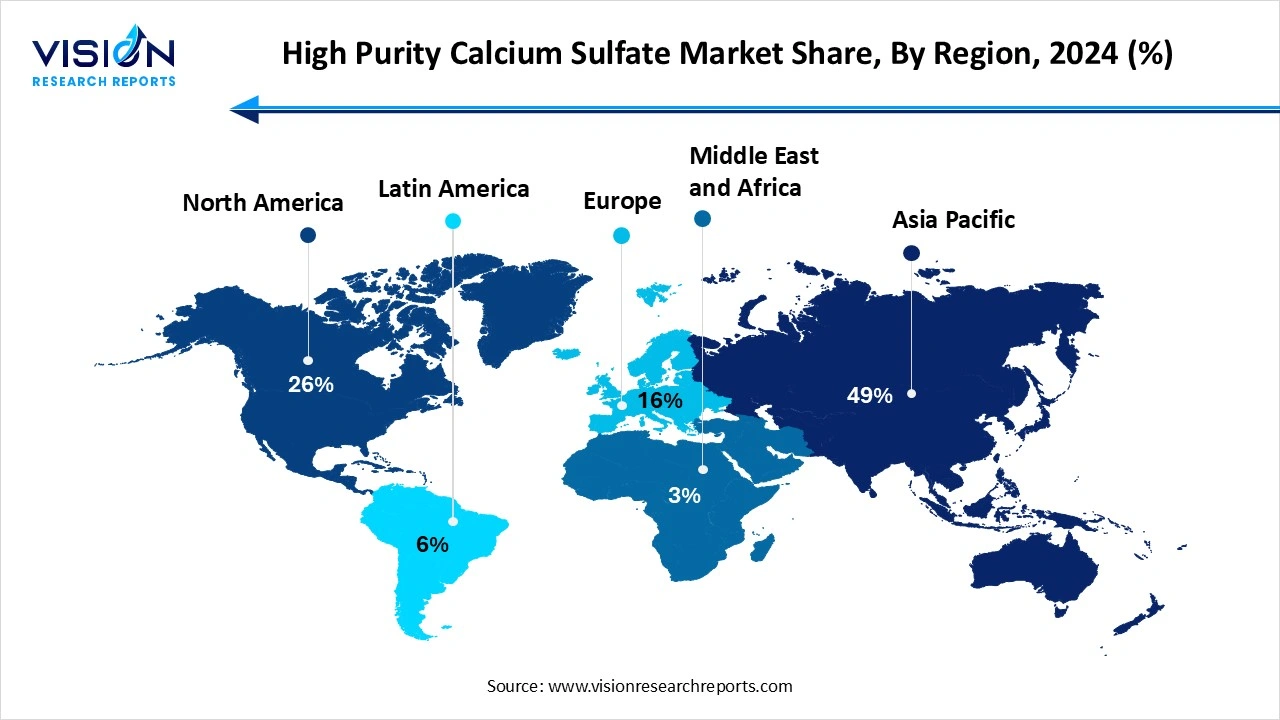 The Middle East and African market is projected to experience substantial growth during the forecast period. This expansion is largely driven by the increasing construction and infrastructure projects, especially within the Gulf Cooperation Council (GCC) countries. Rapid urban development in cities like Dubai, Riyadh, and Doha is fueling a growing demand for gypsum products, which depend heavily on high purity calcium sulfate. The ongoing construction surge, supported by government-funded initiatives across residential and commercial sectors, is boosting the consumption of premium-quality building materials.
The powder segment held the largest revenue market share, accounting for 54% in 2024. Among these, the powder form dominates a significant portion of the market due to its versatility, ease of integration into manufacturing processes, and high solubility. It is widely utilized in the pharmaceutical industry as a diluent in tablet formulations, where uniform particle size and purity are critical for ensuring dosage accuracy and product stability. Additionally, the food industry relies heavily on powdered high purity calcium sulfate as a firming agent and dietary calcium source, particularly in fortified and processed foods.
Granules are expected to achieve the fastest CAGR of 6.6% during the forecast period and rank as the second-largest revenue contributors in the global form market. It is often used in agricultural formulations, industrial desiccants, and specialty building materials. The granular form provides better handling and storage benefits, reducing loss during transportation and improving the efficiency of application in various industrial processes. As industries continue to shift towards cleaner and safer production practices, both powder and granule forms of high purity calcium sulfate are seeing increased adoption. However, the choice between the two often depends on specific end-user requirements, processing compatibility, and regulatory standards.
The pharmaceuticals segment led the market, capturing a 30% share in 2024. Due to its chemical inertness, consistent particle size, and excellent compressibility, high purity calcium sulfate is extensively used as a filler or diluent in tablets and capsules. Its biocompatibility and stability under varying environmental conditions make it an ideal choice for pharmaceutical manufacturers who are required to meet stringent regulatory standards for product safety and efficacy. The growing demand for high-quality excipients, coupled with the expansion of the global pharmaceutical industry especially in emerging economies is contributing to the rising consumption of high purity calcium sulfate in this sector.
The construction sector is projected to achieve the highest CAGR of 6.4% throughout the forecast period. It is commonly used in high-performance plasters, flooring compounds, and wall panels where consistency, setting time control, and mechanical strength are critical. Its thermal insulation properties and compatibility with eco-friendly formulations make it particularly valuable in sustainable construction practices. As the construction sector increasingly embraces green building technologies and stricter quality standards, the use of refined materials like high purity calcium sulfate is expected to rise. This growing emphasis on durable, lightweight, and environmentally responsible construction materials is a major factor driving demand within the industry.
By Form
By End Use
By Regional
Chapter 1. Introduction
1.1. Research Objective
1.2. Scope of the Study
1.3. Definition
Chapter 2. Research Methodology
2.1. Research Approach
2.2. Data Sources
2.3. Assumptions & Limitations
Chapter 3. Executive Summary
3.1. Market Snapshot
Chapter 4. Market Variables and Scope
4.1. Introduction
4.2. Market Classification and Scope
4.3. Industry Value Chain Analysis
4.3.1. Raw Material Procurement Analysis
4.3.2. Sales and Distribution Channel Analysis
4.3.3. Downstream Buyer Analysis
Chapter 5. COVID 19 Impact on High Purity Calcium Sulfate Market
5.1. COVID-19 Landscape: High Purity Calcium Sulfate Industry Impact
5.2. COVID 19 - Impact Assessment for the Industry
5.3. COVID 19 Impact: Major Government Policy
5.4. Market Trends and Opportunities in the COVID-19 Landscape
Chapter 6. Market Dynamics Analysis and Trends
6.1. Market Dynamics
6.1.1. Market Drivers
6.1.2. Market Restraints
6.1.3. Market Opportunities
6.2. Porter’s Five Forces Analysis
6.2.1. Bargaining power of suppliers
6.2.2. Bargaining power of buyers
6.2.3. Threat of substitute
6.2.4. Threat of new entrants
6.2.5. Degree of competition
Chapter 7. Competitive Landscape
7.1.1. Company Market Share/Positioning Analysis
7.1.2. Key Strategies Adopted by Players
7.1.3. Vendor Landscape
7.1.3.1. List of Suppliers
7.1.3.2. List of Buyers
Chapter 8. High Purity Calcium Sulfate Market, By Form
8.1. High Purity Calcium Sulfate Market, by Form
8.1.1. Powder
8.1.1.1. Market Revenue and Forecast
8.1.2. Granules
8.1.2.1. Market Revenue and Forecast
8.1.3. Others
8.1.3.1. Market Revenue and Forecast
Chapter 9. High Purity Calcium Sulfate Market, By End Use
9.1. High Purity Calcium Sulfate Market, by End Use
9.1.1. Pharmaceuticals
9.1.1.1. Market Revenue and Forecast
9.1.2. Food & Beverage
9.1.2.1. Market Revenue and Forecast
9.1.3. Construction
9.1.3.1. Market Revenue and Forecast
9.1.4. Agriculture
9.1.4.1. Market Revenue and Forecast
9.1.5. Cosmetics & Personal Care
9.1.5.1. Market Revenue and Forecast
9.1.6. Others
9.1.6.1. Market Revenue and Forecast
Chapter 10. High Purity Calcium Sulfate Market, Regional Estimates and Trend Forecast
10.1. U.S.
10.1.1. Market Revenue and Forecast, by Form
10.1.2. Market Revenue and Forecast, by End Use
Chapter 11. Company Profiles
11.1. Lhoist Group
11.1.1. Company Overview
11.1.2. Product Offerings
11.1.3. Financial Performance
11.1.4. Recent Initiatives
11.2. Imerys Group
11.2.1. Company Overview
11.2.2. Product Offerings
11.2.3. Financial Performance
11.2.4. Recent Initiatives
11.3. United States Gypsum Company (USG Corporation)
11.3.1. Company Overview
11.3.2. Product Offerings
11.3.3. Financial Performance
11.3.4. Recent Initiatives
11.4. Mineral Technologies Inc.
11.4.1. Company Overview
11.4.2. Product Offerings
11.4.3. Financial Performance
11.4.4. LTE Scientific
11.5. Solvay S.A.
11.5.1. Company Overview
11.5.2. Product Offerings
11.5.3. Financial Performance
11.5.4. Recent Initiatives
11.6. Gypsum Resources Limited
11.6.1. Company Overview
11.6.2. Product Offerings
11.6.3. Financial Performance
11.6.4. Recent Initiatives
11.7. Nouryon (formerly AkzoNobel Specialty Chemicals)
11.7.1. Company Overview
11.7.2. Product Offerings
11.7.3. Financial Performance
11.7.4. Recent Initiatives
11.8. Sibelco Group
11.8.1. Company Overview
11.8.2. Product Offerings
11.8.3. Financial Performance
11.8.4. Recent Initiatives
11.9. Martin Marietta Materials, Inc.
11.9.1. Company Overview
11.9.2. Product Offerings
11.9.3. Financial Performance
11.9.4. Recent Initiatives
11.10. National Gypsum Company
11.10.1. Company Overview
11.10.2. Product Offerings
11.10.3. Financial Performance
11.10.4. Recent Initiatives
Chapter 12. Research Methodology
12.1. Primary Research
12.2. Secondary Research
12.3. Assumptions
Chapter 13. Appendix
13.1. About Us
13.2. Glossary of Terms
 Cross-segment Market Size and Analysis for
Mentioned Segments
Additional Company Profiles (Upto 5 With No Cost)
Additional Countries (Apart From Mentioned Countries)
Country/Region-specific Report
Go To Market Strategy
Region Specific Market DynamicsRegion Level Market Share Import Export AnalysisProduction AnalysisOthers
Cross-segment Market Size and Analysis for
Mentioned Segments
Additional Company Profiles (Upto 5 With No Cost)
Additional Countries (Apart From Mentioned Countries)
Country/Region-specific Report
Go To Market Strategy
Region Specific Market DynamicsRegion Level Market Share Import Export AnalysisProduction AnalysisOthers