
Luxury Hair Care Market Size, Trends, Share, Growth, Report 2025-2034
The global luxury hair care market size was estimated at USD 23.18 billion in 2024, which is expected to grow with a CAGR of 9.50% and reach USD 57.45 billion by 2034.
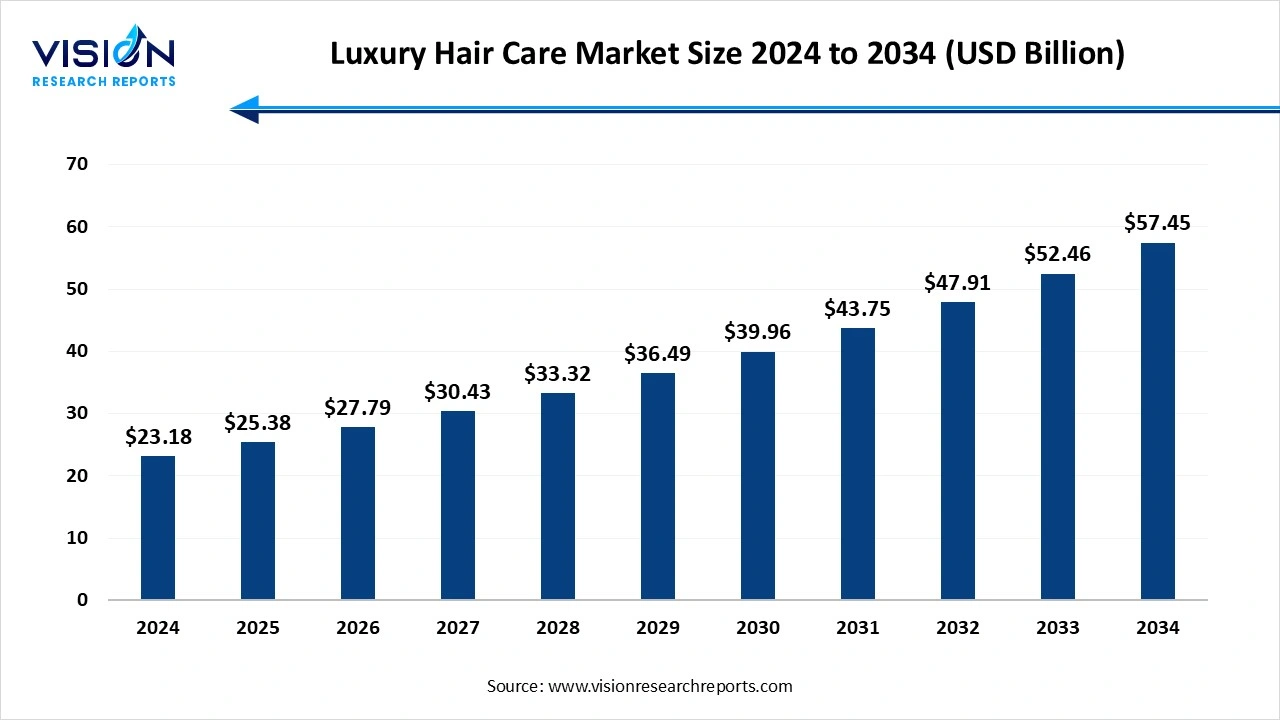
The luxury hair care market has witnessed significant growth in recent years, driven by rising consumer awareness of premium ingredients, personalized hair solutions, and a growing emphasis on self-care and wellness. This segment caters to discerning customers who prioritize quality, brand reputation, and performance over price, often seeking products that offer salon-grade results at home. Increasing disposable incomes, especially in emerging economies, along with the influence of social media and celebrity endorsements, have further fueled demand. Key players in the market are innovating with sustainable packaging, clean formulations, and advanced technologies to meet evolving consumer expectations.
One of the primary drivers of growth in the luxury hair care market is the increasing consumer demand for premium, results-driven products made with high-quality, often natural or organic ingredients. As awareness around hair health and overall well-being rises, consumers are shifting away from mass-market options toward more sophisticated formulations that offer targeted benefits such as damage repair, anti-aging, scalp health, and color protection. This trend is further amplified by the growing popularity of the "skinification" of hair, Where consumers apply skincare principles to hair care, Seeking clean, science-backed, and ingredient-conscious solutions.
Another crucial factor contributing to the market's growth is the influence of digital media and influencer marketing. Social media platforms, beauty influencers, and celebrity endorsements have played a pivotal role in shaping consumer preferences and building brand loyalty within the luxury segment.
North America led the global luxury hair care market, accounting for approximately 33% of the total share in 2024. The region's demand is driven by growing consumer interest in premium haircare products and increased expenditure on hair styling items. As a key market for luxury hair care, North America is primarily influenced by the U.S. The region's dominance is largely attributed to growing consumer interest in premium hair care products and rising expenditures on hair styling solutions. The U.S. plays a central role in driving this growth, making North America a key market for luxury hair care. Strong economic performance across most North American countries has resulted in higher consumer purchasing power, allowing greater access to high-end hair care and other beauty products.
The luxury hair care market in the Asia Pacific region is projected to grow at a compound annual growth rate (CAGR) of 10.9% between 2025 and 2030. As economic conditions improve across Asia, rising disposable incomes are enabling consumers to spend more on personal care products, with a strong focus on premium hair care. This economic growth has paved the way for luxury international brands to enter the market. For example, Nuggela Sule, a prominent hair care brand from Spain, has successfully expanded into Asia, particularly gaining significant traction in China and Singapore, where it ranks as the top-selling shampoo on Amazon.
The luxury shampoo dominated the market, capturing a 31% share in 2024. Luxury shampoos are formulated with carefully selected ingredients, often including botanical extracts, essential oils, proteins, and scientifically advanced compounds designed to address specific hair concerns such as damage repair, hydration, scalp health, and anti-aging. Consumers are also gravitating toward shampoos that are free from harsh chemicals like sulfates and parabens, aligning with the broader clean beauty movement. In response, luxury brands are innovating with sulfate-free and pH-balanced formulas that provide a gentle yet effective cleansing experience.
The luxury hair coloring market is projected to expand at a compound annual growth rate (CAGR) of 10.9% between 2025 and 2034. These high-end color products offer a superior experience compared to conventional dyes, often infused with nourishing agents that minimize hair damage and enhance shine. The demand for ammonia-free, low-chemical formulations is particularly strong, as consumers seek healthier alternatives that preserve hair integrity while achieving professional-level results.
The luxury hair care products priced between USD 30 and USD 65 held the largest market share, accounting for 41% of the total market.Typically, luxury shampoos are positioned at a premium price point, reflecting their high-quality ingredients and advanced hair care benefits. On average, these shampoos range from approximately $30 to $100 or more per bottle, with some exclusive or limited-edition products commanding even higher prices. Consumers are willing to invest in these premium shampoos due to their perceived efficacy, safety profiles, and the overall sensory experience they provide, including texture, fragrance, and packaging aesthetics
Hair care products priced between USD 65 and USD 100 are projected to grow at a compound annual growth rate (CAGR) of 10.5% from 2025 to 2034. These products typically range from $40 to $120, depending on the brand, product type, and additional features such as nourishing additives or ammonia-free formulations. At-home luxury hair coloring kits that include multiple steps, Such as pre-treatment, color application, and post-color care, are often priced toward the upper end of this spectrum due to the comprehensive care they offer.
Specialty stores accounted for 32% of total sales in 2024. These stores, which include high-end beauty boutiques, exclusive salons, and premium department store counters, offer consumers a curated and immersive shopping experience. In these settings, customers benefit from personalized consultations and expert recommendations, which enhance their confidence in selecting the right products for their specific hair care needs.
The online channel is projected to expand at a compound annual growth rate (CAGR) of approximately 10.6% between 2025 and 2034. The convenience, accessibility, and extensive product range available through e-commerce platforms have significantly broadened consumer reach, particularly among younger, tech-savvy demographics. Luxury brands have invested heavily in their own direct-to-consumer websites as well as partnerships with high-end online retailers to offer seamless shopping experiences that include detailed product information, customer reviews, and virtual consultations. The rise of social media and influencer marketing has further driven online sales by increasing brand visibility and trust among potential buyers.
By Product
By Price Range
By Distribution Channel
By Regional
Chapter 1. Introduction
1.1. Research Objective
1.2. Scope of the Study
1.3. Definition
Chapter 2. Research Methodology
2.1. Research Approach
2.2. Data Sources
2.3. Assumptions & Limitations
Chapter 3. Executive Summary
3.1. Market Snapshot
Chapter 4. Market Variables and Scope
4.1. Introduction
4.2. Market Classification and Scope
4.3. Industry Value Chain Analysis
4.3.1. Raw Material Procurement Analysis
4.3.2. Sales and Distribution Product Analysis
4.3.3. Downstream Buyer Analysis
Chapter 5. COVID 19 Impact on Luxury Hair Care Market
5.1. COVID-19 Landscape: Luxury Hair Care Industry Impact
5.2. COVID 19 - Impact Assessment for the Industry
5.3. COVID 19 Impact: Global Major Government Policy
5.4. Market Trends and Opportunities in the COVID-19 Landscape
Chapter 6. Market Dynamics Analysis and Trends
6.1. Market Dynamics
6.1.1. Market Drivers
6.1.2. Market Restraints
6.1.3. Market Opportunities
6.2. Porter’s Five Forces Analysis
6.2.1. Bargaining power of suppliers
6.2.2. Bargaining power of buyers
6.2.3. Threat of substitute
6.2.4. Threat of new entrants
6.2.5. Degree of competition
Chapter 7. Competitive Landscape
7.1.1. Company Market Share/Positioning Analysis
7.1.2. Key Strategies Adopted by Players
7.1.3. Vendor Landscape
7.1.3.1. List of Suppliers
7.1.3.2. List of Buyers
Chapter 8. Global Luxury Hair Care Market, By Product
8.1. Luxury Hair Care Market, by Product
8.1.1 Shampoos
8.1.1.1. Market Revenue and Forecast
8.1.2. Conditioners
8.1.2.1. Market Revenue and Forecast
8.1.3. Hair Coloring Products
8.1.3.1. Market Revenue and Forecast
8.1.4. Hair Styling Products
8.1.4.1. Market Revenue and Forecast
8.1.5. Hair Oil
8.1.5.1. Market Revenue and Forecast
8.1.6. Others
8.1.6.1. Market Revenue and Forecast
Chapter 9. Global Luxury Hair Care Market, By Price Range
9.1. Luxury Hair Care Market, by Price Range
9.1.1. USD 30 to USD 65
9.1.1.1. Market Revenue and Forecast
9.1.2. USD 65 to USD 100
9.1.2.1. Market Revenue and Forecast
9.1.3. USD 100 to USD 150
9.1.3.1. Market Revenue and Forecast
9.1.4. USD 150 to USD 200
9.1.4.1. Market Revenue and Forecast
9.1.5. Above USD 200
9.1.5.1. Market Revenue and Forecast
Chapter 10. Global Luxury Hair Care Market, By Distribution Channel
10.1. Luxury Hair Care Market, by Distribution Channel
10.1.1. Hypermarkets & Supermarkets
10.1.1.1. Market Revenue and Forecast
10.1.2. Pharmacy & Drugstore
10.1.2.1. Market Revenue and Forecast
10.1.3. Specialty Stores
10.1.3.1. Market Revenue and Forecast
10.1.4. Online
10.1.4.1. Market Revenue and Forecast
10.1.5. Others
10.1.5.1. Market Revenue and Forecast
Chapter 11. Global Luxury Hair Care Market, Regional Estimates and Trend Forecast
11.1. North America
11.1.1. Market Revenue and Forecast, by Product
11.1.2. Market Revenue and Forecast, by Price Range
11.1.3. Market Revenue and Forecast, by Distribution Channel
11.1.4. U.S.
11.1.4.1. Market Revenue and Forecast, by Product
11.1.4.2. Market Revenue and Forecast, by Price Range
11.1.4.3. Market Revenue and Forecast, by Distribution Channel
11.1.5. Rest of North America
11.1.5.1. Market Revenue and Forecast, by Product
11.1.5.2. Market Revenue and Forecast, by Price Range
11.1.5.3. Market Revenue and Forecast, by Distribution Channel
11.2. Europe
11.2.1. Market Revenue and Forecast, by Product
11.2.2. Market Revenue and Forecast, by Price Range
11.2.3. Market Revenue and Forecast, by Distribution Channel
11.2.4. UK
11.2.4.1. Market Revenue and Forecast, by Product
11.2.4.2. Market Revenue and Forecast, by Price Range
11.2.4.3. Market Revenue and Forecast, by Distribution Channel
11.2.5. Germany
11.2.5.1. Market Revenue and Forecast, by Product
11.2.5.2. Market Revenue and Forecast, by Price Range
11.2.5.3. Market Revenue and Forecast, by Distribution Channel
11.2.6. France
11.2.6.1. Market Revenue and Forecast, by Product
11.2.6.2. Market Revenue and Forecast, by Price Range
11.2.6.3. Market Revenue and Forecast, by Distribution Channel
11.2.7. Rest of Europe
11.2.7.1. Market Revenue and Forecast, by Product
11.2.7.2. Market Revenue and Forecast, by Price Range
11.2.7.3. Market Revenue and Forecast, by Distribution Channel
11.3. APAC
11.3.1. Market Revenue and Forecast, by Product
11.3.2. Market Revenue and Forecast, by Price Range
11.3.3. Market Revenue and Forecast, by Distribution Channel
11.3.4. India
11.3.4.1. Market Revenue and Forecast, by Product
11.3.4.2. Market Revenue and Forecast, by Price Range
11.3.4.3. Market Revenue and Forecast, by Distribution Channel
11.3.5. China
11.3.5.1. Market Revenue and Forecast, by Product
11.3.5.2. Market Revenue and Forecast, by Price Range
11.3.5.3. Market Revenue and Forecast, by Distribution Channel
11.3.6. Japan
11.3.6.1. Market Revenue and Forecast, by Product
11.3.6.2. Market Revenue and Forecast, by Price Range
11.3.6.3. Market Revenue and Forecast, by Distribution Channel
11.3.7. Rest of APAC
11.3.7.1. Market Revenue and Forecast, by Product
11.3.7.2. Market Revenue and Forecast, by Price Range
11.3.7.3. Market Revenue and Forecast, by Distribution Channel
11.4. MEA
11.4.1. Market Revenue and Forecast, by Product
11.4.2. Market Revenue and Forecast, by Price Range
11.4.3. Market Revenue and Forecast, by Distribution Channel
11.4.4. GCC
11.4.4.1. Market Revenue and Forecast, by Product
11.4.4.2. Market Revenue and Forecast, by Price Range
11.4.4.3. Market Revenue and Forecast, by Distribution Channel
11.4.5. North Africa
11.4.5.1. Market Revenue and Forecast, by Product
11.4.5.2. Market Revenue and Forecast, by Price Range
11.4.5.3. Market Revenue and Forecast, by Distribution Channel
11.4.6. South Africa
11.4.6.1. Market Revenue and Forecast, by Product
11.4.6.2. Market Revenue and Forecast, by Price Range
11.4.6.3. Market Revenue and Forecast, by Distribution Channel
11.4.7. Rest of MEA
11.4.7.1. Market Revenue and Forecast, by Product
11.4.7.2. Market Revenue and Forecast, by Price Range
11.4.7.3. Market Revenue and Forecast, by Distribution Channel
11.5. Latin America
11.5.1. Market Revenue and Forecast, by Product
11.5.2. Market Revenue and Forecast, by Price Range
11.5.3. Market Revenue and Forecast, by Distribution Channel
11.5.4. Brazil
11.5.4.1. Market Revenue and Forecast, by Product
11.5.4.2. Market Revenue and Forecast, by Price Range
11.5.4.3. Market Revenue and Forecast, by Distribution Channel
11.5.5. Rest of LATAM
11.5.5.1. Market Revenue and Forecast, by Product
11.5.5.2. Market Revenue and Forecast, by Price Range
11.5.5.3. Market Revenue and Forecast, by Distribution Channel
Chapter 12. Company Profiles
12.1. L’Oréal S.A..
12.1.1. Company Overview
12.1.2. Product Offerings
12.1.3. Financial Performance
12.1.4. Recent Initiatives
12.2. Estée Lauder Companies Inc..
12.2.1. Company Overview
12.2.2. Product Offerings
12.2.3. Financial Performance
12.2.4. Recent Initiatives
12.3. Procter & Gamble Co..
12.3.1. Company Overview
12.3.2. Product Offerings
12.3.3. Financial Performance
12.3.4. Recent Initiatives
12.4. Unilever PLC.
12.4.1. Company Overview
12.4.2. Product Offerings
12.4.3. Financial Performance
12.4.4. Recent Initiatives
12.5. Shiseido Company, Limited.
12.5.1. Company Overview
12.5.2. Product Offerings
12.5.3. Financial Performance
12.5.4. Recent Initiatives
12.6. Coty Inc.
12.6.1. Company Overview
12.6.2. Product Offerings
12.6.3. Financial Performance
12.6.4. Recent Initiatives
12.7. Kao Corporation.
12.7.1. Company Overview
12.7.2. Product Offerings
12.7.3. Financial Performance
12.7.4. Recent Initiatives
12.8. Henkel AG & Co. KGaA
12.8.1. Company Overview
12.8.2. Product Offerings
12.8.3. Financial Performance
12.8.4. Recent Initiatives
12.9. Amorepacific Corporation.
12.9.1. Company Overview
12.9.2. Product Offerings
12.9.3. Financial Performance
12.9.4. Recent Initiatives
12.10. Oribe Hair Care
12.10.1. Company Overview
12.10.2. Product Offerings
12.10.3. Financial Performance
12.10.4. Recent Initiatives
Chapter 13. Research Methodology
13.1. Primary Research
13.2. Secondary Research
13.3. Assumptions
Chapter 14. Appendix
14.1. About Us
14.2. Glossary of Terms
 Cross-segment Market Size and Analysis for
Mentioned Segments
Additional Company Profiles (Upto 5 With No Cost)
Additional Countries (Apart From Mentioned Countries)
Country/Region-specific Report
Go To Market Strategy
Region Specific Market DynamicsRegion Level Market Share Import Export AnalysisProduction AnalysisOthers
Cross-segment Market Size and Analysis for
Mentioned Segments
Additional Company Profiles (Upto 5 With No Cost)
Additional Countries (Apart From Mentioned Countries)
Country/Region-specific Report
Go To Market Strategy
Region Specific Market DynamicsRegion Level Market Share Import Export AnalysisProduction AnalysisOthers