
Network Access Control Market Size, Growth, Trends, Report 2023-2032
The global network access control market size was estimated at around USD 2.54 billion in 2022 and it is projected to hit around USD 28.25 billion by 2032, growing at a CAGR of 27.24% from 2023 to 2032. The network access control market in the United States was accounted for USD 597 million in 2022.
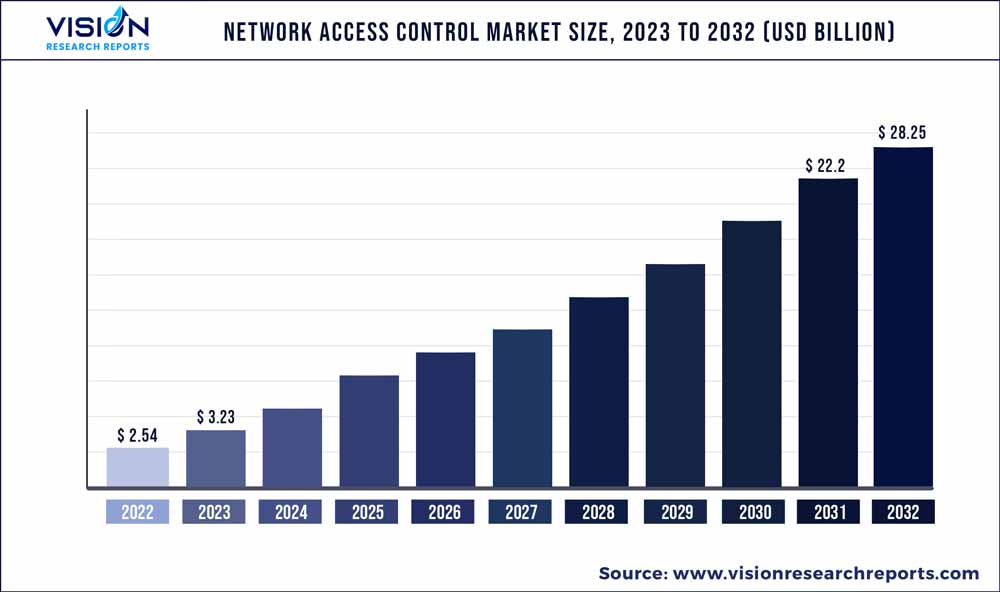
Key Pointers
Report Scope of the Network Access Control Market
| Report Coverage | Details |
| Revenue Share of North America in 2022 | 35% |
| CAGR of Asia Pacific from 2023 to 2032 | 30.05% |
| Revenue Forecast by 2032 | USD 28.25 billion |
| Growth Rate from 2023 to 2032 | CAGR of 27.24% |
| Base Year | 2022 |
| Forecast Period | 2023 to 2032 |
| Market Analysis (Terms Used) | Value (US$ Million/Billion) or (Volume/Units) |
| Companies Covered | Cisco; AP Access Control; Sophos; Fortinet; Huawei; Extreme Networks; Check Point Software Technology; Microsoft Corporation; Hewlett Packard Enterprises (HPE); Juniper Networks, Inc.; IBM Corporation; Broadcom, Inc.; ManageEngine; VMware; Forescout Technologies; Aruba ClearPass |
The growing incidents of non-corporate devices hampering corporate networks and breaching privacy laws require businesses to invest additional costs and attention to ensure network security. Network access control ensures a higher level of authentication, authorization, and compliance policies to permit access across the users’ network. It also allows users to instantly block devices, users, and endpoints from making unwanted connections. Thus, it offers advanced protection against data security breaches, helps restrict malicious activities, safeguard critical information, and offers higher visibility on the security posture of connected devices. These factors are expected to bode well for the market.
The recent trends such as hybrid work culture, bring your own devices, and remote working scenarios are increasing the dependency of users’ devices on business networks and are the key factors driving the market’s growth across various industries such as BFSI, IT & Telecommunication, healthcare, government, and manufacturing.
Further, the rising use of technology-enabled devices such as the Internet of Things (IoT) is being rapidly utilized by businesses, leading to potential threats of offering access to unwanted and malicious applications and devices. Thus, organizations that remain protected against cybercrimes, data theft, and malware are adopting network access control systems and solutions that help them regain control over their network, authorize and deny access, and monitor the security postures of organizational devices.
The rising access to third-party and non-employed resources further drives the need for the NAC solution. It helps reduce the costs and time associated with authorizing and authenticating networks and devices and enables users to determine whether the devices are compliant enough. In recent years, cybercriminals have adopted highly sophisticated campaigns to exploit vulnerabilities across various industries such as BFSI, IT, and government organizations.
The rising technology advancements across network access control solutions are helping users to detect unusual activities and suspicious network breaches while enabling them to isolate and quarantine critical devices from the network. Thus, it helps in protecting users against potential damages the key factor expected to drive the demand.
The growing adoption of web applications, IoT devices, and industrial software across verticals such as BFSI, Government, IT & telecommunication contains highly confidential information related to customers, vendors, and employees. These organizations follow strict security regulatory compliance, authentication, and verification guidelines and spend significant amounts to deploy network access control solutions.
For instance, in June 2023, Fortinet, a security and networking solutions provider, announced that 11 renowned managed security service providers initiated the adopted Fortinet’s’ Secure SD-WAN solution named as solutions by KT Corporation; STCClaro Empresas, Kyndryl, InfiniVAN, Inc., Globe Business, 11:11 Systems, SPTel, Sify Technologies, Neurosoft S.A., and Tata Teleservices to offer enhanced user experience and drive better business outcomes without compromising on security positioning.
Key companies in the market are taking various strategic initiatives, such as new product launches, partnerships, and mergers and acquisitions, to offer advanced solutions and service offerings. For instance, in February 2023, Cisco announced a series of innovations in cloud-managed networking to help customers simplify their IT operations with advanced and powerful cloud management tools enabling simplified dashboard operation, flexible network intelligence, and sophisticated IoT applications to visualize and secure industrial assets.
Type Insights
The hardware segment accounted for the largest market share of 43% in 2022. The hardware solutions and devices consist of firewalls, routers, switches, controllers, and others designed to deliver high-performance capability and dynamic network security functionalities. These advanced NAC hardware solutions provide endpoint security, network security, web-based application security, and identity and access management, enabling superior visibility and representation of real-time threats across the users’ network are the key factors expected to drive the growth of the segment.
The services segment is anticipated to grow at a CAGR of 30.34% during the forecast period. Network access control services include deployment, customer support, maintenance, training, and consultation services. The rising demand for network access control solutions, devices, and infrastructures is expected to support the service segments for a more extended period owing to the regular need for support and maintenance, license renewal, and customer support requirements are the primary factors expected to drive the growth of the segment.
Deployment Insights
The cloud-based segment accounted for a market share of 52% in 2022. Cloud-based network access control is primarily defined as subscription models. It enables organizations to access and utilize advanced network security offerings from the cloud infrastructure. It offers organizations a cost-effective and flexible way of monitoring and ensuring network security based on usage, demand, and buying capabilities. Thus, the underlined factors are expected to drive the growth of the cloud-based network access control segment during the forecast period.
The on-premise segment is expected to grow at a CAGR of 25.53% over the forecast period. On-premise network access control offers in-house solution offerings where the organizations can run and maintain their network’s security with higher flexibility in the usage as per their focus areas, organizational demand, and changing business requirements, along with offering complete control on the use and management. These factors are expected to drive the segment’s growth in the network access control market.
Enterprise Size Insights
The large enterprise segment accounted for a revenue share of 55% in 2022. The rising incidences of cyberattacks, data theft, and security breaches due to the rapid use of technologies, connected devices, remote work cultures, and the use of unsecured networks to share data are the key factors attracting cybercriminals toward large organizations such as banking and financial institutions, IT companies, healthcare institutes, and government organizations. Thus, ensuring the safety of organizational networks and connected devices is becoming highly important among large organizations.
The SMEs segment is expected to grow at the highest CAGR of 27.82% during the forecast period. Small and medium enterprises are emerging as the easiest and most valuable target for cybercriminals due to the lack of adoption of security solutions, accessible to-comprisable networks, and lack of technological knowledge and infrastructures. The growing technological advancements in the network security industry offering reliable and cost-effective solutions are the key factors expected to drive the adoption of network access control software and hardware solutions in the SME segment.
Vertical Insights
The BFSI segment accounted for the largest revenue share of 21% in 2022. The financial and banking industries constantly witness higher risks of data theft, cybersecurity breaches, device compromission, and network hijackings. Meanwhile, these industries are expanding their IT spending at an unprecedented pace to keep up with the latest technologies, IoT devices, and web-based applications making them highly vulnerable and accessible to security breaches. Thus, the demand for zero-trust, network security, and access monitoring and control solutions is rapidly growing for banking and financial services organizations.
The IT and telecommunication segment is anticipated to grow at a CAGR of 30.34% during the forecast period. IT and Telecommunication industries are experiencing a rapid surge in cyberattacks and data security breaches owing to the higher availability of customer data, sharing of critical information through large networks, higher use of digital technologies, and rise in application of connected devices. Further, the growing security concerns and rising awareness among organizations are expected to drive the demand for network access control solutions in the IT and telecommunication segment.
Regional Insights
North America accounted for a major revenue share of 35% in 2022. North America's network access control market is expected to witness growth opportunities due to the rising demand for network security solutions among major end-use industries such as healthcare, Government, Education, IT and Telecom, and BFSI. Cybercriminals and data thefts are constantly targeting the following industries in the region to gain access to critical organizational networks and devices containing exorbitant personal and organizational data. These factors are expected to drive the regional market growth.
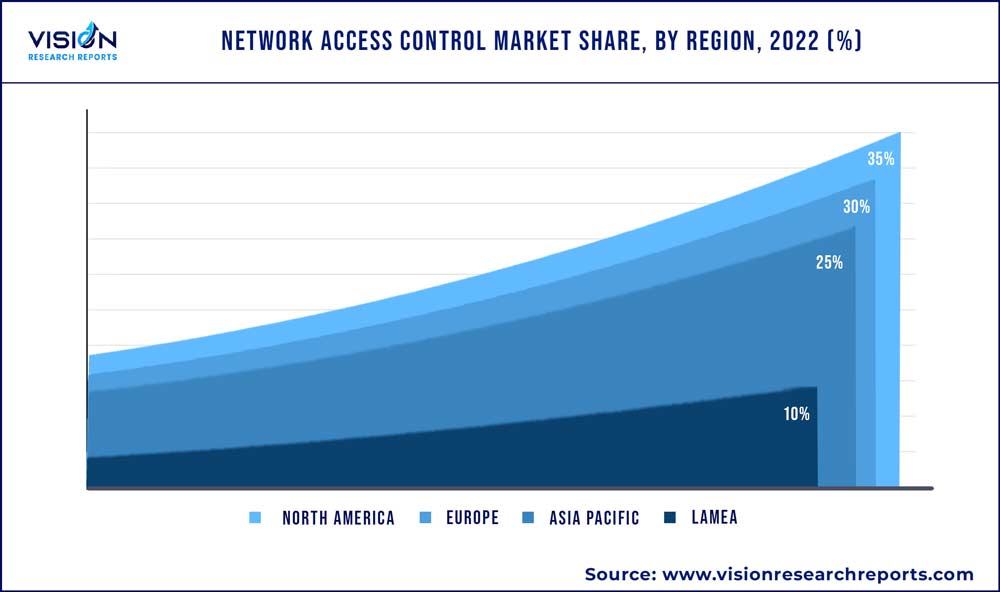
Asia Pacific is expected to emerge as the fastest-growing regional market with a CAGR of 30.05% during the forecast period. The rapid adoption of advanced technologies such as IoT in various end-use industries such as IT and Telecom, BFSI, healthcare, manufacturing, retail, and others, along with the growing security compliances and regulatory policies to protect customer data BFSI and IT sectors is driving the demand for NAC solutions. Further, the rapidly growing industrial infrastructure, large customer base in the region, and rising awareness among organizations toward adopting network security and access control solutions are expected to strengthen the adoption of network access control in the Asia Pacific region.
Network Access Control Market Segmentations:
By Type
By Deployment
By Enterprise Size
By Vertical
By Regional
Chapter 1. Introduction
1.1. Research Objective
1.2. Scope of the Study
1.3. Definition
Chapter 2. Research Methodology
2.1. Research Approach
2.2. Data Sources
2.3. Assumptions & Limitations
Chapter 3. Executive Summary
3.1. Market Snapshot
Chapter 4. Market Variables and Scope
4.1. Introduction
4.2. Market Classification and Scope
4.3. Industry Value Chain Analysis
4.3.1. Raw Material Procurement Analysis
4.3.2. Sales and Distribution Channel Analysis
4.3.3. Downstream Buyer Analysis
Chapter 5. COVID 19 Impact on Network Access Control Market
5.1. COVID-19 Landscape: Network Access Control Industry Impact
5.2. COVID 19 - Impact Assessment for the Industry
5.3. COVID 19 Impact: Global Major Government Policy
5.4. Market Trends and Opportunities in the COVID-19 Landscape
Chapter 6. Market Dynamics Analysis and Trends
6.1. Market Dynamics
6.1.1. Market Drivers
6.1.2. Market Restraints
6.1.3. Market Opportunities
6.2. Porter’s Five Forces Analysis
6.2.1. Bargaining power of suppliers
6.2.2. Bargaining power of buyers
6.2.3. Threat of substitute
6.2.4. Threat of new entrants
6.2.5. Degree of competition
Chapter 7. Competitive Landscape
7.1.1. Company Market Share/Positioning Analysis
7.1.2. Key Strategies Adopted by Players
7.1.3. Vendor Landscape
7.1.3.1. List of Suppliers
7.1.3.2. List of Buyers
Chapter 8. Global Network Access Control Market, By Type
8.1. Network Access Control Market, by Type, 2023-2032
8.1.1. Hardware
8.1.1.1. Market Revenue and Forecast (2020-2032)
8.1.2. Software
8.1.2.1. Market Revenue and Forecast (2020-2032)
8.1.3. Services
8.1.3.1. Market Revenue and Forecast (2020-2032)
Chapter 9. Global Network Access Control Market, By Deployment
9.1. Network Access Control Market, by Deployment, 2023-2032
9.1.1. On-premise
9.1.1.1. Market Revenue and Forecast (2020-2032)
9.1.2. Cloud
9.1.2.1. Market Revenue and Forecast (2020-2032)
Chapter 10. Global Network Access Control Market, By Deployment
10.1. Network Access Control Market, by Deployment, 2023-2032
10.1.1. Large Enterprise
10.1.1.1. Market Revenue and Forecast (2020-2032)
10.1.2. Small & Medium Enterprises
10.1.2.1. Market Revenue and Forecast (2020-2032)
Chapter 11. Global Network Access Control Market, By Vertical
11.1. Network Access Control Market, by Vertical, 2023-2032
11.1.1. BFSI
11.1.1.1. Market Revenue and Forecast (2020-2032)
11.1.2. IT and Telecom
11.1.2.1. Market Revenue and Forecast (2020-2032)
11.1.3. Retail & E-commerce
11.1.3.1. Market Revenue and Forecast (2020-2032)
11.1.4. Healthcare
11.1.4.1. Market Revenue and Forecast (2020-2032)
11.1.5. Manufacturing
11.1.5.1. Market Revenue and Forecast (2020-2032)
11.1.6. Government
11.1.6.1. Market Revenue and Forecast (2020-2032)
11.1.7. Education
11.1.7.1. Market Revenue and Forecast (2020-2032)
11.1.8. Others
11.1.8.1. Market Revenue and Forecast (2020-2032)
Chapter 12. Global Network Access Control Market, Regional Estimates and Trend Forecast
12.1. North America
12.1.1. Market Revenue and Forecast, by Type (2020-2032)
12.1.2. Market Revenue and Forecast, by Deployment (2020-2032)
12.1.3. Market Revenue and Forecast, by Deployment (2020-2032)
12.1.4. Market Revenue and Forecast, by Vertical (2020-2032)
12.1.5. U.S.
12.1.5.1. Market Revenue and Forecast, by Type (2020-2032)
12.1.5.2. Market Revenue and Forecast, by Deployment (2020-2032)
12.1.5.3. Market Revenue and Forecast, by Deployment (2020-2032)
12.1.5.4. Market Revenue and Forecast, by Vertical (2020-2032)
12.1.6. Rest of North America
12.1.6.1. Market Revenue and Forecast, by Type (2020-2032)
12.1.6.2. Market Revenue and Forecast, by Deployment (2020-2032)
12.1.6.3. Market Revenue and Forecast, by Deployment (2020-2032)
12.1.6.4. Market Revenue and Forecast, by Vertical (2020-2032)
12.2. Europe
12.2.1. Market Revenue and Forecast, by Type (2020-2032)
12.2.2. Market Revenue and Forecast, by Deployment (2020-2032)
12.2.3. Market Revenue and Forecast, by Deployment (2020-2032)
12.2.4. Market Revenue and Forecast, by Vertical (2020-2032)
12.2.5. UK
12.2.5.1. Market Revenue and Forecast, by Type (2020-2032)
12.2.5.2. Market Revenue and Forecast, by Deployment (2020-2032)
12.2.5.3. Market Revenue and Forecast, by Deployment (2020-2032)
12.2.5.4. Market Revenue and Forecast, by Vertical (2020-2032)
12.2.6. Germany
12.2.6.1. Market Revenue and Forecast, by Type (2020-2032)
12.2.6.2. Market Revenue and Forecast, by Deployment (2020-2032)
12.2.6.3. Market Revenue and Forecast, by Deployment (2020-2032)
12.2.6.4. Market Revenue and Forecast, by Vertical (2020-2032)
12.2.7. France
12.2.7.1. Market Revenue and Forecast, by Type (2020-2032)
12.2.7.2. Market Revenue and Forecast, by Deployment (2020-2032)
12.2.7.3. Market Revenue and Forecast, by Deployment (2020-2032)
12.2.7.4. Market Revenue and Forecast, by Vertical (2020-2032)
12.2.8. Rest of Europe
12.2.8.1. Market Revenue and Forecast, by Type (2020-2032)
12.2.8.2. Market Revenue and Forecast, by Deployment (2020-2032)
12.2.8.3. Market Revenue and Forecast, by Deployment (2020-2032)
12.2.8.4. Market Revenue and Forecast, by Vertical (2020-2032)
12.3. APAC
12.3.1. Market Revenue and Forecast, by Type (2020-2032)
12.3.2. Market Revenue and Forecast, by Deployment (2020-2032)
12.3.3. Market Revenue and Forecast, by Deployment (2020-2032)
12.3.4. Market Revenue and Forecast, by Vertical (2020-2032)
12.3.5. India
12.3.5.1. Market Revenue and Forecast, by Type (2020-2032)
12.3.5.2. Market Revenue and Forecast, by Deployment (2020-2032)
12.3.5.3. Market Revenue and Forecast, by Deployment (2020-2032)
12.3.5.4. Market Revenue and Forecast, by Vertical (2020-2032)
12.3.6. China
12.3.6.1. Market Revenue and Forecast, by Type (2020-2032)
12.3.6.2. Market Revenue and Forecast, by Deployment (2020-2032)
12.3.6.3. Market Revenue and Forecast, by Deployment (2020-2032)
12.3.6.4. Market Revenue and Forecast, by Vertical (2020-2032)
12.3.7. Japan
12.3.7.1. Market Revenue and Forecast, by Type (2020-2032)
12.3.7.2. Market Revenue and Forecast, by Deployment (2020-2032)
12.3.7.3. Market Revenue and Forecast, by Deployment (2020-2032)
12.3.7.4. Market Revenue and Forecast, by Vertical (2020-2032)
12.3.8. Rest of APAC
12.3.8.1. Market Revenue and Forecast, by Type (2020-2032)
12.3.8.2. Market Revenue and Forecast, by Deployment (2020-2032)
12.3.8.3. Market Revenue and Forecast, by Deployment (2020-2032)
12.3.8.4. Market Revenue and Forecast, by Vertical (2020-2032)
12.4. MEA
12.4.1. Market Revenue and Forecast, by Type (2020-2032)
12.4.2. Market Revenue and Forecast, by Deployment (2020-2032)
12.4.3. Market Revenue and Forecast, by Deployment (2020-2032)
12.4.4. Market Revenue and Forecast, by Vertical (2020-2032)
12.4.5. GCC
12.4.5.1. Market Revenue and Forecast, by Type (2020-2032)
12.4.5.2. Market Revenue and Forecast, by Deployment (2020-2032)
12.4.5.3. Market Revenue and Forecast, by Deployment (2020-2032)
12.4.5.4. Market Revenue and Forecast, by Vertical (2020-2032)
12.4.6. North Africa
12.4.6.1. Market Revenue and Forecast, by Type (2020-2032)
12.4.6.2. Market Revenue and Forecast, by Deployment (2020-2032)
12.4.6.3. Market Revenue and Forecast, by Deployment (2020-2032)
12.4.6.4. Market Revenue and Forecast, by Vertical (2020-2032)
12.4.7. South Africa
12.4.7.1. Market Revenue and Forecast, by Type (2020-2032)
12.4.7.2. Market Revenue and Forecast, by Deployment (2020-2032)
12.4.7.3. Market Revenue and Forecast, by Deployment (2020-2032)
12.4.7.4. Market Revenue and Forecast, by Vertical (2020-2032)
12.4.8. Rest of MEA
12.4.8.1. Market Revenue and Forecast, by Type (2020-2032)
12.4.8.2. Market Revenue and Forecast, by Deployment (2020-2032)
12.4.8.3. Market Revenue and Forecast, by Deployment (2020-2032)
12.4.8.4. Market Revenue and Forecast, by Vertical (2020-2032)
12.5. Latin America
12.5.1. Market Revenue and Forecast, by Type (2020-2032)
12.5.2. Market Revenue and Forecast, by Deployment (2020-2032)
12.5.3. Market Revenue and Forecast, by Deployment (2020-2032)
12.5.4. Market Revenue and Forecast, by Vertical (2020-2032)
12.5.5. Brazil
12.5.5.1. Market Revenue and Forecast, by Type (2020-2032)
12.5.5.2. Market Revenue and Forecast, by Deployment (2020-2032)
12.5.5.3. Market Revenue and Forecast, by Deployment (2020-2032)
12.5.5.4. Market Revenue and Forecast, by Vertical (2020-2032)
12.5.6. Rest of LATAM
12.5.6.1. Market Revenue and Forecast, by Type (2020-2032)
12.5.6.2. Market Revenue and Forecast, by Deployment (2020-2032)
12.5.6.3. Market Revenue and Forecast, by Deployment (2020-2032)
12.5.6.4. Market Revenue and Forecast, by Vertical (2020-2032)
Chapter 13. Company Profiles
13.1. Cisco
13.1.1. Company Overview
13.1.2. Product Offerings
13.1.3. Financial Performance
13.1.4. Recent Initiatives
13.2. AP Access Control
13.2.1. Company Overview
13.2.2. Product Offerings
13.2.3. Financial Performance
13.2.4. Recent Initiatives
13.3. Sophos
13.3.1. Company Overview
13.3.2. Product Offerings
13.3.3. Financial Performance
13.3.4. Recent Initiatives
13.4. Fortinet
13.4.1. Company Overview
13.4.2. Product Offerings
13.4.3. Financial Performance
13.4.4. Recent Initiatives
13.5. Huawei
13.5.1. Company Overview
13.5.2. Product Offerings
13.5.3. Financial Performance
13.5.4. Recent Initiatives
13.6. Extreme Networks
13.6.1. Company Overview
13.6.2. Product Offerings
13.6.3. Financial Performance
13.6.4. Recent Initiatives
13.7. Check Point Software Technology
13.7.1. Company Overview
13.7.2. Product Offerings
13.7.3. Financial Performance
13.7.4. Recent Initiatives
13.8. Microsoft Corporation
13.8.1. Company Overview
13.8.2. Product Offerings
13.8.3. Financial Performance
13.8.4. Recent Initiatives
13.9. Hewlett Packard Enterprises (HPE)
13.9.1. Company Overview
13.9.2. Product Offerings
13.9.3. Financial Performance
13.9.4. Recent Initiatives
13.10. Juniper Networks, Inc.
13.10.1. Company Overview
13.10.2. Product Offerings
13.10.3. Financial Performance
13.10.4. Recent Initiatives
Chapter 14. Research Methodology
14.1. Primary Research
14.2. Secondary Research
14.3. Assumptions
Chapter 15. Appendix
15.1. About Us
15.2. Glossary of Terms
 Cross-segment Market Size and Analysis for
Mentioned Segments
Additional Company Profiles (Upto 5 With No Cost)
Additional Countries (Apart From Mentioned Countries)
Country/Region-specific Report
Go To Market Strategy
Region Specific Market DynamicsRegion Level Market Share Import Export AnalysisProduction AnalysisOthers
Cross-segment Market Size and Analysis for
Mentioned Segments
Additional Company Profiles (Upto 5 With No Cost)
Additional Countries (Apart From Mentioned Countries)
Country/Region-specific Report
Go To Market Strategy
Region Specific Market DynamicsRegion Level Market Share Import Export AnalysisProduction AnalysisOthers