
North America Alopecia Market Size, Share, Report 2023-2032
The North America alopecia market was valued at USD 2.91 billion in 2022 and it is predicted to surpass around USD 6.02 billion by 2032 with a CAGR of 7.54% from 2023 to 2032.
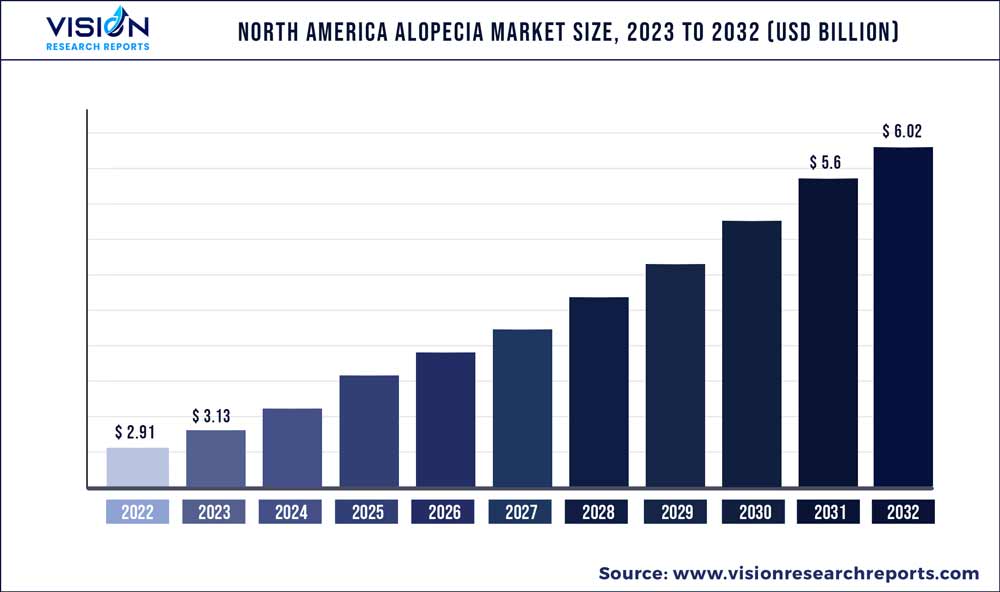
Key Pointers
Report Scope of the North America Alopecia Market
| Report Coverage | Details |
| Market Size in 2022 | USD 2.91 billion |
| Revenue Forecast by 2032 | USD 6.02 billion |
| Growth rate from 2023 to 2032 | CAGR of 7.54% |
| Base Year | 2022 |
| Forecast Period | 2023 to 2032 |
| Market Analysis (Terms Used) | Value (US$ Million/Billion) or (Volume/Units) |
| Companies Covered | Cipla Inc; Sun Pharmaceuticals Industries Ltd; Johnson & Johnson Services, Inc; Merck & Co., Inc.; Lexington Intl., LLC; Cirrus Hair Centers; Vita-Cos-Med Klett-Loch GmbH; Transitions Hair; Puretech Health; Curallux, LLC; Dr. Reddy's Laboratories Ltd; GSK plc; Aurobindo Pharma; Mylan N.V. (Viatris, Inc.); Freedom Laser Therapy, Inc.; Apira Science, Inc. (iGrow Laser.); Revian, Inc; Theradome Inc.; LUTRONIC Inc.; WON TECH Co., Ltd; LifeMD; LG Electronics |
The increasing prevalence of alopecia coupled with the rising prevalence of autoimmune and other chronic disorders that lead to hair loss are the major factors driving the market. According to the American Academy of Dermatology Association, hair loss affects around 80 million American people with 30 million women and 50 million men. Moreover, it is an estimation that around 10% to 20% of people with alopecia areata have a close blood relative who already has AA.
Moreover, the presence of several leading players in the region and the introduction of novel therapeutic options are also expected to drive the North America alopecia market. The market is driven by product line expansion undertaken by leading players. For instance, in June 2021, Hims & Hers Health, Inc, a leading telehealth company announced the availability of Hers Minoxidil 5% Foam and Hims Minoxidil 5% Foam for topical hair regrowth and to fulfill customer needs, which is expected to increase the market growth. Moreover, the presence of organizations that help to promote awareness regarding hair loss is likely to facilitate market expansion. Organizations such as American Hair Loss Association, National Alopecia Areata Foundation, and Canadian Alopecia Areata Foundation are involved in promoting awareness regarding hair loss and supporting research activities through funding.
The presence of a robust pipeline of investigational candidates for the treatment of hair loss is anticipated to accelerate the North America alopecia market. For instance, Equillium Bio, a leading clinical-stage biopharmaceutical company engaged in the development of novel therapeutics for autoimmune disorders is investigating EQ101, an IL-2/9/15 antagonist for the treatment of alopecia areata (AA). Moreover, Concert Pharmaceuticals is engaged in the development of CTP-543 which is a JAK1 and JAK2 inhibitor for the management of AA. In July 2020, the company obtained breakthrough therapy designation for CTP-543 from the U.S. FDA for the treatment of severe to moderate cases of alopecia. Furthermore, additional investigational candidates such as LY3009104 of Lily, PF 06651600 of Pfizer Inc., HCW9302 of HCW Biologics, and LH-8 of Legacy Healthcare are also being investigated for the treatment of hair loss.
The prevalence of cancer is expected to increase in the U.S. According to the American Cancer Society, in 2020, the estimated number of new cancer cases was 1.8 million in the country, whereas, in 2022, the number is expected to reach 1.9 million. The national expenditure for cancer care was estimated to be around USD 150.8 billion in 2018, which is expected to reach around USD 245 billion in 2030. Certain medications prescribed to patients for the treatment of cancer are also responsible for hair loss. For instance, chemotherapeutic agents, radiation therapy, hormone therapy, and immunotherapy are more likely to induce hair loss or hair thinning. Cancer incidences are expected to rise by about 70% over the next two decades, thus driving the North America alopecia industry.
Treatment Insights
Based on treatment, the pharmaceuticals segment dominated the North America alopecia market with a revenue share of 99% in 2022 and is expected to dominate the treatment segment during the forecast period. The growth of the pharmaceutical segment is attributed to the rising demand for drugs for the treatment of hair loss, lower costs of pharmaceutical products, easy availability, and various efforts taken by pharmaceuticals company to develop novel therapeutics for alopecia. For instance, companies such as Lilly, Concert Pharmaceuticals, Pfizer Inc, etc. are involved in the development of novel therapeutics with high efficacy for the treatment of hair loss.
The devices segment is estimated to register a steady growth rate during the projected period. Laser cap is growing at the fastest CAGR attributed to increasing demand for painless treatment, user-friendly, high adoption of non-invasive therapies, and occurrence of minimal side effects with high adoption of such devices. Moreover, the demand for the segment is also fueled by rising disposable incomes and a surge in healthcare spending in the region.
Disease Type Insights
The alopecia areata segment dominated the disease type segment with a share of 42% in 2022 and is likely to hold the largest share over the forecast period. The growth of the segment is owing to increasing disease prevalence, high treatment rates, the surge in awareness about alopecia areata, and various ongoing regulatory approvals. For instance, according to the NAAF, more than 6.8 million people in the U.S. have alopecia areata with a lifetime risk of 2.1%. In addition, ongoing regulatory approvals are expected to propel segment growth forward. For instance, in March 2020, Incyte Corporation and Eli Lilly and Company announced that the U.S. FDA had granted a breakthrough therapy designation to baricitinib for the management of alopecia areata.
Alopecia universalis is anticipated to grow at the fastest CAGR over the forecast period. The market growth is strongly driven by the impending launches of key late-stage pipeline products: baricitinib, ruxolitinib, ritlecitinib, Xeljanz (tofacitinib), Breezula (clascoterone), & SM04554, and initiatives undertaken by various organizations to aware people about the condition and available treatment.
End-use Insights
In 2022, the dermatological clinics led the North America alopecia market with a share of 58% and are expected to maintain their dominance over the forecast period. The demand for the dermatological clinics segment is driven by the growing focus on aesthetic appearance, rising consciousness about looks, and increased consumer awareness about the management & treatment of hair loss. The worldwide increase in the usage of prescription drugs and increase in doctor visits also contributes to the large share of the dermatology clinics segment.
The homecare settings segment is anticipated to register the fastest CAGR during the forecast period. The high demand for the homecare settings segment is primarily due to the high degree of convenience, and higher penetration of topical hair growth products. Moreover, the growing number of regulatory approvals for home-use devices and the rising adoption of laser therapy for hair loss treatment is anticipated to boost the segment growth.
Gender Insights
The male segment held the largest share of 55% of the North America alopecia market in 2022. Cases of androgenetic alopecia among men are a key contributor to the segment growth. Furthermore, awareness related to hair fall and trends in medical & surgical treatments for hair restoration procedures are also on the rise among men. However, the adoption of hair restoration procedures and traditional medicines may negatively impact market growth.
The female segment is estimated to grow at the fastest rate over the forecast period. The growth of this segment is supported by changing lifestyles, increasing incidences of PCOS, and high penetration of cosmetic products. Moreover, the increasing incidence of female pattern hair loss and the introduction of treatment options for females also highlights the growth in the alopecia treatment industry.
Sales Channel Insights
The prescription segment dominated the North America alopecia industry in 2022, with a share of 66%. The growth of the prescription segment is due to the rising incidences of severe forms of alopecia areata, increasing outpatient visits for AA treatment, and the presence of a robust pipeline of investigational candidates for the management of hair loss.
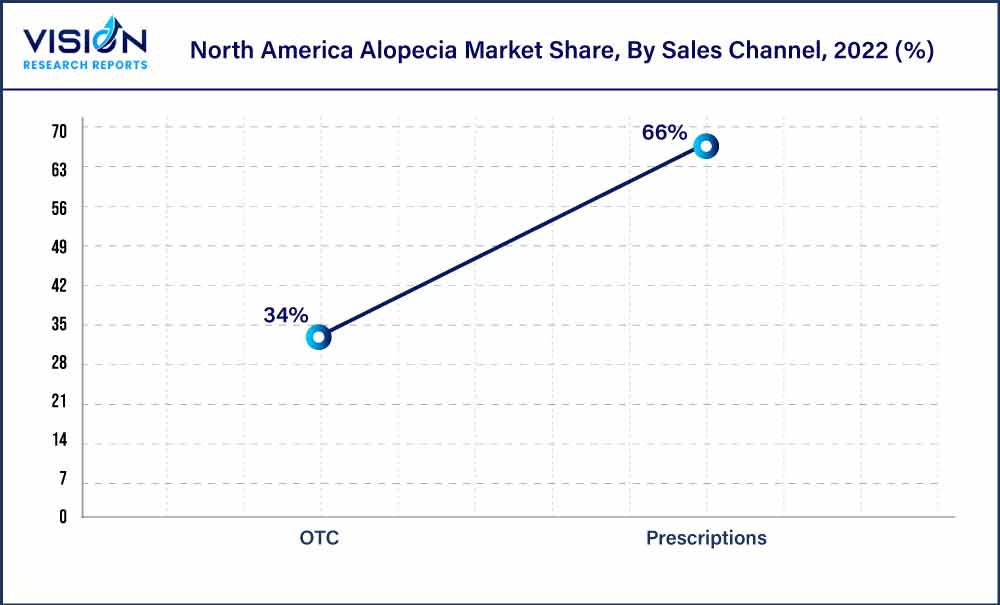
Rising penetration of OTC products and e-commerce remain major positives for the growth of the market. Furthermore, the surge in demand for OTC products owing to their easy availability has driven the usage of several products. Growing demand for low-cost hair loss treatment, rising consumer awareness regarding the adverse effects of prescribed drugs, and increasing availability of OTC drugs are major drivers in the market. OTC products are widely used in developing regions where players may find multiple opportunities to address unmet medical needs by reformulating products.
North America Alopecia Market Segmentations:
By Treatment
By Disease Type
By End-use
By Sales Channel
By Gender
Chapter 1. Introduction
1.1. Research Objective
1.2. Scope of the Study
1.3. Definition
Chapter 2. Research Methodology
2.1. Research Approach
2.2. Data Sources
2.3. Assumptions & Limitations
Chapter 3. Executive Summary
3.1. Market Snapshot
Chapter 4. Market Variables and Scope
4.1. Introduction
4.2. Market Classification and Scope
4.3. Industry Value Chain Analysis
4.3.1. Raw Material Procurement Analysis
4.3.2. Sales and Distribution Channel Analysis
4.3.3. Downstream Buyer Analysis
Chapter 5. COVID 19 Impact on North America Alopecia Market
5.1. COVID-19 Landscape: North America Alopecia Industry Impact
5.2. COVID 19 - Impact Assessment for the Industry
5.3. COVID 19 Impact: Major Government Policy
5.4. Market Trends and Opportunities in the COVID-19 Landscape
Chapter 6. Market Dynamics Analysis and Trends
6.1. Market Dynamics
6.1.1. Market Drivers
6.1.2. Market Restraints
6.1.3. Market Opportunities
6.2. Porter’s Five Forces Analysis
6.2.1. Bargaining power of suppliers
6.2.2. Bargaining power of buyers
6.2.3. Threat of substitute
6.2.4. Threat of new entrants
6.2.5. Degree of competition
Chapter 7. Competitive Landscape
7.1.1. Company Market Share/Positioning Analysis
7.1.2. Key Strategies Adopted by Players
7.1.3. Vendor Landscape
7.1.3.1. List of Suppliers
7.1.3.2. List of Buyers
Chapter 8. North America Alopecia Market, By Treatment
8.1. North America Alopecia Market, by Treatment, 2023-2032
8.1.1. Pharmaceuticals
8.1.1.1. Market Revenue and Forecast (2020-2032)
8.1.2. Devices
8.1.2.1. Market Revenue and Forecast (2020-2032)
Chapter 9. North America Alopecia Market, By Disease Type
9.1. North America Alopecia Market, by Disease Type, 2023-2032
9.1.1. Alopecia Areata
9.1.1.1. Market Revenue and Forecast (2020-2032)
9.1.2. Cicatricial Alopecia
9.1.2.1. Market Revenue and Forecast (2020-2032)
9.1.3. Traction Alopecia
9.1.3.1. Market Revenue and Forecast (2020-2032)
9.1.4. Alopecia Totalis
9.1.4.1. Market Revenue and Forecast (2020-2032)
9.1.5. Alopecia Universalis
9.1.5.1. Market Revenue and Forecast (2020-2032)
9.1.6. Androgenetic Alopecia
9.1.6.1. Market Revenue and Forecast (2020-2032)
9.1.7. Others
9.1.7.1. Market Revenue and Forecast (2020-2032)
Chapter 10. North America Alopecia Market, By End-use
10.1. North America Alopecia Market, by End-use, 2023-2032
10.1.1. Homecare Settings
10.1.1.1. Market Revenue and Forecast (2020-2032)
10.1.2. Dermatology Clinics
10.1.2.1. Market Revenue and Forecast (2020-2032)
Chapter 11. North America Alopecia Market, By Sales Channel
11.1. North America Alopecia Market, by Sales Channel, 2023-2032
11.1.1. Prescriptions
11.1.1.1. Market Revenue and Forecast (2020-2032)
11.1.2. OTC
11.1.2.1. Market Revenue and Forecast (2020-2032)
Chapter 12. North America Alopecia Market, By Gender
12.1. North America Alopecia Market, by Gender, 2023-2032
12.1.1. Male
12.1.1.1. Market Revenue and Forecast (2020-2032)
12.1.2. Female
12.1.2.1. Market Revenue and Forecast (2020-2032)
Chapter 13. North America Alopecia Market, Regional Estimates and Trend Forecast
13.1. North America
13.1.1. Market Revenue and Forecast, by Treatment (2020-2032)
13.1.2. Market Revenue and Forecast, by Disease Type (2020-2032)
13.1.3. Market Revenue and Forecast, by End-use (2020-2032)
13.1.4. Market Revenue and Forecast, by Sales Channel (2020-2032)
13.1.5. Market Revenue and Forecast, by Gender (2020-2032)
Chapter 14. Company Profiles
14.1. Cipla Inc
14.1.1. Company Overview
14.1.2. Product Offerings
14.1.3. Financial Performance
14.1.4. Recent Initiatives
14.2. Sun Pharmaceuticals Industries Ltd
14.2.1. Company Overview
14.2.2. Product Offerings
14.2.3. Financial Performance
14.2.4. Recent Initiatives
14.3. Johnson & Johnson Services, Inc
14.3.1. Company Overview
14.3.2. Product Offerings
14.3.3. Financial Performance
14.3.4. Recent Initiatives
14.4. Merck & Co., Inc.
14.4.1. Company Overview
14.4.2. Product Offerings
14.4.3. Financial Performance
14.4.4. Recent Initiatives
14.5. Lexington Intl., LLC
14.5.1. Company Overview
14.5.2. Product Offerings
14.5.3. Financial Performance
14.5.4. Recent Initiatives
14.6. Cirrus Hair Centers
14.6.1. Company Overview
14.6.2. Product Offerings
14.6.3. Financial Performance
14.6.4. Recent Initiatives
14.7. Vita-Cos-Med Klett-Loch GmbH
14.7.1. Company Overview
14.7.2. Product Offerings
14.7.3. Financial Performance
14.7.4. Recent Initiatives
14.8. Transitions Hair
14.8.1. Company Overview
14.8.2. Product Offerings
14.8.3. Financial Performance
14.8.4. Recent Initiatives
14.9. Puretech Health
14.9.1. Company Overview
14.9.2. Product Offerings
14.9.3. Financial Performance
14.9.4. Recent Initiatives
14.10. Curallux, LLC
14.10.1. Company Overview
14.10.2. Product Offerings
14.10.3. Financial Performance
14.10.4. Recent Initiatives
Chapter 15. Research Methodology
15.1. Primary Research
15.2. Secondary Research
15.3. Assumptions
Chapter 16. Appendix
16.1. About Us
16.2. Glossary of Terms
 Cross-segment Market Size and Analysis for
Mentioned Segments
Additional Company Profiles (Upto 5 With No Cost)
Additional Countries (Apart From Mentioned Countries)
Country/Region-specific Report
Go To Market Strategy
Region Specific Market DynamicsRegion Level Market Share Import Export AnalysisProduction AnalysisOthers
Cross-segment Market Size and Analysis for
Mentioned Segments
Additional Company Profiles (Upto 5 With No Cost)
Additional Countries (Apart From Mentioned Countries)
Country/Region-specific Report
Go To Market Strategy
Region Specific Market DynamicsRegion Level Market Share Import Export AnalysisProduction AnalysisOthers