The global octadecanedioic acid market size was estimated at around USD 8.7 billion in 2023 and it is projected to hit around USD 13.41 billion by 2033, growing at a CAGR of 4.42% from 2024 to 2033. Octadecanedioic acid, also known as behenic acid, is a dicarboxylic acid with the chemical formula C18H36O4. It is a white crystalline substance that is primarily used in various industrial applications, including the production of surfactants, lubricants, and polymers. Its unique chemical properties make it a valuable ingredient in the formulation of cosmetics, personal care products, and food additives.
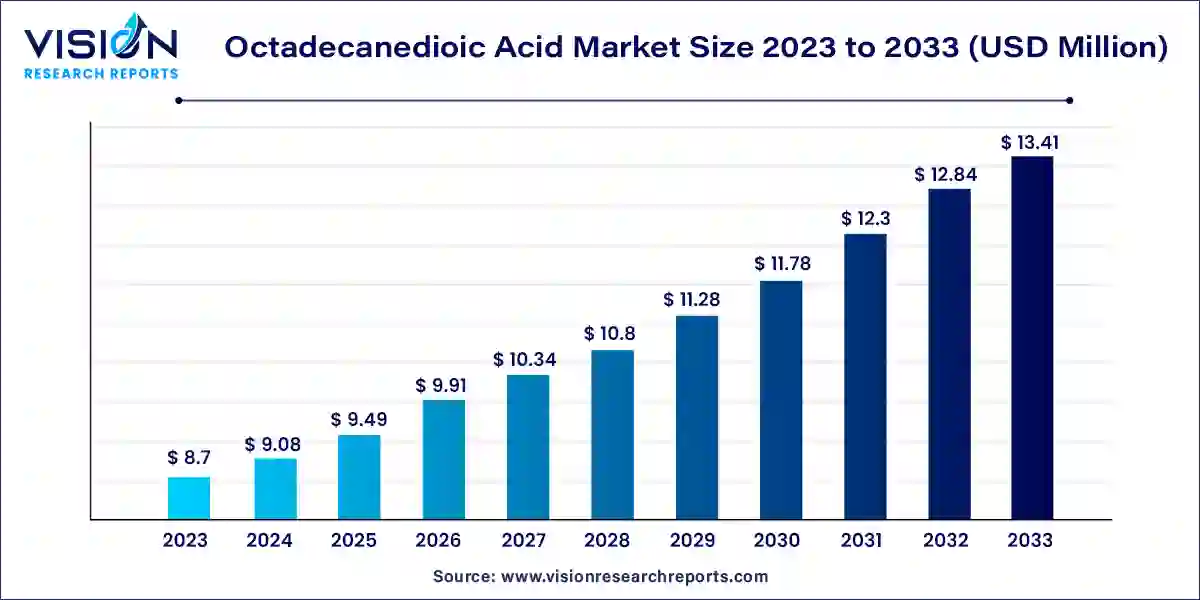
The growth of the octadecanedioic acid market is significantly driven by an increasing consumer demand for natural and eco-friendly ingredients in personal care products is propelling the adoption of octadecanedioic acid due to its safe and effective properties as an emollient and emulsifier. Additionally, the expanding applications of octadecanedioic acid in various industrial sectors, including the production of biodegradable lubricants, surfactants, and polymers, are enhancing its market potential. The rising awareness of environmental sustainability and the shift towards greener alternatives further boost the demand for this versatile compound. Moreover, advancements in manufacturing processes have improved the production efficiency and cost-effectiveness of octadecanedioic acid, making it more accessible to a broader range of industries.
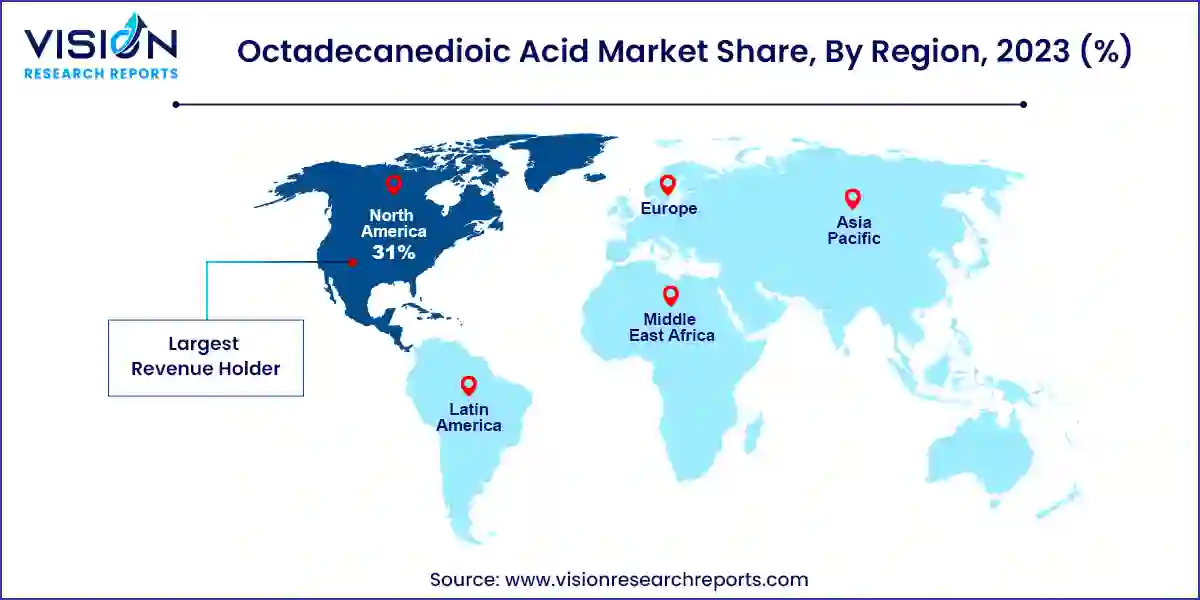
In 2023, North America led the global octadecanedioic acid market with a market share of 31%. The region benefits from a well-established industrial base that supports the production and utilization of compounds like ODDA. Numerous chemical manufacturing facilities in North America have intensified their R&D efforts to enhance production processes and product quality. This robust industrial infrastructure provides a favorable environment for the large-scale production and distribution of ODDA.
The octadecanedioic acid market in the U.S. dominated the North American segment with a market share of 78.05% in 2023. The U.S. features a mature chemical manufacturing sector characterized by advanced technologies, skilled labor, and complex supply chains, which facilitate the synthesis of ODDA. Additionally, the U.S. government actively promotes the use of bio-based chemicals like ODDA to foster environmental sustainability.
The Asia Pacific region is expected to experience the highest CAGR of 5.65% during the forecast period. The market for ODDA is growing rapidly in this region due to industrialization, urbanization, and infrastructure development. Significant investments in sectors such as automotive, construction, and electronics are driving this growth, particularly in countries like China, India, and Japan. The cosmetics market also shows considerable potential for expansion, driven by rising per capita incomes and a shift toward high-quality skincare products.
India is set to witness growth in the octadecanedioic acid market throughout the forecast period. As the largest producer of ODDA, India has made substantial investments in its chemical manufacturing industry, resulting in several large-scale production facilities employing modern technologies. This capacity enables India to meet both domestic and international demand effectively.
In 2023, Europe held a significant share of the octadecanedioic acid market. The region benefits from a reliable industrial foundation and a strong emphasis on environmental sustainability. Regulations from the EPA that restrict chemical usage in regional industries encourage the adoption of ODDA in sustainable products like powder coatings and bio-based lubricants. Moreover, the European cosmetics sector recognizes ODDA as a natural ingredient beneficial for skin health, aligning with the growing trend towards organic and environmentally friendly cosmetics.
Germany, in particular, captured a substantial market share in 2023. With one of the largest chemical industries in Europe, Germany is home to several prominent chemical companies that focus on R&D for specialty chemicals, including ODDA. This robust industrial base supports effective manufacturing processes and continuous product innovation.
In 2023, polyester polyols accounted for the largest segment of the market, commanding a revenue share of 51%. The remarkable flexibility and elongation properties of octadecanedioic acid (ODDA) make it an excellent choice for applications that demand enhanced strength and durability. Its resistance to chemicals further improves material performance in challenging environments. Industries such as automotive and construction leverage polyester polyols to create high-performance coatings known for their superior adhesion and weather resistance.
The cosmetics sector is projected to exhibit the fastest compound annual growth rate (CAGR) of 5.14% during the forecast period. The increasing consumer focus on skin health has led to a surge in demand for anti-aging skincare products. The properties of ODDA, which support skin elasticity and hydration, make it particularly effective in anti-aging formulations. As safety and efficacy continue to be priorities in the cosmetics industry, the demand for products containing ODDA is anticipated to rise.
By Application
By Region
Chapter 1. Introduction
1.1. Research Objective
1.2. Scope of the Study
1.3. Definition
Chapter 2. Research Methodology
2.1. Research Approach
2.2. Data Sources
2.3. Assumptions & Limitations
Chapter 3. Executive Summary
3.1. Market Snapshot
Chapter 4. Market Variables and Scope
4.1. Introduction
4.2. Market Classification and Scope
4.3. Industry Value Chain Analysis
4.3.1. Raw Material Procurement Analysis
4.3.2. Sales and Distribution Channel Analysis
4.3.3. Downstream Buyer Analysis
Chapter 5. COVID 19 Impact on Octadecanedioic Acid Market
5.1. COVID-19 Landscape: Octadecanedioic Acid Industry Impact
5.2. COVID 19 - Impact Assessment for the Industry
5.3. COVID 19 Impact: Global Major Government Policy
5.4. Market Trends and Opportunities in the COVID-19 Landscape
Chapter 6. Market Dynamics Analysis and Trends
6.1. Market Dynamics
6.1.1. Market Drivers
6.1.2. Market Restraints
6.1.3. Market Opportunities
6.2. Porter’s Five Forces Analysis
6.2.1. Bargaining power of suppliers
6.2.2. Bargaining power of buyers
6.2.3. Threat of substitute
6.2.4. Threat of new entrants
6.2.5. Degree of competition
Chapter 7. Competitive Landscape
7.1.1. Company Market Share/Positioning Analysis
7.1.2. Key Strategies Adopted by Players
7.1.3. Vendor Landscape
7.1.3.1. List of Suppliers
7.1.3.2. List of Buyers
Chapter 8. Global Octadecanedioic Acid Market, By Application
8.1.Octadecanedioic Acid Market, by Application Type
8.1.1. Polyester Polyols
8.1.1.1. Market Revenue and Forecast
8.1.2. Cosmetics
8.1.2.1. Market Revenue and Forecast
8.1.3. Powder Coatings
8.1.3.1. Market Revenue and Forecast
8.1.4. Lubricating Oils
8.1.4.1. Market Revenue and Forecast
8.1.5. Others
8.1.5.1. Market Revenue and Forecast
Chapter 9. Global Octadecanedioic Acid Market, Regional Estimates and Trend Forecast
9.1. North America
9.1.1. Market Revenue and Forecast, by Application
9.1.2. U.S.
9.1.2.1. Market Revenue and Forecast, by Application
9.1.3. Rest of North America
9.1.3.1. Market Revenue and Forecast, by Application
9.2. Europe
9.2.1. Market Revenue and Forecast, by Application
9.2.2. UK
9.2.2.1. Market Revenue and Forecast, by Application
9.2.3. Germany
9.2.3.1. Market Revenue and Forecast, by Application
9.2.4. France
9.2.4.1. Market Revenue and Forecast, by Application
9.2.5. Rest of Europe
9.2.5.1. Market Revenue and Forecast, by Application
9.3. APAC
9.3.1. Market Revenue and Forecast, by Application
9.3.2. India
9.3.2.1. Market Revenue and Forecast, by Application
9.3.3. China
9.3.3.1. Market Revenue and Forecast, by Application
9.3.4. Japan
9.3.4.1. Market Revenue and Forecast, by Application
9.3.5. Rest of APAC
9.3.5.1. Market Revenue and Forecast, by Application
9.4. MEA
9.4.1. Market Revenue and Forecast, by Application
9.4.2. GCC
9.4.2.1. Market Revenue and Forecast, by Application
9.4.3. North Africa
9.4.3.1. Market Revenue and Forecast, by Application
9.4.4. South Africa
9.4.4.1. Market Revenue and Forecast, by Application
9.4.5. Rest of MEA
9.4.5.1. Market Revenue and Forecast, by Application
9.5. Latin America
9.5.1. Market Revenue and Forecast, by Application
9.5.2. Brazil
9.5.2.1. Market Revenue and Forecast, by Application
9.5.3. Rest of LATAM
9.5.3.1. Market Revenue and Forecast, by Application
Chapter 10. Company Profiles
10.1. Larodan AB
10.1.1. Company Overview
10.1.2. Product Offerings
10.1.3. Financial Performance
10.1.4. Recent Initiatives
10.2. Procter & Gamble
10.2.1. Company Overview
10.2.2. Product Offerings
10.2.3. Financial Performance
10.2.4. Recent Initiatives
10.3. Cathay Biotech Inc.
10.3.1. Company Overview
10.3.2. Product Offerings
10.3.3. Financial Performance
10.3.4. Recent Initiatives
10.4. Tokyo Chemical Industry (India) Pvt. Ltd.
10.4.1. Company Overview
10.4.2. Product Offerings
10.4.3. Financial Performance
10.4.4. Recent Initiatives
10.5. INDOFINE Chemical Company, Inc.
10.5.1. Company Overview
10.5.2. Product Offerings
10.5.3. Financial Performance
10.5.4. Recent Initiatives
10.6. XIAMEN SINOPEG BIOTECH CO., LTD.
10.6.1. Company Overview
10.6.2. Product Offerings
10.6.3. Financial Performance
10.6.4. Recent Initiatives
10.7. Hunan Huateng Pharmaceutical Co., Ltd
10.7.1. Company Overview
10.7.2. Product Offerings
10.7.3. Financial Performance
10.7.4. Recent Initiatives
Chapter 11. Research Methodology
11.1. Primary Research
11.2. Secondary Research
11.3. Assumptions
Chapter 12. Appendix
12.1. About Us
12.2. Glossary of Terms
 Cross-segment Market Size and Analysis for
Mentioned Segments
Additional Company Profiles (Upto 5 With No Cost)
Additional Countries (Apart From Mentioned Countries)
Country/Region-specific Report
Go To Market Strategy
Region Specific Market DynamicsRegion Level Market Share Import Export AnalysisProduction AnalysisOthers
Cross-segment Market Size and Analysis for
Mentioned Segments
Additional Company Profiles (Upto 5 With No Cost)
Additional Countries (Apart From Mentioned Countries)
Country/Region-specific Report
Go To Market Strategy
Region Specific Market DynamicsRegion Level Market Share Import Export AnalysisProduction AnalysisOthers