
Oral Irrigator Market Size, Growth, Trends | Report 2022-2030
The global oral irrigator market was surpassed at USD 962.45 million in 2021 and is expected to hit around USD 1.57 billion by 2030, growing at a CAGR of 5.59% from 2022 to 2030.
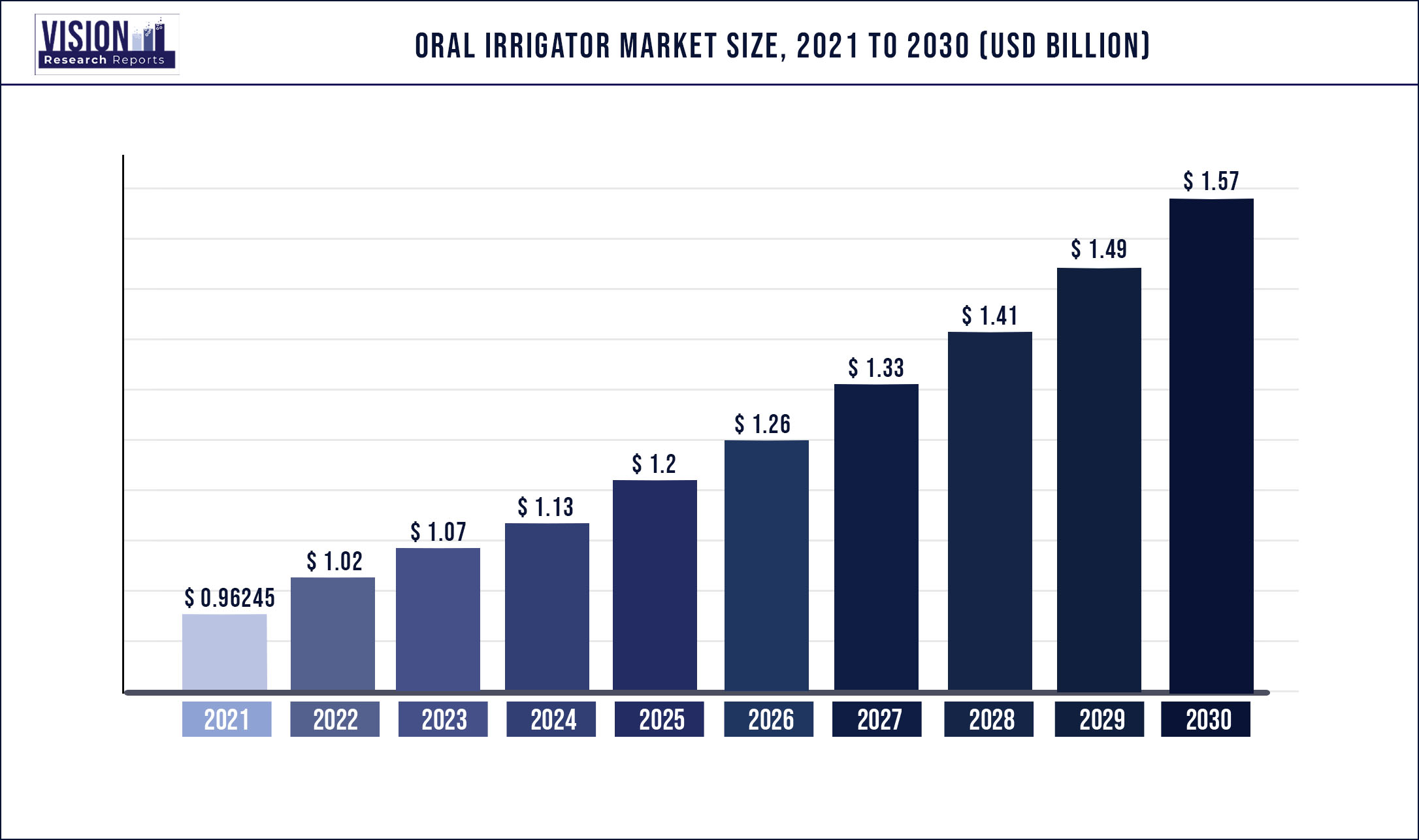
Report Highlights
The main factors driving this market are the rising incidence of dental diseases such as periodontitis and dental carries, increasing awareness regarding the use of technologically advanced products, the ready availability of oral irrigators, and several initiatives taken by various government agencies and dental organizations.
The COVID-19 pandemic significantly impacted the market growth. All dental, medical, and surgical procedures that are nonessential and elective were postponed in the first and second quarters of 2020. Oral examinations, routine cleaning, preventive therapies, and orthodontic procedures that do not involve pain management were postponed. This negatively impacted the global dental market and successively impacted the market for oral irrigators. Dental services were among the last to relaunch post-pandemic relaxations as dental procedures have a high risk of transmission.
As oral irrigators are more expensive than conventional floss, their market expansion is being constrained. Nevertheless, it is believed that the value benefits provided by manufacturers in exchange for the promotion of technologically advanced items will lessen the impact of high costs and boost consumer acceptance of these products. This may influence people's preferences to change from utilizing conventional flossing techniques to effective oral irrigators.
Scope of The Report
| Report Coverage | Details |
| Market Size in 2021 | USD 962.45 million |
| Revenue Forecast by 2030 | USD 1.57 billion |
| Growth rate from 2022 to 2030 | CAGR of 5.59% |
| Base Year | 2021 |
| Forecast Period | 2022 to 2030 |
| Segmentation | Product type, application, distribution channel, region |
| Companies Covered |
Colgate-Palmolive; Procter & Gamble; Church & Dwight; GlaxoSmithKline; Johnson & Johnson; Lion Corporation; Sunstar Suisse S.A.; Dr. Fresh; Dentaid |
Product Type Insights
The cordless segment accounted for the largest share of over 65.06% in 2021. It is a battery-operated device that helps in removing debris and bacteria from gums. It can be used easily and is portable, making it a widely used device for home care. Besides, it is easier to carry and cheaper than the countertop variant. Based on product type, the market is segmented into countertop and cordless.
The countertop segment is anticipated to register a CAGR of 4.55% during the forecast period. It is a traditional type of model. It has a cord or wire that must be connected to an outlet in order for it to operate. Compared to cordless counterparts, these gadgets typically run longer on a single water tank and do not need to be recharged.
Distribution Channel Insights
The online segment dominated the market and accounted for a revenue share of over 70.12% in 2021 and is expected to grow lucratively during the forecast period. Consumers' reevaluation of their priorities in life as a result of the pandemic led to the development of new standards for values and expenditure. Consumer behavior is shifting away from conventional techniques due to an increased reliance on technology, technical performance, and the online payments industry.
Prior to the COVID-19 epidemic, consumers were shifting their purchasing preferences from physical stores to internet retailers. Those escalated sooner, though, amid the crisis. However, the variety of choices, reduced costs, and the strong visibility of multinational brands that offline retailers provide to clients make them an ideal platform for all different sorts of customers.
Application Insights
The home segment dominated the market with a share of over 70.04% in 2021 and is anticipated to maintain its dominance during the forecast period due to the rising product use at home. Additionally, growing consumer awareness regarding high-tech, user-friendly oral irrigation devices is having an effect on market expansion. Regardless of price, consumers are concentrating on buying high-quality dental supplies. The segment is projected to be driven by this tendency.
The purchasing habits of consumers who shop at home have seen a substantial change as a result of advancements in oral irrigators. They are increasingly gravitating toward items with cutting-edge designs, which may enable manufacturers to release more devices to meet various needs while simultaneously keeping their competitive advantage.
The significant demand for the product among dental professionals is expected to cause the dentistry industry to expand remarkably in the years to come. The rising prevalence of periodontal illnesses among a sizable population, particularly in developing economies, can be blamed for this.
Regional Insights
The Asia Pacific region dominated the market with a share of over 40.09% in 2021 and is anticipated to expand at the fastest CAGR during the forecast period. This is due to a rise in the number of people suffering from periodontal disease. This can be due to poor dietary practices, particularly a large intake of sugary foods. The market is also being driven by an increase in the number of dental clinics and experts. Adoption of cutting-edge technology, rising medical tourism in the area, and increased awareness regarding oral hygiene are all contributing to the market expansion.
For instance, the National Oral Health Survey of India conducted a study in 2020 wherein a total of 92,219 adults participated. It was found that the overall prevalence of periodontal disease was 51% and gingivitis was 46.6%. It was more prevalent in the urban population than in the rural. And females showed a prevalence of around 34.4%, which was lower as compared to males (42.2%).
Key Players
Market Segmentation
Chapter 1. Introduction
1.1. Research Objective
1.2. Scope of the Study
1.3. Definition
Chapter 2. Research Methodology
2.1. Research Approach
2.2. Data Sources
2.3. Assumptions & Limitations
Chapter 3. Executive Summary
3.1. Market Snapshot
Chapter 4. Market Variables and Scope
4.1. Introduction
4.2. Market Classification and Scope
4.3. Industry Value Chain Analysis
4.3.1. Raw Material Procurement Analysis
4.3.2. Sales and Distribution Channel Analysis
4.3.3. Downstream Buyer Analysis
Chapter 5. COVID 19 Impact on Oral Irrigator Market
5.1. COVID-19 Landscape: Oral Irrigator Industry Impact
5.2. COVID 19 - Impact Assessment for the Industry
5.3. COVID 19 Impact: Global Major Government Policy
5.4. Market Trends and Opportunities in the COVID-19 Landscape
Chapter 6. Market Dynamics Analysis and Trends
6.1. Market Dynamics
6.1.1. Market Drivers
6.1.2. Market Restraints
6.1.3. Market Opportunities
6.2. Porter’s Five Forces Analysis
6.2.1. Bargaining power of suppliers
6.2.2. Bargaining power of buyers
6.2.3. Threat of substitute
6.2.4. Threat of new entrants
6.2.5. Degree of competition
Chapter 7. Competitive Landscape
7.1.1. Company Market Share/Positioning Analysis
7.1.2. Key Strategies Adopted by Players
7.1.3. Vendor Landscape
7.1.3.1. List of Suppliers
7.1.3.2. List of Buyers
Chapter 8. Global Oral Irrigator Market, By Product Type
8.1. Oral Irrigator Market, by Product Type, 2022-2030
8.1.1 Countertop
8.1.1.1. Market Revenue and Forecast (2017-2030)
8.1.2. Cordless
8.1.2.1. Market Revenue and Forecast (2017-2030)
Chapter 9. Global Oral Irrigator Market, By Application
9.1. Oral Irrigator Market, by Application, 2022-2030
9.1.1. Home
9.1.1.1. Market Revenue and Forecast (2017-2030)
9.1.2. Dentistry
9.1.2.1. Market Revenue and Forecast (2017-2030)
Chapter 10. Global Oral Irrigator Market, By Distribution Channel
10.1. Oral Irrigator Market, by Distribution Channel, 2022-2030
10.1.1. Online
10.1.1.1. Market Revenue and Forecast (2017-2030)
10.1.2. Offline
10.1.2.1. Market Revenue and Forecast (2017-2030)
Chapter 11. Global Oral Irrigator Market, Regional Estimates and Trend Forecast
11.1. North America
11.1.1. Market Revenue and Forecast, by Product Type (2017-2030)
11.1.2. Market Revenue and Forecast, by Application (2017-2030)
11.1.3. Market Revenue and Forecast, by Distribution Channel (2017-2030)
11.1.4. U.S.
11.1.4.1. Market Revenue and Forecast, by Product Type (2017-2030)
11.1.4.2. Market Revenue and Forecast, by Application (2017-2030)
11.1.4.3. Market Revenue and Forecast, by Distribution Channel (2017-2030)
11.1.5. Rest of North America
11.1.5.1. Market Revenue and Forecast, by Product Type (2017-2030)
11.1.5.2. Market Revenue and Forecast, by Application (2017-2030)
11.1.5.3. Market Revenue and Forecast, by Distribution Channel (2017-2030)
11.2. Europe
11.2.1. Market Revenue and Forecast, by Product Type (2017-2030)
11.2.2. Market Revenue and Forecast, by Application (2017-2030)
11.2.3. Market Revenue and Forecast, by Distribution Channel (2017-2030)
11.2.4. UK
11.2.4.1. Market Revenue and Forecast, by Product Type (2017-2030)
11.2.4.2. Market Revenue and Forecast, by Application (2017-2030)
11.2.4.3. Market Revenue and Forecast, by Distribution Channel (2017-2030)
11.2.5. Germany
11.2.5.1. Market Revenue and Forecast, by Product Type (2017-2030)
11.2.5.2. Market Revenue and Forecast, by Application (2017-2030)
11.2.5.3. Market Revenue and Forecast, by Distribution Channel (2017-2030)
11.2.6. France
11.2.6.1. Market Revenue and Forecast, by Product Type (2017-2030)
11.2.6.2. Market Revenue and Forecast, by Application (2017-2030)
11.2.6.3. Market Revenue and Forecast, by Distribution Channel (2017-2030)
11.2.7. Rest of Europe
11.2.7.1. Market Revenue and Forecast, by Product Type (2017-2030)
11.2.7.2. Market Revenue and Forecast, by Application (2017-2030)
11.2.7.3. Market Revenue and Forecast, by Distribution Channel (2017-2030)
11.3. APAC
11.3.1. Market Revenue and Forecast, by Product Type (2017-2030)
11.3.2. Market Revenue and Forecast, by Application (2017-2030)
11.3.3. Market Revenue and Forecast, by Distribution Channel (2017-2030)
11.3.4. India
11.3.4.1. Market Revenue and Forecast, by Product Type (2017-2030)
11.3.4.2. Market Revenue and Forecast, by Application (2017-2030)
11.3.4.3. Market Revenue and Forecast, by Distribution Channel (2017-2030)
11.3.5. China
11.3.5.1. Market Revenue and Forecast, by Product Type (2017-2030)
11.3.5.2. Market Revenue and Forecast, by Application (2017-2030)
11.3.5.3. Market Revenue and Forecast, by Distribution Channel (2017-2030)
11.3.6. Japan
11.3.6.1. Market Revenue and Forecast, by Product Type (2017-2030)
11.3.6.2. Market Revenue and Forecast, by Application (2017-2030)
11.3.6.3. Market Revenue and Forecast, by Distribution Channel (2017-2030)
11.3.7. Rest of APAC
11.3.7.1. Market Revenue and Forecast, by Product Type (2017-2030)
11.3.7.2. Market Revenue and Forecast, by Application (2017-2030)
11.3.7.3. Market Revenue and Forecast, by Distribution Channel (2017-2030)
11.4. MEA
11.4.1. Market Revenue and Forecast, by Product Type (2017-2030)
11.4.2. Market Revenue and Forecast, by Application (2017-2030)
11.4.3. Market Revenue and Forecast, by Distribution Channel (2017-2030)
11.4.4. GCC
11.4.4.1. Market Revenue and Forecast, by Product Type (2017-2030)
11.4.4.2. Market Revenue and Forecast, by Application (2017-2030)
11.4.4.3. Market Revenue and Forecast, by Distribution Channel (2017-2030)
11.4.5. North Africa
11.4.5.1. Market Revenue and Forecast, by Product Type (2017-2030)
11.4.5.2. Market Revenue and Forecast, by Application (2017-2030)
11.4.5.3. Market Revenue and Forecast, by Distribution Channel (2017-2030)
11.4.6. South Africa
11.4.6.1. Market Revenue and Forecast, by Product Type (2017-2030)
11.4.6.2. Market Revenue and Forecast, by Application (2017-2030)
11.4.6.3. Market Revenue and Forecast, by Distribution Channel (2017-2030)
11.4.7. Rest of MEA
11.4.7.1. Market Revenue and Forecast, by Product Type (2017-2030)
11.4.7.2. Market Revenue and Forecast, by Application (2017-2030)
11.4.7.3. Market Revenue and Forecast, by Distribution Channel (2017-2030)
11.5. Latin America
11.5.1. Market Revenue and Forecast, by Product Type (2017-2030)
11.5.2. Market Revenue and Forecast, by Application (2017-2030)
11.5.3. Market Revenue and Forecast, by Distribution Channel (2017-2030)
11.5.4. Brazil
11.5.4.1. Market Revenue and Forecast, by Product Type (2017-2030)
11.5.4.2. Market Revenue and Forecast, by Application (2017-2030)
11.5.4.3. Market Revenue and Forecast, by Distribution Channel (2017-2030)
11.5.5. Rest of LATAM
11.5.5.1. Market Revenue and Forecast, by Product Type (2017-2030)
11.5.5.2. Market Revenue and Forecast, by Application (2017-2030)
11.5.5.3. Market Revenue and Forecast, by Distribution Channel (2017-2030)
Chapter 12. Company Profiles
12.1. Colgate-Palmolive
12.1.1. Company Overview
12.1.2. Product Offerings
12.1.3. Financial Performance
12.1.4. Recent Initiatives
12.2. Procter & Gamble
12.2.1. Company Overview
12.2.2. Product Offerings
12.2.3. Financial Performance
12.2.4. Recent Initiatives
12.3. Church & Dwight
12.3.1. Company Overview
12.3.2. Product Offerings
12.3.3. Financial Performance
12.3.4. Recent Initiatives
12.4. GlaxoSmithKline
12.4.1. Company Overview
12.4.2. Product Offerings
12.4.3. Financial Performance
12.4.4. Recent Initiatives
12.5. Johnson & Johnson
12.5.1. Company Overview
12.5.2. Product Offerings
12.5.3. Financial Performance
12.5.4. Recent Initiatives
12.6. Lion Corporation
12.6.1. Company Overview
12.6.2. Product Offerings
12.6.3. Financial Performance
12.6.4. Recent Initiatives
12.7. Sunstar Suisse S.A.
12.7.1. Company Overview
12.7.2. Product Offerings
12.7.3. Financial Performance
12.7.4. Recent Initiatives
12.8. Dr. Fresh
12.8.1. Company Overview
12.8.2. Product Offerings
12.8.3. Financial Performance
12.8.4. Recent Initiatives
12.9. Dentaid
12.9.1. Company Overview
12.9.2. Product Offerings
12.9.3. Financial Performance
12.9.4. Recent Initiatives
Chapter 13. Research Methodology
13.1. Primary Research
13.2. Secondary Research
13.3. Assumptions
Chapter 14. Appendix
14.1. About Us
14.2. Glossary of Terms
 Cross-segment Market Size and Analysis for
Mentioned Segments
Additional Company Profiles (Upto 5 With No Cost)
Additional Countries (Apart From Mentioned Countries)
Country/Region-specific Report
Go To Market Strategy
Region Specific Market DynamicsRegion Level Market Share Import Export AnalysisProduction AnalysisOthers
Cross-segment Market Size and Analysis for
Mentioned Segments
Additional Company Profiles (Upto 5 With No Cost)
Additional Countries (Apart From Mentioned Countries)
Country/Region-specific Report
Go To Market Strategy
Region Specific Market DynamicsRegion Level Market Share Import Export AnalysisProduction AnalysisOthers