
Ovine And Caprine Artificial Insemination Market Report 2023-2032
The global ovine and caprine artificial insemination market size was estimated at around USD 1.08 billion in 2022 and it is projected to hit around USD 1.98 billion by 2032, growing at a CAGR of 6.26% from 2023 to 2032. The ovine and caprine artificial insemination market in the United States was accounted for USD 248.8 million in 2022.
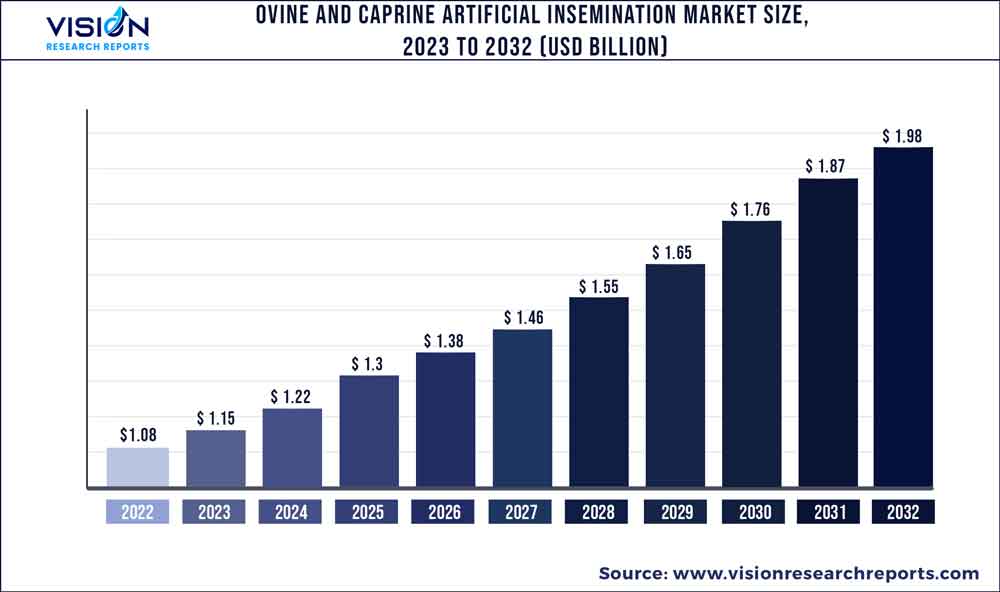
Key Pointers
Report Scope of the Ovine And Caprine Artificial Insemination Market
| Report Coverage | Details |
| Revenue Share of North America in 2022 | 25.06% |
| Revenue Forecast by 2032 | USD 1.98 billion |
| Growth Rate from 2023 to 2032 | CAGR of 6.26% |
| Base Year | 2022 |
| Forecast Period | 2023 to 2032 |
| Market Analysis (Terms Used) | Value (US$ Million/Billion) or (Volume/Units) |
| Companies Covered | IMV Technologies; Zoetis; Agtech, Inc.; B&D Genetics; SEK Genetics; Neogen Corporation; Jorgensen Laboratories; Continental Genetics, LLC; Nasco; MINITÜB GMBH |
The increasing demand for ovine/caprine meat & dairy products, advancements in sheep & goat reproduction technology, the need for sustainable food production, and supportive initiatives by private & public sectors are key factors responsible for the market growth. In addition, growing awareness about the benefits of ovine & caprine artificial insemination is another factor fueling the growth.
Artificial insemination provides several benefits to goat or sheep producers by enabling unlimited breeding selection. The procedure allows breeders/producers to get desired seminal fluid from sires located in various geographies with superior genetics. Moreover, AI (Artificial Insemination) in ovine & caprine prevents the spread of contagious ruminant diseases that are mostly transmitted through sexual contact. As the seminal fluid of the donating animal is thoroughly tested and the procedure itself is done without actual physical contact, it largely minimizes the risk of diseases.
The COVID-19 pandemic of 2020-21 and macroeconomic headwinds of 2022-23 had a notable impact on the market with supply chain challenges, dampened growth rate, reduced sales & marketing activities, etc. However, the market is expected to grow notably during the forecast period as the underlying drivers continue to fuel the market growth. Ovine & Caprine artificial insemination & seminal fluid collection companies faced significant supply chain challenges owing to the increased animal welfare issues, zoonotic measures, and state & nationwide lockdowns. However, several animal husbandries continued their AI (Artificial Insemination) activities of collecting, preparing, and storing normal & sexed seminal fluid during the period.
Artificial insemination in ovine & caprine species facilitates producers to breed more often than natural breeding. It allows farmers to inseminate several ewes or doe (female animals) with semen collected from a single ram or buck (male animals). This way, the farmers can reduce the time and cost of the breeding process. Artificial insemination also enables sheep & goat producers to keep accurate records of the genetics and performance of their herds. This information can be used to make more informed breeding decisions and improve the productivity of the herd over time.
Solution Insights
In 2022, the services segment generated the largest revenue with about 42.03% share in the ovine & caprine artificial insemination market. In developing countries, AI activities have gained greater attention in serving as a successful tool for genetic improvement in ovine & caprine species. An article published by the National Library of Medicine in 2019 states that over 500,000 sheep in Australia, more than 60,000 sheep in Spain, about 50,000 sheep in Canada, and over 300,000 sheep in America have been successfully inseminated each year. The number of inseminated animals is significantly growing in small-scale production units owing to the rising awareness among breeders of AI services.
The semen segment by solution in the ovine & caprine artificial insemination industry is growing at the fastest CAGR of 6.62% over the forecast period. According to TNAU, there are three methods approved for semen collection from male caprine & ovine animals: vaginal method, electro-ejaculation, and artificial vagina method. The growing number of government-approved semen collection centers for domestic animals like ovine & caprine is boosting the growth of the segment. For instance, on 16th March 2023, the UK government updated its list from five to six authorized ovine & caprine semen collection centers available in the country.
Procedure Insights
The intrauterine procedure segment dominated the market with over 60.04% share in 2022. Laparoscopic artificial insemination is an invasive intrauterine procedure that offers the maximum conception rate of up to 90% in ovine & caprine species. This procedure involves the direct deposit of semen into the uterus through an abdominal incision, thereby resulting in satisfactory animal pregnancy rates. As per the Sustainable Agriculture Research and Education Organization, in developed countries like the U.S., intrauterine laparoscopic AI is commonly performed to breed sheep and goats.
Following the intrauterine method, the other procedures, such as cervical and vaginal methods, are significantly considered to inseminate ovine & caprine. Cervical & transcervical methods involve mild restraint to limit the movement of an animal to access the insemination sight easily. Post-cleaning the vulvar region with the aid of a suitable illumination tool, the cervix is located to inject seminal fluid as deeply as possible for a higher conception rate of up to 60%. Owing to its significant pregnancy rate and growing usage because of comparatively lesser cost than laparoscopic, the cervical segment is growing at the fastest CAGR of 7.04% over the forecast period.
Sector Insights
The meat sector segment held the dominant share of over 40.1% in 2022. This substantial share is due to the large production and trading of sheep & goats for the meat sector worldwide. In countries such as the U.S., China, and India, sheep are mainly produced through AI for meat & wool purposes. In major markets like the U.S., meat production is considered to be the profit center for ovine breeding. Globally, around 1.5 billion ovine & caprine provides meat & milk yearly, as per the United States Department of Agriculture. As per the same source, around 574 million sheep & 479 million goats are slaughtered each year.
The dairy segment is anticipated to grow at the fastest CAGR of 6.72% over the projected timeline. The dairy sheep industry is concentrated largely in European countries, followed by developing Asian countries. Dairy goats produce approximately 50% more milk than the dairy sheep population. According to the USDA, about 21% of the world’s dairy products come from goats and sheep, with 1.3% to 1.9% of global milk production comes from ovine & caprine. As per the Indian Department of Animal Husbandry & Dairying, artificial insemination is largely benefitting the dairy ovine & caprine units by controlling or preventing venereal diseases possible through natural breeding.
Animal Type Insights
The ovine/sheep segment dominated the market with a share of over 55.07% in 2022, owing to the large adoption of AI among the population. According to the OIE (World Organization for Animal Health) database, the global sheep population has increased from 1.21 billion in 2017 to 1.29 billion in 2021. The same source indicates that the global goat population grew from 1.05 billion to 1.11 billion from 2017 to 2021. Moreover, artificial insemination in sheep is more intensively used in Western Europe to increase the number of inseminated ewes in the countries.
The goat segment is growing at the fastest CAGR of 6.61% over the forecast period. Dairy goats are largely inseminated in developing countries such as India, China, Southeast Asian countries, and Middle East African countries. As per an article published in the National Library of Medicine, the conception rate of artificially inseminated goats was 70%. Therefore, AI is widely preferred among goat producers as it enables the dissemination of required genetic traits and prevents sexually transmitted diseases.
Distribution Channel Insights
The private segment held the dominant market share of over 62.02% by the distribution channel in 2022. This is owing to a growing number of private sectors offering cost-effective insemination services and semen collection & storage facilities for ovine & caprine. These centers are very crucial for ovine & caprine artificial insemination as they provide various AI procedures from technically skilled laborers with a range of normal/sexed semen of different geographies. In addition, growing awareness among goat/sheep breeders to adopt AI for a satisfactory production rate is boosting segment growth.
The private distribution channel is also anticipated to grow at the fastest CAGR of 6.44% over the forecast period. On the other side, the public segment holds a significant share owing to the large support provided by local & state governments of developing countries to inseminate sheep/goats. India, for example, has several state governments that offer supportive programs to inseminate ovine & caprine species. Similarly, European Union launched a project on November 2022 to train AI activities in ovine & caprine to aid breeders/producers.
Regional Insights
North America held more than a 25.06% share of the ovine & caprine artificial insemination market in 2022. The significant availability & usage of artificial insemination techniques, well-equipped & advanced animal husbandry industries, presence of key players in the market, and growing awareness of AI among ovine & caprine producers are some of the factors contributing to the North American market growth. As per TNAU, Government of India, the AI breeding of sheep has made commendable achievements as of late in the U.S. with the main objective of using superior sires against low-performing female animals.
The Europe region holds the second-largest share of the market, closely following North America. This is owing to the large adoption of ovine AI in eastern & central European countries. On the other side, the Asia Pacific region is estimated to grow at the fastest CAGR of 7% in the projected timeline. This is attributable to the large sheep & goat population, increasing disposable income & animal breeding expenditure in key markets, and growing awareness about various sheep/goat AI services in developing countries.
Ovine And Caprine Artificial Insemination Market Segmentations:
By Solution
By Procedure
By Sector
By Animal Type
By Distribution Channel
By Regional
Chapter 1. Introduction
1.1. Research Objective
1.2. Scope of the Study
1.3. Definition
Chapter 2. Research Methodology
2.1. Research Approach
2.2. Data Sources
2.3. Assumptions & Limitations
Chapter 3. Executive Summary
3.1. Market Snapshot
Chapter 4. Market Variables and Scope
4.1. Introduction
4.2. Market Classification and Scope
4.3. Industry Value Chain Analysis
4.3.1. Raw Material Procurement Analysis
4.3.2. Sales and Distribution Channel Analysis
4.3.3. Downstream Buyer Analysis
Chapter 5. COVID 19 Impact on Ovine And Caprine Artificial Insemination Market
5.1. COVID-19 Landscape: Ovine And Caprine Artificial Insemination Industry Impact
5.2. COVID 19 - Impact Assessment for the Industry
5.3. COVID 19 Impact: Global Major Government Policy
5.4. Market Trends and Opportunities in the COVID-19 Landscape
Chapter 6. Market Dynamics Analysis and Trends
6.1. Market Dynamics
6.1.1. Market Drivers
6.1.2. Market Restraints
6.1.3. Market Opportunities
6.2. Porter’s Five Forces Analysis
6.2.1. Bargaining power of suppliers
6.2.2. Bargaining power of buyers
6.2.3. Threat of substitute
6.2.4. Threat of new entrants
6.2.5. Degree of competition
Chapter 7. Competitive Landscape
7.1.1. Company Market Share/Positioning Analysis
7.1.2. Key Strategies Adopted by Players
7.1.3. Vendor Landscape
7.1.3.1. List of Suppliers
7.1.3.2. List of Buyers
Chapter 8. Global Ovine And Caprine Artificial Insemination Market, By Solution
8.1. Ovine And Caprine Artificial Insemination Market, by Solution, 2023-2032
8.1.1. Equipment & Consumables
8.1.1.1. Market Revenue and Forecast (2020-2032)
8.1.2. Semen
8.1.2.1. Market Revenue and Forecast (2020-2032)
8.1.3. Services
8.1.3.1. Market Revenue and Forecast (2020-2032)
Chapter 9. Global Ovine And Caprine Artificial Insemination Market, By Procedure
9.1. Ovine And Caprine Artificial Insemination Market, by Procedure, 2023-2032
9.1.1. Intrauterine
9.1.1.1. Market Revenue and Forecast (2020-2032)
9.1.2. Vaginal
9.1.2.1. Market Revenue and Forecast (2020-2032)
9.1.3. Cervical
9.1.3.1. Market Revenue and Forecast (2020-2032)
Chapter 10. Global Ovine And Caprine Artificial Insemination Market, By Sector
10.1. Ovine And Caprine Artificial Insemination Market, by Sector, 2023-2032
10.1.1. Meat
10.1.1.1. Market Revenue and Forecast (2020-2032)
10.1.2. Dairy
10.1.2.1. Market Revenue and Forecast (2020-2032)
10.1.3. Others
10.1.3.1. Market Revenue and Forecast (2020-2032)
Chapter 11. Global Ovine And Caprine Artificial Insemination Market, By Animal Type
11.1. Ovine And Caprine Artificial Insemination Market, by Animal Type, 2023-2032
11.1.1. Ovine/Sheep
11.1.1.1. Market Revenue and Forecast (2020-2032)
11.1.2. Caprine/Goat
11.1.2.1. Market Revenue and Forecast (2020-2032)
Chapter 12. Global Ovine And Caprine Artificial Insemination Market, By Distribution Channel
12.1. Ovine And Caprine Artificial Insemination Market, by Distribution Channel, 2023-2032
12.1.1. Private
12.1.1.1. Market Revenue and Forecast (2020-2032)
12.1.2. Public
12.1.2.1. Market Revenue and Forecast (2020-2032)
Chapter 13. Global Ovine And Caprine Artificial Insemination Market, Regional Estimates and Trend Forecast
13.1. North America
13.1.1. Market Revenue and Forecast, by Solution (2020-2032)
13.1.2. Market Revenue and Forecast, by Procedure (2020-2032)
13.1.3. Market Revenue and Forecast, by Sector (2020-2032)
13.1.4. Market Revenue and Forecast, by Animal Type (2020-2032)
13.1.5. Market Revenue and Forecast, by Distribution Channel (2020-2032)
13.1.6. U.S.
13.1.6.1. Market Revenue and Forecast, by Solution (2020-2032)
13.1.6.2. Market Revenue and Forecast, by Procedure (2020-2032)
13.1.6.3. Market Revenue and Forecast, by Sector (2020-2032)
13.1.6.4. Market Revenue and Forecast, by Animal Type (2020-2032)
13.1.7. Market Revenue and Forecast, by Distribution Channel (2020-2032)
13.1.8. Rest of North America
13.1.8.1. Market Revenue and Forecast, by Solution (2020-2032)
13.1.8.2. Market Revenue and Forecast, by Procedure (2020-2032)
13.1.8.3. Market Revenue and Forecast, by Sector (2020-2032)
13.1.8.4. Market Revenue and Forecast, by Animal Type (2020-2032)
13.1.8.5. Market Revenue and Forecast, by Distribution Channel (2020-2032)
13.2. Europe
13.2.1. Market Revenue and Forecast, by Solution (2020-2032)
13.2.2. Market Revenue and Forecast, by Procedure (2020-2032)
13.2.3. Market Revenue and Forecast, by Sector (2020-2032)
13.2.4. Market Revenue and Forecast, by Animal Type (2020-2032)
13.2.5. Market Revenue and Forecast, by Distribution Channel (2020-2032)
13.2.6. UK
13.2.6.1. Market Revenue and Forecast, by Solution (2020-2032)
13.2.6.2. Market Revenue and Forecast, by Procedure (2020-2032)
13.2.6.3. Market Revenue and Forecast, by Sector (2020-2032)
13.2.7. Market Revenue and Forecast, by Animal Type (2020-2032)
13.2.8. Market Revenue and Forecast, by Distribution Channel (2020-2032)
13.2.9. Germany
13.2.9.1. Market Revenue and Forecast, by Solution (2020-2032)
13.2.9.2. Market Revenue and Forecast, by Procedure (2020-2032)
13.2.9.3. Market Revenue and Forecast, by Sector (2020-2032)
13.2.10. Market Revenue and Forecast, by Animal Type (2020-2032)
13.2.11. Market Revenue and Forecast, by Distribution Channel (2020-2032)
13.2.12. France
13.2.12.1. Market Revenue and Forecast, by Solution (2020-2032)
13.2.12.2. Market Revenue and Forecast, by Procedure (2020-2032)
13.2.12.3. Market Revenue and Forecast, by Sector (2020-2032)
13.2.12.4. Market Revenue and Forecast, by Animal Type (2020-2032)
13.2.13. Market Revenue and Forecast, by Distribution Channel (2020-2032)
13.2.14. Rest of Europe
13.2.14.1. Market Revenue and Forecast, by Solution (2020-2032)
13.2.14.2. Market Revenue and Forecast, by Procedure (2020-2032)
13.2.14.3. Market Revenue and Forecast, by Sector (2020-2032)
13.2.14.4. Market Revenue and Forecast, by Animal Type (2020-2032)
13.2.15. Market Revenue and Forecast, by Distribution Channel (2020-2032)
13.3. APAC
13.3.1. Market Revenue and Forecast, by Solution (2020-2032)
13.3.2. Market Revenue and Forecast, by Procedure (2020-2032)
13.3.3. Market Revenue and Forecast, by Sector (2020-2032)
13.3.4. Market Revenue and Forecast, by Animal Type (2020-2032)
13.3.5. Market Revenue and Forecast, by Distribution Channel (2020-2032)
13.3.6. India
13.3.6.1. Market Revenue and Forecast, by Solution (2020-2032)
13.3.6.2. Market Revenue and Forecast, by Procedure (2020-2032)
13.3.6.3. Market Revenue and Forecast, by Sector (2020-2032)
13.3.6.4. Market Revenue and Forecast, by Animal Type (2020-2032)
13.3.7. Market Revenue and Forecast, by Distribution Channel (2020-2032)
13.3.8. China
13.3.8.1. Market Revenue and Forecast, by Solution (2020-2032)
13.3.8.2. Market Revenue and Forecast, by Procedure (2020-2032)
13.3.8.3. Market Revenue and Forecast, by Sector (2020-2032)
13.3.8.4. Market Revenue and Forecast, by Animal Type (2020-2032)
13.3.9. Market Revenue and Forecast, by Distribution Channel (2020-2032)
13.3.10. Japan
13.3.10.1. Market Revenue and Forecast, by Solution (2020-2032)
13.3.10.2. Market Revenue and Forecast, by Procedure (2020-2032)
13.3.10.3. Market Revenue and Forecast, by Sector (2020-2032)
13.3.10.4. Market Revenue and Forecast, by Animal Type (2020-2032)
13.3.10.5. Market Revenue and Forecast, by Distribution Channel (2020-2032)
13.3.11. Rest of APAC
13.3.11.1. Market Revenue and Forecast, by Solution (2020-2032)
13.3.11.2. Market Revenue and Forecast, by Procedure (2020-2032)
13.3.11.3. Market Revenue and Forecast, by Sector (2020-2032)
13.3.11.4. Market Revenue and Forecast, by Animal Type (2020-2032)
13.3.11.5. Market Revenue and Forecast, by Distribution Channel (2020-2032)
13.4. MEA
13.4.1. Market Revenue and Forecast, by Solution (2020-2032)
13.4.2. Market Revenue and Forecast, by Procedure (2020-2032)
13.4.3. Market Revenue and Forecast, by Sector (2020-2032)
13.4.4. Market Revenue and Forecast, by Animal Type (2020-2032)
13.4.5. Market Revenue and Forecast, by Distribution Channel (2020-2032)
13.4.6. GCC
13.4.6.1. Market Revenue and Forecast, by Solution (2020-2032)
13.4.6.2. Market Revenue and Forecast, by Procedure (2020-2032)
13.4.6.3. Market Revenue and Forecast, by Sector (2020-2032)
13.4.6.4. Market Revenue and Forecast, by Animal Type (2020-2032)
13.4.7. Market Revenue and Forecast, by Distribution Channel (2020-2032)
13.4.8. North Africa
13.4.8.1. Market Revenue and Forecast, by Solution (2020-2032)
13.4.8.2. Market Revenue and Forecast, by Procedure (2020-2032)
13.4.8.3. Market Revenue and Forecast, by Sector (2020-2032)
13.4.8.4. Market Revenue and Forecast, by Animal Type (2020-2032)
13.4.9. Market Revenue and Forecast, by Distribution Channel (2020-2032)
13.4.10. South Africa
13.4.10.1. Market Revenue and Forecast, by Solution (2020-2032)
13.4.10.2. Market Revenue and Forecast, by Procedure (2020-2032)
13.4.10.3. Market Revenue and Forecast, by Sector (2020-2032)
13.4.10.4. Market Revenue and Forecast, by Animal Type (2020-2032)
13.4.10.5. Market Revenue and Forecast, by Distribution Channel (2020-2032)
13.4.11. Rest of MEA
13.4.11.1. Market Revenue and Forecast, by Solution (2020-2032)
13.4.11.2. Market Revenue and Forecast, by Procedure (2020-2032)
13.4.11.3. Market Revenue and Forecast, by Sector (2020-2032)
13.4.11.4. Market Revenue and Forecast, by Animal Type (2020-2032)
13.4.11.5. Market Revenue and Forecast, by Distribution Channel (2020-2032)
13.5. Latin America
13.5.1. Market Revenue and Forecast, by Solution (2020-2032)
13.5.2. Market Revenue and Forecast, by Procedure (2020-2032)
13.5.3. Market Revenue and Forecast, by Sector (2020-2032)
13.5.4. Market Revenue and Forecast, by Animal Type (2020-2032)
13.5.5. Market Revenue and Forecast, by Distribution Channel (2020-2032)
13.5.6. Brazil
13.5.6.1. Market Revenue and Forecast, by Solution (2020-2032)
13.5.6.2. Market Revenue and Forecast, by Procedure (2020-2032)
13.5.6.3. Market Revenue and Forecast, by Sector (2020-2032)
13.5.6.4. Market Revenue and Forecast, by Animal Type (2020-2032)
13.5.7. Market Revenue and Forecast, by Distribution Channel (2020-2032)
13.5.8. Rest of LATAM
13.5.8.1. Market Revenue and Forecast, by Solution (2020-2032)
13.5.8.2. Market Revenue and Forecast, by Procedure (2020-2032)
13.5.8.3. Market Revenue and Forecast, by Sector (2020-2032)
13.5.8.4. Market Revenue and Forecast, by Animal Type (2020-2032)
13.5.8.5. Market Revenue and Forecast, by Distribution Channel (2020-2032)
Chapter 14. Company Profiles
14.1. IMV Technologies
14.1.1. Company Overview
14.1.2. Product Offerings
14.1.3. Financial Performance
14.1.4. Recent Initiatives
14.2. Zoetis
14.2.1. Company Overview
14.2.2. Product Offerings
14.2.3. Financial Performance
14.2.4. Recent Initiatives
14.3. Agtech, Inc.
14.3.1. Company Overview
14.3.2. Product Offerings
14.3.3. Financial Performance
14.3.4. Recent Initiatives
14.4. B&D Genetics
14.4.1. Company Overview
14.4.2. Product Offerings
14.4.3. Financial Performance
14.4.4. Recent Initiatives
14.5. SEK Genetics
14.5.1. Company Overview
14.5.2. Product Offerings
14.5.3. Financial Performance
14.5.4. Recent Initiatives
14.6. Neogen Corporation
14.6.1. Company Overview
14.6.2. Product Offerings
14.6.3. Financial Performance
14.6.4. Recent Initiatives
14.7. Jorgensen Laboratories
14.7.1. Company Overview
14.7.2. Product Offerings
14.7.3. Financial Performance
14.7.4. Recent Initiatives
14.8. Continental Genetics, LLC
14.8.1. Company Overview
14.8.2. Product Offerings
14.8.3. Financial Performance
14.8.4. Recent Initiatives
14.9. Nasco
14.9.1. Company Overview
14.9.2. Product Offerings
14.9.3. Financial Performance
14.9.4. Recent Initiatives
14.10. MINITÜB GMBH
14.10.1. Company Overview
14.10.2. Product Offerings
14.10.3. Financial Performance
14.10.4. Recent Initiatives
Chapter 15. Research Methodology
15.1. Primary Research
15.2. Secondary Research
15.3. Assumptions
Chapter 16. Appendix
16.1. About Us
16.2. Glossary of Terms
 Cross-segment Market Size and Analysis for
Mentioned Segments
Additional Company Profiles (Upto 5 With No Cost)
Additional Countries (Apart From Mentioned Countries)
Country/Region-specific Report
Go To Market Strategy
Region Specific Market DynamicsRegion Level Market Share Import Export AnalysisProduction AnalysisOthers
Cross-segment Market Size and Analysis for
Mentioned Segments
Additional Company Profiles (Upto 5 With No Cost)
Additional Countries (Apart From Mentioned Countries)
Country/Region-specific Report
Go To Market Strategy
Region Specific Market DynamicsRegion Level Market Share Import Export AnalysisProduction AnalysisOthers