
Polyethylene Terephthalate Additives Market Size, Trends, Share, Growth | Report 2022-2030
The global polyethylene terephthalate additives market was surpassed at USD 1.3 billion in 2021 and is expected to hit around USD 2.48 billion by 2030, growing at a CAGR of 7.44% from 2022 to 2030.
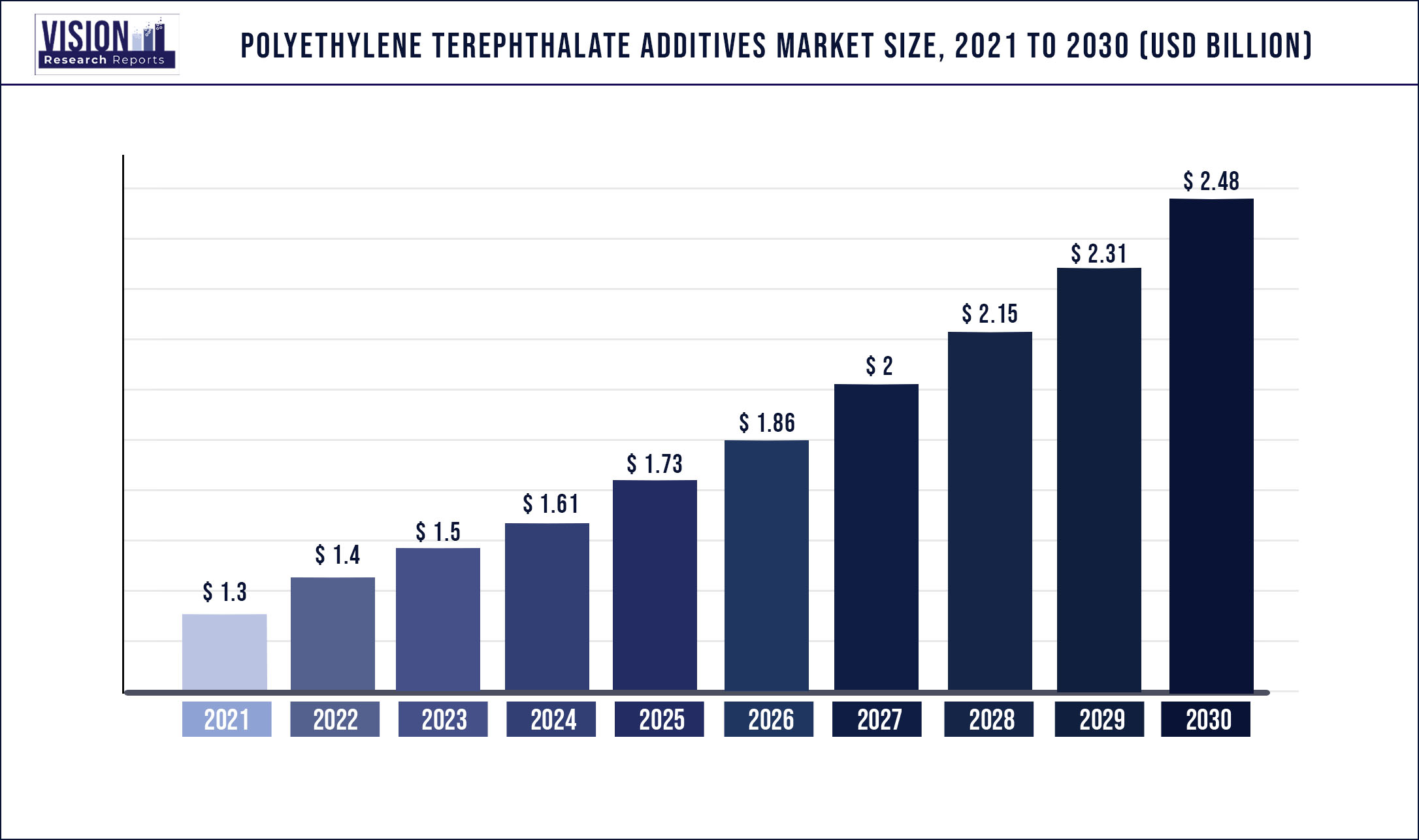
Report Highlights
The market is anticipated to grow due to the rising application scope in the packaging, medical, and automotive industries. Polyethylene terephthalate (PET) additives offer enhanced chemical resistance and shatterproof attributes and thus, are widely used across the packaging industry. The demand for colored plastics is increasing swiftly led by the growth in the packaging industry. The global packaging industry is witnessing significant growth, driven by the consolidated development of sub-segments, such as food, industrial, retail, consumer, and medical packaging.
Changing consumer lifestyles have resulted in high demand for Ready-To-Eat (RTE) foods. Governments across the globe are encouraging the use of recycled plastic material in single-use plastic products as a move towards a circular economy. The European Union already has implemented regulation (EC) No 282/2008 designed explicitly for PET recycling processes. However, due to a few shortcomings in the existing regulation, the EU is drafting a new rule that can drive the demand for PET bottle recycling, thus creating a growth opportunity for chain extender additives for PET. The recycled PET often encounters yellowish brown effect due to increased recycled content loading.
The yellowish effect discourages the consumers from purchasing the recycled PET bottles. The optical brightener additive reduces the yellowish effect and helps the HBA, food, condiments and beverage packaging companies in correcting the package color to offer a clear look. Ultraviolet (UV) light barrier held the largest market share among the function segment in 2021. Light passing through a packaged material may catalyze an oxidation reaction in a photosensitive product and reduce its shelf life. Also, light promotes the decomposition of nutrients in food through the formation of various chemicals, thus causing discoloration, off-flavor, and others.
UV blocking is used to prevent food quality deterioration and maintain its shelf life. This is expected to boost the demand for UV light barriers during the forecast period. The presence of several global companies including LyondellBasell Industries Holdings B.V., Avient Corp., and Sukano AG is expected to trigger competition. Pricing is the key to achieving sustainability for market participants, which has resulted in extensive R&D activities to develop cost-effective PET additives with wider acceptability, in terms of regulations. Therefore, rivalry in the global industry is expected to remain high during the forecast period.
Scope of The Report
| Report Coverage | Details |
| Market Size in 2021 | USD 1.3 billion |
| Revenue Forecast by 2030 | USD 2.48 billion |
| Growth rate from 2022 to 2030 | CAGR of 7.44% |
| Base Year | 2021 |
| Forecast Period | 2022 to 2030 |
| Segmentation | Function, region |
| Companies Covered |
LyondellBasell Industries Holdings B.V.; Spearepet Pvt. Ltd.; Gabriel-Chemie; NYACOL Nano Technologies Inc.; Capital Colors; Sukano AG; Avient Corporation Yildiz Kolor; Holland Colours; PLASTIKA KRITIS SA; Milliken & Company |
Function Insights
The ultraviolet light barrier function segment dominated the global market in 2021 and accounted for more than 20.12% overall revenue share. If light passes through a packaged material, it may catalyze an oxidation reaction in a photosensitive product and reduce its shelf life. Light promotes the decomposition of nutrients in food through the formation of various chemicals, thus, causing off-flavor, discoloration, and others. Ultraviolet (UV) blocking is used to prevent food quality deterioration and maintain its shelf life. This is expected to boost the demand for ultraviolet light barriers during the forecast period.
Furthermore, these films provide transparency, which enables consumers to catch sight of the product. Anti-blocking is a measure to prevent film sheets from sticking together. The higher the temperature and processing time, the higher the tendency of film sheets to stick together. Anti-blocking additives reduce the blocking at the surface of films and allow easy handling & processing of plastic articles. Anti-block PET is ideal for use in sheets, films, plates, and others, which provides an optimal anti-blocking effect during the extrusion process and avoids problems during processing.
This is expected to drive the demand for anti-block additives during the forecast period. Antiviral PET additives have excellent antiviral effects and are used to treat plastic items to trap and reduce the growth of viruses. This is useful to produce better Personal Protective Equipment (PPE) especially face masks. This makes the facemasks reusable and reduces the waste, which is produced in the case of disposable masks. Antiviral additives are also used in medical devices, gloves, door handles, light switches, and also in packaging solutions.
Regional Insights
The Asia Pacific dominated the global market in 2021 and accounted for the maximum share of more than 40.03% of the global revenue. The demand for (PET) additives in the Asia Pacific is growing because of its increasing consumption in end-use industries, such as packaging, building & construction, automotive, agriculture, and consumer goods. Due to rising disposable income and economically viable vehicle models made available by local companies, the automobile market in the Asia Pacific region has also been responsible for growing product demand. In November 2021, Japan-based Polyplastics Co., Ltd. introduced PET grades for automotive applications that provide good weather resistance for exterior components of automobiles and superior mechanical properties.
Since PET parts are not painted, weathering degradation can occur over time. Hence, the improved grades of PET indicate the use of PET additives, which further supports the market growth. The growing population and rapid urbanization are creating more demand for housing facilities in the Asia-Pacific, which is expected to influence the consumption of PET additives in building & construction applications during the forecast period. These additives can delay the fire ignition and spread, which increases the escape time, making them a critical part of plastic products. Moreover, no plastic is entirely fireproof; these additives can delay fire ignition and avoid major mishaps, which is expected to drive the demand for flame-resistant additives during the forecast period.
In Europe, the growing concerns about reducing Greenhouse Gas(GHG) emissions and vehicle weight are expected to drive the demand for plastic components. Growing demand for contamination-free packaging of innovative & attractively packaged food items, and rising sales of lightweight vehicles due to the implementation of stringent emission standards will support market growth. PET additives provide color and durability to bioplastics and government support for their development is likely to raise the demand for PET additives in Europe over the forecast period.
Key Players
Market Segmentation
Chapter 1. Introduction
1.1.Research Objective
1.2.Scope of the Study
1.3.Definition
Chapter 2. Research Methodology
2.1.Research Approach
2.2.Data Sources
2.3.Assumptions & Limitations
Chapter 3. Executive Summary
3.1.Market Snapshot
Chapter 4. Market Variables and Scope
4.1.Introduction
4.2.Market Classification and Scope
4.3.Industry Value Chain Analysis
4.3.1. Raw Material Procurement Analysis
4.3.2. Sales and Distribution Channel Analysis
4.3.3. Downstream Buyer Analysis
Chapter 5.COVID 19 Impact on Polyethylene Terephthalate Additives Market
5.1. COVID-19 Landscape: Polyethylene Terephthalate Additives Industry Impact
5.2. COVID 19 - Impact Assessment for the Industry
5.3. COVID 19 Impact: Global Major Government Policy
5.4.Market Trends and Opportunities in the COVID-19 Landscape
Chapter 6. Market Dynamics Analysis and Trends
6.1.Market Dynamics
6.1.1. Market Drivers
6.1.2. Market Restraints
6.1.3. Market Opportunities
6.2.Porter’s Five Forces Analysis
6.2.1. Bargaining power of suppliers
6.2.2. Bargaining power of buyers
6.2.3. Threat of substitute
6.2.4. Threat of new entrants
6.2.5. Degree of competition
Chapter 7. Competitive Landscape
7.1.1. Company Market Share/Positioning Analysis
7.1.2. Key Strategies Adopted by Players
7.1.3. Vendor Landscape
7.1.3.1.List of Suppliers
7.1.3.2.List of Buyers
Chapter 8. Global Polyethylene Terephthalate Additives Market, By Function
8.1.Polyethylene Terephthalate Additives Market, by Function Type, 2020-2030
8.1.1. Color Addition
8.1.1.1.Market Revenue and Forecast (2017-2030)
8.1.2. Antiblock
8.1.2.1.Market Revenue and Forecast (2017-2030)
8.1.3. Antistatic
8.1.3.1.Market Revenue and Forecast (2017-2030)
8.1.4. Ultraviolet Light Barrier
8.1.4.1.Market Revenue and Forecast (2017-2030)
8.1.5. Oxygen Scavenging
8.1.5.1.Market Revenue and Forecast (2017-2030)
8.1.6. Acetaldehyde Scavenging
8.1.6.1.Market Revenue and Forecast (2017-2030)
8.1.7. Flame Resistance
8.1.7.1.Market Revenue and Forecast (2017-2030)
8.1.8. Chain Extender
8.1.8.1.Market Revenue and Forecast (2017-2030)
8.1.9. Odor Scavenger
8.1.9.1.Market Revenue and Forecast (2017-2030)
8.1.10.Reheat
8.1.10.1. Market Revenue and Forecast (2017-2030)
8.1.11.Other
8.1.11.1. Market Revenue and Forecast (2017-2030)
Chapter 9. Global Polyethylene Terephthalate Additives Market, Regional Estimates and Trend Forecast
9.1. North America
9.1.1. Market Revenue and Forecast, by Type (2017-2030)
9.1.2. Market Revenue and Forecast, by End-use (2017-2030)
9.1.3. U.S.
9.1.3.1. Market Revenue and Forecast, by Type (2017-2030)
9.1.3.2. Market Revenue and Forecast, by End-use (2017-2030)
9.1.4. Rest of North America
9.1.4.1. Market Revenue and Forecast, by Type (2017-2030)
9.1.4.2. Market Revenue and Forecast, by End-use (2017-2030)
9.2. Europe
9.2.1. Market Revenue and Forecast, by Type (2017-2030)
9.2.2. Market Revenue and Forecast, by End-use (2017-2030)
9.2.3. UK
9.2.3.1. Market Revenue and Forecast, by Type (2017-2030)
9.2.3.2. Market Revenue and Forecast, by End-use (2017-2030)
9.2.4. Germany
9.2.4.1. Market Revenue and Forecast, by Type (2017-2030)
9.2.4.2. Market Revenue and Forecast, by End-use (2017-2030)
9.2.5. France
9.2.5.1. Market Revenue and Forecast, by Type (2017-2030)
9.2.5.2. Market Revenue and Forecast, by End-use (2017-2030)
9.2.6. Rest of Europe
9.2.6.1. Market Revenue and Forecast, by Type (2017-2030)
9.2.6.2. Market Revenue and Forecast, by End-use (2017-2030)
9.3. APAC
9.3.1. Market Revenue and Forecast, by Type (2017-2030)
9.3.2. Market Revenue and Forecast, by End-use (2017-2030)
9.3.3. India
9.3.3.1. Market Revenue and Forecast, by Type (2017-2030)
9.3.3.2. Market Revenue and Forecast, by End-use (2017-2030)
9.3.4. China
9.3.4.1. Market Revenue and Forecast, by Type (2017-2030)
9.3.4.2. Market Revenue and Forecast, by End-use (2017-2030)
9.3.5. Japan
9.3.5.1. Market Revenue and Forecast, by Type (2017-2030)
9.3.5.2. Market Revenue and Forecast, by End-use (2017-2030)
9.3.6. Rest of APAC
9.3.6.1. Market Revenue and Forecast, by Type (2017-2030)
9.3.6.2. Market Revenue and Forecast, by End-use (2017-2030)
9.4. MEA
9.4.1. Market Revenue and Forecast, by Type (2017-2030)
9.4.2. Market Revenue and Forecast, by End-use (2017-2030)
9.4.3. GCC
9.4.3.1. Market Revenue and Forecast, by Type (2017-2030)
9.4.3.2. Market Revenue and Forecast, by End-use (2017-2030)
9.4.4. North Africa
9.4.4.1. Market Revenue and Forecast, by Type (2017-2030)
9.4.4.2. Market Revenue and Forecast, by End-use (2017-2030)
9.4.5. South Africa
9.4.5.1. Market Revenue and Forecast, by Type (2017-2030)
9.4.5.2. Market Revenue and Forecast, by End-use (2017-2030)
9.4.6. Rest of MEA
9.4.6.1. Market Revenue and Forecast, by Type (2017-2030)
9.4.6.2. Market Revenue and Forecast, by End-use (2017-2030)
9.5. Latin America
9.5.1. Market Revenue and Forecast, by Type (2017-2030)
9.5.2. Market Revenue and Forecast, by End-use (2017-2030)
9.5.3. Brazil
9.5.3.1. Market Revenue and Forecast, by Type (2017-2030)
9.5.3.2. Market Revenue and Forecast, by End-use (2017-2030)
9.5.4. Rest of LATAM
9.5.4.1. Market Revenue and Forecast, by Type (2017-2030)
9.5.4.2. Market Revenue and Forecast, by End-use (2017-2030)
Chapter 10.Company Profiles
10.1.LyondellBasell Industries Holdings B.V.
10.1.1.Company Overview
10.1.2.Product Offerings
10.1.3.Financial Performance
10.1.4.Recent Initiatives
10.2.SPEAREPET PVT LTD
10.2.1.Company Overview
10.2.2.Product Offerings
10.2.3.Financial Performance
10.2.4.Recent Initiatives
10.3.Gabriel-Chemie
10.3.1.Company Overview
10.3.2.Product Offerings
10.3.3.Financial Performance
10.3.4.Recent Initiatives
10.4.NYACOL Nano Technologies, Inc.
10.4.1.Company Overview
10.4.2.Product Offerings
10.4.3.Financial Performance
10.4.4.Recent Initiatives
10.5.Capital Colors
10.5.1.Company Overview
10.5.2.Product Offerings
10.5.3.Financial Performance
10.5.4.Recent Initiatives
10.6.Sukano AG
10.6.1.Company Overview
10.6.2.Product Offerings
10.6.3.Financial Performance
10.6.4.Recent Initiatives
10.7.Avient Corp.
10.7.1.Company Overview
10.7.2.Product Offerings
10.7.3.Financial Performance
10.7.4.Recent Initiatives
10.8.Yildiz Kolor
10.8.1.Company Overview
10.8.2.Product Offerings
10.8.3.Financial Performance
10.8.4.Recent Initiatives
10.9.Holland Colours
10.9.1.Company Overview
10.9.2.Product Offerings
10.9.3.Financial Performance
10.9.4.Recent Initiatives
10.10.PLASTIKA KRITIS SA
10.10.1. Company Overview
10.10.2. Product Offerings
10.10.3. Financial Performance
10.10.4. Recent Initiatives
Chapter 11.Research Methodology
11.1.Primary Research
11.2.Secondary Research
11.3.Assumptions
Chapter 12.Appendix
12.1.About Us
12.2.Glossary of Terms
 Cross-segment Market Size and Analysis for
Mentioned Segments
Additional Company Profiles (Upto 5 With No Cost)
Additional Countries (Apart From Mentioned Countries)
Country/Region-specific Report
Go To Market Strategy
Region Specific Market DynamicsRegion Level Market Share Import Export AnalysisProduction AnalysisOthers
Cross-segment Market Size and Analysis for
Mentioned Segments
Additional Company Profiles (Upto 5 With No Cost)
Additional Countries (Apart From Mentioned Countries)
Country/Region-specific Report
Go To Market Strategy
Region Specific Market DynamicsRegion Level Market Share Import Export AnalysisProduction AnalysisOthers