
Postpartum Health Supplements Market Size, Share | Report 2022-2030
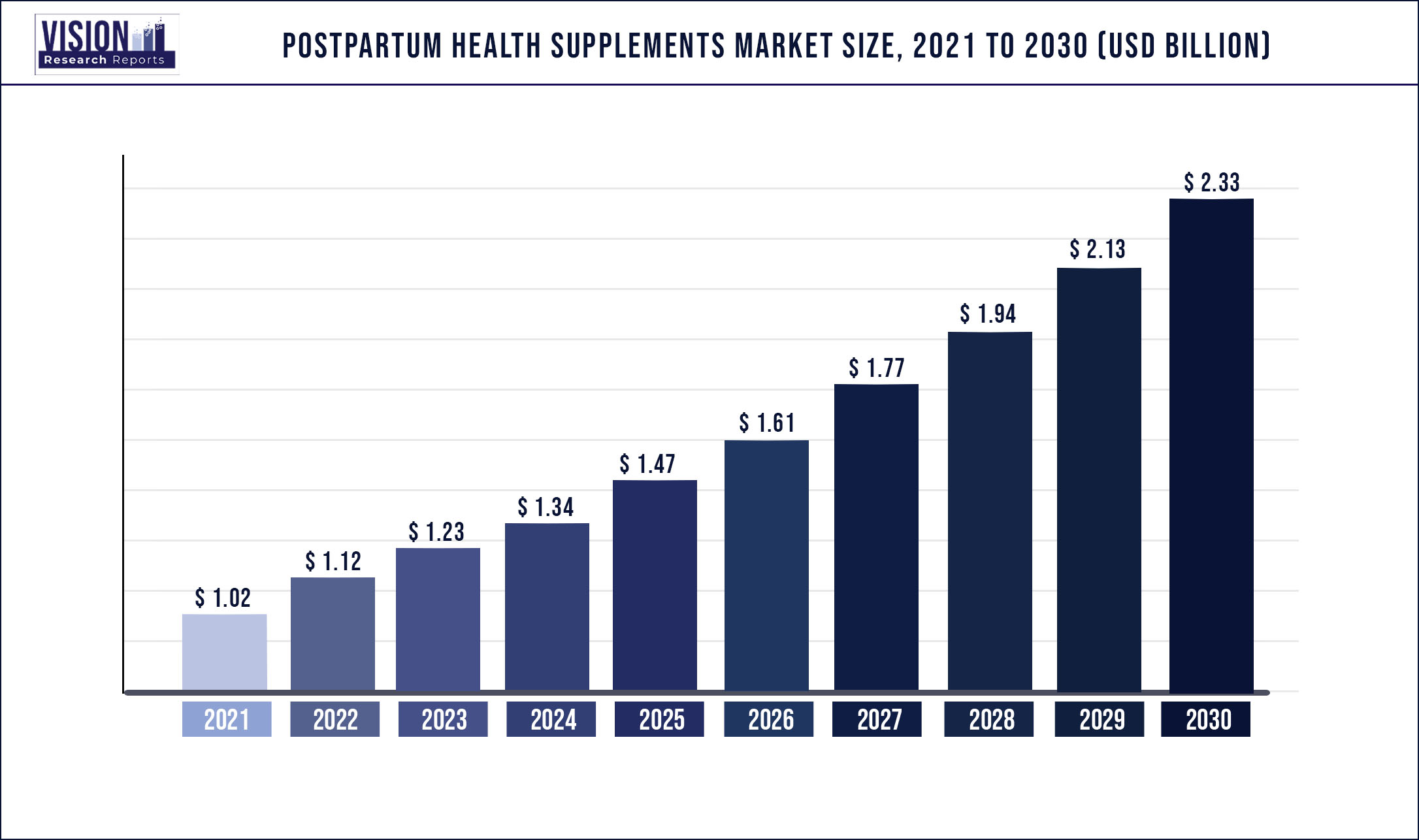
The global postpartum health supplements market was valued at USD 1.02 billion in 2021 and it is predicted to surpass around USD 2.33 billion by 2030 with a CAGR of 9.61% from 2022 to 2030.
Report Highlights
Increasing prevalence of postnatal depression is one of the major factors driving its growth. Postnatal depression approximately affects 10-15% of mothers. Also, it may have a detrimental effect on the cognitive and social well-being of infants, children, and spouses. This has raised awareness as well as demand for these products.
Active steps are being taken by public and private institutions to increase awareness about postnatal health among women. This is anticipated to drive demand for the products during the forecast period. For instance, WHO in March 2022, launched global guidelines that include recommendations to support newborns and women in the postnatal period such as treatment, advice, and backing to aid the recovery of women and manage common problems that women experience after childbirth. The guidelines also recommend checkups and screening for maternal anxiety and depression, this is anticipated to drive demand for postnatal health supplements during the forecast period.
In addition, the increasing number of working women and rising awareness of nutritional supplements is positively impacting the growth of the market. Furthermore, the increased digitalization and easy availability of these products on the online channel is adding fuel to the growth. Moreover, increasing urbanization has caused people to spend on health supplements, which are expected to drive the market during the forecast period. Also, dietitians and nutritionists recommending postnatal supplements to avoid various nutritional deficiencies are expected to impel the market growth throughout the forecast period.
Key players are involved in the development of new postnatal supplements. For instance, in March 2022, Purer Vita, a UK-based company launched the “PurerMama” range, a nutritional and wellness brand, which consists of products such as Pure Glow Superfood Collagen to help in postnatal recovery. Furthermore, the increasing investment by the key players, to meet the consumer demand, is fueling the growth.
Scope of The Report
| Report Coverage | Details |
| Market Size in 2021 | USD 1.02 billion |
| Revenue Forecast by 2030 | USD 2.33 billion |
| Growth rate from 2022 to 2030 | CAGR of 9.61% |
| Base Year | 2021 |
| Forecast Period | 2022 to 2030 |
| Segmentation | Product type, formulations, sales channel, region |
| Companies Covered |
New Chapter; Mama's Select; ACTIF USA; Nutrafol (Nutraceuticals Wellness Inc.); Anya; DSM; Pink Stork; Mommy’s Bliss Inc.; Church & Dwight Co.; Nordic Naturals |
Product Type Insights
By product type, combined nutritional supplements segment dominated the market with a 68.66% share in 2021. Combined nutritional supplements help to meet the overall nutritional requirements of the women and cure multiple conditions in women and also help in the healthy development of the baby. This is expected to increase the growth of the segment.
The segment is also anticipated to witness lucrative growth owing to rising R&D initiatives undertaken by the key players to introduce new products in the market. This is expected to drive the growth of the segment during the forecast period. For instance, Full Well Prenatal Multivitamin by Full well Fertility supports the nutritional requirements after delivery and breastfeeding. The supplements cover about 55.0% of the chlorine needs during breastfeeding and 4,000 IU of vitamin D per dose.
Formulations Insights
By formulations, the capsules/tablets segment held the largest share of 38.5% in 2021. Factors such as ease of consumption, faster relief, and breakdown than other formulation types are anticipated to support the growth of the segment during the forecast period. Moreover, the key players launching their products in the form of capsules/tablets further contributed to the revenue of the segment.
Softgel segment is anticipated to witness lucrative growth during the forecast period. Factors such as easy and fast digestion, increased bioavailability of poorly soluble nutrients such as vitamin B12, targeted dose, and longer shelf life of the capsules are anticipated to boost the growth of the segment. Also, the availability of a range of products in this segment is a key factor anticipated to drive the segment growth during the forecast period.
Sales Channel Insights
By sales channel, the pharmacies/drug stores segment held the largest share of 34.52% in 2021. Factors such as the preference of patients to buy supplements from drug stores and pharmacies are expected to drive segment growth. The pharmacists can guide patients to take the correct supplements according to their needs. This is anticipated to boost segment growth during the forecast period.
The online sales segment is anticipated to witness the fastest growth of 9.88% during the forecast period owing to the increased penetration of the internet and availability of a wide range of products on the online channel. The key players are actively entering this segment by listing their products on e-commerce platforms, which is projected to boost market growth.
Regional Insights
Asia Pacific held the largest share of 38.95% in 2021. The rapid increase in adoption of the supplements for postnatal conditions and increased awareness about the same in order to meet the nutritional requirements in women and support the growth of the baby are the few factors anticipated to support the growth of the market in the region. Furthermore, the rising birth rate in countries such as India is expected to increase demand for postnatal supplements, thereby supporting market growth.
MEA is anticipated to witness the fastest growth during the forecast period. The factors, such as increasing disposable income of the population and growing cases of postnatal depression among women are expected to drive the market growth. For instance, according to an article by Gulf News dated March 2022, the Dubai Health Authority reported that one in nine women suffer from postnatal depression. This is anticipated to increase the demand for postnatal health supplements in the region.
Key Players
Market Segmentation
Chapter 1. Introduction
1.1. Research Objective
1.2. Scope of the Study
1.3. Definition
Chapter 2. Research Methodology
2.1. Research Approach
2.2. Data Sources
2.3. Assumptions & Limitations
Chapter 3. Executive Summary
3.1. Market Snapshot
Chapter 4. Market Variables and Scope
4.1. Introduction
4.2. Market Classification and Scope
4.3. Industry Value Chain Analysis
4.3.1. Raw Material Procurement Analysis
4.3.2. Sales and Distribution Channel Analysis
4.3.3. Downstream Buyer Analysis
Chapter 5. COVID 19 Impact on Postpartum Health Supplements Market
5.1. COVID-19 Landscape: Postpartum Health Supplements Industry Impact
5.2. COVID 19 - Impact Assessment for the Industry
5.3. COVID 19 Impact: Global Major Government Policy
5.4. Market Trends and Opportunities in the COVID-19 Landscape
Chapter 6. Market Dynamics Analysis and Trends
6.1. Market Dynamics
6.1.1. Market Drivers
6.1.2. Market Restraints
6.1.3. Market Opportunities
6.2. Porter’s Five Forces Analysis
6.2.1. Bargaining power of suppliers
6.2.2. Bargaining power of buyers
6.2.3. Threat of substitute
6.2.4. Threat of new entrants
6.2.5. Degree of competition
Chapter 7. Competitive Landscape
7.1.1. Company Market Share/Positioning Analysis
7.1.2. Key Strategies Adopted by Players
7.1.3. Vendor Landscape
7.1.3.1. List of Suppliers
7.1.3.2. List of Buyers
Chapter 8. Global Postpartum Health Supplements Market, By Product type
8.1. Postpartum Health Supplements Market, by Product type, 2022-2030
8.1.1 Single Nutritional Supplements
8.1.1.1. Market Revenue and Forecast (2017-2030)
8.1.2. Combined Nutritional Supplements
8.1.2.1. Market Revenue and Forecast (2017-2030)
Chapter 9. Global Postpartum Health Supplements Market, By Formulations
9.1. Postpartum Health Supplements Market, by Formulations, 2022-2030
9.1.1. Capsules/Tablets
9.1.1.1. Market Revenue and Forecast (2017-2030)
9.1.2. Soft gels
9.1.2.1. Market Revenue and Forecast (2017-2030)
9.1.3. Powder
9.1.3.1. Market Revenue and Forecast (2017-2030)
9.1.4. Liquid
9.1.4.1. Market Revenue and Forecast (2017-2030)
9.1.5. Others
9.1.5.1. Market Revenue and Forecast (2017-2030)
Chapter 10. Global Postpartum Health Supplements Market, By Sales Channel
10.1. Postpartum Health Supplements Market, by Sales Channel, 2022-2030
10.1.1. Online Sales Channel
10.1.1.1. Market Revenue and Forecast (2017-2030)
10.1.2. Direct Sales Channel
10.1.2.1. Market Revenue and Forecast (2017-2030)
10.1.3. Pharmacies/Drug Stores
10.1.3.1. Market Revenue and Forecast (2017-2030)
10.1.4. Other Offline Channels
10.1.4.1. Market Revenue and Forecast (2017-2030)
Chapter 11. Global Postpartum Health Supplements Market, Regional Estimates and Trend Forecast
11.1. North America
11.1.1. Market Revenue and Forecast, by Product type (2017-2030)
11.1.2. Market Revenue and Forecast, by Formulations (2017-2030)
11.1.3. Market Revenue and Forecast, by Sales Channel (2017-2030)
11.1.4. U.S.
11.1.4.1. Market Revenue and Forecast, by Product type (2017-2030)
11.1.4.2. Market Revenue and Forecast, by Formulations (2017-2030)
11.1.4.3. Market Revenue and Forecast, by Sales Channel (2017-2030)
11.1.5. Rest of North America
11.1.5.1. Market Revenue and Forecast, by Product type (2017-2030)
11.1.5.2. Market Revenue and Forecast, by Formulations (2017-2030)
11.1.5.3. Market Revenue and Forecast, by Sales Channel (2017-2030)
11.2. Europe
11.2.1. Market Revenue and Forecast, by Product type (2017-2030)
11.2.2. Market Revenue and Forecast, by Formulations (2017-2030)
11.2.3. Market Revenue and Forecast, by Sales Channel (2017-2030)
11.2.4. UK
11.2.4.1. Market Revenue and Forecast, by Product type (2017-2030)
11.2.4.2. Market Revenue and Forecast, by Formulations (2017-2030)
11.2.4.3. Market Revenue and Forecast, by Sales Channel (2017-2030)
11.2.5. Germany
11.2.5.1. Market Revenue and Forecast, by Product type (2017-2030)
11.2.5.2. Market Revenue and Forecast, by Formulations (2017-2030)
11.2.5.3. Market Revenue and Forecast, by Sales Channel (2017-2030)
11.2.6. France
11.2.6.1. Market Revenue and Forecast, by Product type (2017-2030)
11.2.6.2. Market Revenue and Forecast, by Formulations (2017-2030)
11.2.6.3. Market Revenue and Forecast, by Sales Channel (2017-2030)
11.2.7. Rest of Europe
11.2.7.1. Market Revenue and Forecast, by Product type (2017-2030)
11.2.7.2. Market Revenue and Forecast, by Formulations (2017-2030)
11.2.7.3. Market Revenue and Forecast, by Sales Channel (2017-2030)
11.3. APAC
11.3.1. Market Revenue and Forecast, by Product type (2017-2030)
11.3.2. Market Revenue and Forecast, by Formulations (2017-2030)
11.3.3. Market Revenue and Forecast, by Sales Channel (2017-2030)
11.3.4. India
11.3.4.1. Market Revenue and Forecast, by Product type (2017-2030)
11.3.4.2. Market Revenue and Forecast, by Formulations (2017-2030)
11.3.4.3. Market Revenue and Forecast, by Sales Channel (2017-2030)
11.3.5. China
11.3.5.1. Market Revenue and Forecast, by Product type (2017-2030)
11.3.5.2. Market Revenue and Forecast, by Formulations (2017-2030)
11.3.5.3. Market Revenue and Forecast, by Sales Channel (2017-2030)
11.3.6. Japan
11.3.6.1. Market Revenue and Forecast, by Product type (2017-2030)
11.3.6.2. Market Revenue and Forecast, by Formulations (2017-2030)
11.3.6.3. Market Revenue and Forecast, by Sales Channel (2017-2030)
11.3.7. Rest of APAC
11.3.7.1. Market Revenue and Forecast, by Product type (2017-2030)
11.3.7.2. Market Revenue and Forecast, by Formulations (2017-2030)
11.3.7.3. Market Revenue and Forecast, by Sales Channel (2017-2030)
11.4. MEA
11.4.1. Market Revenue and Forecast, by Product type (2017-2030)
11.4.2. Market Revenue and Forecast, by Formulations (2017-2030)
11.4.3. Market Revenue and Forecast, by Sales Channel (2017-2030)
11.4.4. GCC
11.4.4.1. Market Revenue and Forecast, by Product type (2017-2030)
11.4.4.2. Market Revenue and Forecast, by Formulations (2017-2030)
11.4.4.3. Market Revenue and Forecast, by Sales Channel (2017-2030)
11.4.5. North Africa
11.4.5.1. Market Revenue and Forecast, by Product type (2017-2030)
11.4.5.2. Market Revenue and Forecast, by Formulations (2017-2030)
11.4.5.3. Market Revenue and Forecast, by Sales Channel (2017-2030)
11.4.6. South Africa
11.4.6.1. Market Revenue and Forecast, by Product type (2017-2030)
11.4.6.2. Market Revenue and Forecast, by Formulations (2017-2030)
11.4.6.3. Market Revenue and Forecast, by Sales Channel (2017-2030)
11.4.7. Rest of MEA
11.4.7.1. Market Revenue and Forecast, by Product type (2017-2030)
11.4.7.2. Market Revenue and Forecast, by Formulations (2017-2030)
11.4.7.3. Market Revenue and Forecast, by Sales Channel (2017-2030)
11.5. Latin America
11.5.1. Market Revenue and Forecast, by Product type (2017-2030)
11.5.2. Market Revenue and Forecast, by Formulations (2017-2030)
11.5.3. Market Revenue and Forecast, by Sales Channel (2017-2030)
11.5.4. Brazil
11.5.4.1. Market Revenue and Forecast, by Product type (2017-2030)
11.5.4.2. Market Revenue and Forecast, by Formulations (2017-2030)
11.5.4.3. Market Revenue and Forecast, by Sales Channel (2017-2030)
11.5.5. Rest of LATAM
11.5.5.1. Market Revenue and Forecast, by Product type (2017-2030)
11.5.5.2. Market Revenue and Forecast, by Formulations (2017-2030)
11.5.5.3. Market Revenue and Forecast, by Sales Channel (2017-2030)
Chapter 12. Company Profiles
12.1. New Chapter
12.1.1. Company Overview
12.1.2. Product Offerings
12.1.3. Financial Performance
12.1.4. Recent Initiatives
12.2. Mama's Select
12.2.1. Company Overview
12.2.2. Product Offerings
12.2.3. Financial Performance
12.2.4. Recent Initiatives
12.3. ACTIF USA
12.3.1. Company Overview
12.3.2. Product Offerings
12.3.3. Financial Performance
12.3.4. Recent Initiatives
12.4. Nutrafol (Nutraceuticals Wellness Inc.)
12.4.1. Company Overview
12.4.2. Product Offerings
12.4.3. Financial Performance
12.4.4. Recent Initiatives
12.5. Anya
12.5.1. Company Overview
12.5.2. Product Offerings
12.5.3. Financial Performance
12.5.4. Recent Initiatives
12.6. DSM
12.6.1. Company Overview
12.6.2. Product Offerings
12.6.3. Financial Performance
12.6.4. Recent Initiatives
12.7. Pink Stork
12.7.1. Company Overview
12.7.2. Product Offerings
12.7.3. Financial Performance
12.7.4. Recent Initiatives
12.8. Mommy’s Bliss Inc.
12.8.1. Company Overview
12.8.2. Product Offerings
12.8.3. Financial Performance
12.8.4. Recent Initiatives
12.9. Church & Dwight Co.
12.9.1. Company Overview
12.9.2. Product Offerings
12.9.3. Financial Performance
12.9.4. Recent Initiatives
12.10. Nordic Naturals
12.10.1. Company Overview
12.10.2. Product Offerings
12.10.3. Financial Performance
12.10.4. Recent Initiatives
Chapter 13. Research Methodology
13.1. Primary Research
13.2. Secondary Research
13.3. Assumptions
Chapter 14. Appendix
14.1. About Us
14.2. Glossary of Terms
 Cross-segment Market Size and Analysis for
Mentioned Segments
Additional Company Profiles (Upto 5 With No Cost)
Additional Countries (Apart From Mentioned Countries)
Country/Region-specific Report
Go To Market Strategy
Region Specific Market DynamicsRegion Level Market Share Import Export AnalysisProduction AnalysisOthers
Cross-segment Market Size and Analysis for
Mentioned Segments
Additional Company Profiles (Upto 5 With No Cost)
Additional Countries (Apart From Mentioned Countries)
Country/Region-specific Report
Go To Market Strategy
Region Specific Market DynamicsRegion Level Market Share Import Export AnalysisProduction AnalysisOthers