
Premium Cosmetics Market Size, Growth, Trends, Report 2025-2034
The global premium cosmetics market size was estimated at around USD 165.13 billion in 2024 and it is projected to hit around USD 307.07 billion by 2034, growing at a CAGR of 6.40% from 2025 to 2034.
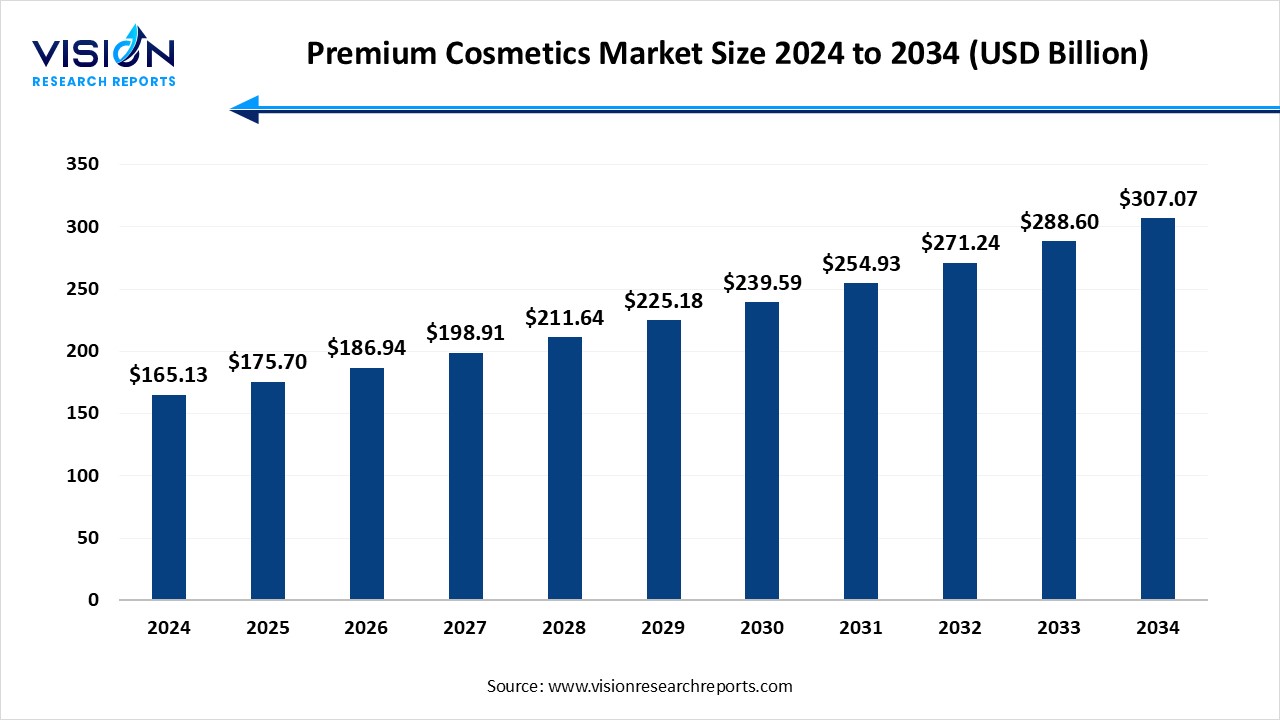
The global premium cosmetics market is a dynamic and rapidly expanding sector of the beauty industry, characterized by high-quality products, exclusive formulations, and prestigious branding. Driven by increasing consumer demand for luxury skincare, makeup, fragrances, and personal care products, the market is fueled by factors such as rising disposable incomes, growing awareness of skincare benefits, and the influence of social media and celebrity endorsements. Key players in this market continually innovate with natural, organic, and sustainable product lines, catering to a discerning customer base that values quality, efficacy, and brand reputation.
The growth of the premium cosmetics market is primarily driven by increasing consumer demand for high-quality, innovative, and personalized beauty products. As disposable incomes rise, especially in emerging economies, consumers are willing to invest in luxury skincare, makeup, and fragrances that promise superior results and unique experiences. The influence of social media, beauty influencers, and celebrity endorsements has further fueled consumer interest, creating a desire for premium brands that are associated with status, sophistication, and self-expression.
Another critical growth factor is the rapid expansion of e-commerce and digital marketing, which has transformed how premium cosmetics are marketed and distributed. Luxury brands are leveraging digital platforms to reach a global audience, offering personalized online shopping experiences, virtual try-ons, and direct-to-consumer (DTC) sales. Strategic collaborations with beauty influencers and the adoption of omnichannel retail strategies have enabled brands to engage consumers effectively.
Asia Pacific held the largest revenue share, representing 40% in 2024. E-commerce and social media platforms are pivotal in driving sales, with beauty influencers and live-streaming sessions playing a significant role in product promotion. Premium cosmetics brands in this region are also embracing local ingredients and traditional beauty rituals, creating a unique blend of luxury and cultural relevance.
North America stands as a leading market, driven by high consumer spending, widespread awareness of premium skincare and makeup products, and a strong presence of established luxury beauty brands. The United States, in particular, is a major contributor, where consumers prioritize high-quality, science-backed formulations and clean beauty options. The region's robust e-commerce infrastructure further enhances market growth, allowing premium brands to reach a vast audience through online platforms and digital marketing.
Skin care products led the market, capturing a revenue share of 42% in 2024. Premium skincare products, including serums, moisturizers, face masks, and cleansers, are formulated with high-quality, clinically tested ingredients that promise visible results. These products are often enriched with advanced active compounds, such as peptides, hyaluronic acid, retinol, and plant-based extracts, offering targeted benefits for various skin concerns.
Color cosmetics made a significant contribution to the market revenue in 2024. This segment encompasses a wide range of products, including foundations, lipsticks, eyeshadows, mascaras, and blushes, all of which are formulated using superior pigments, innovative textures, and skin-friendly ingredients. Premium color cosmetics brands are constantly innovating with long-lasting, smudge-proof, and multi-functional formulations that enhance convenience for users.
Women end-users led the premium cosmetics market, accounting for 80% of the revenue share in 2024. As the primary consumers of skincare, makeup, fragrances, and haircare products, women’s preferences and purchasing behaviors are pivotal to market growth. The increasing focus on self-care, wellness, and anti-aging solutions has led to a surge in demand for high-quality skincare products that promise visible results. Premium brands cater to women with diverse product ranges, including age-specific formulations, clean beauty options, and personalized skincare solutions.
Despite a clear inclination towards premium cosmetics, the market also faces evolving consumer expectations driven by growing awareness of sustainability, ingredient transparency, and ethical practices. Women are becoming more discerning, preferring brands that align with their values, such as cruelty-free testing, eco-friendly packaging, and the use of natural ingredients. This shift has prompted premium cosmetics brands to innovate with clean beauty formulations and responsible sourcing practices.
Supermarkets and hypermarkets led the market, capturing a revenue share of 36% in 2024. These large retail outlets provide a diverse selection of premium skincare, makeup, fragrances, and personal care products from renowned brands, allowing consumers to explore, test, and compare options before making a purchase. Strategic product placement, attractive in-store displays, and exclusive promotional offers further enhance the shopping experience, making premium cosmetics more accessible to a broad consumer base.
The rise of online channels and e-commerce has revolutionized the premium cosmetics market, offering unparalleled convenience and accessibility for consumers. Premium beauty brands have rapidly adopted digital platforms, creating sophisticated websites and collaborating with e-commerce giants to reach a global audience. Online channels enable consumers to explore an extensive range of premium products, read reviews, access expert recommendations, and benefit from personalized skincare consultations through virtual tools.
By Product
By End Use
By Distribution Channel
By Regional
Chapter 1. Introduction
1.1. Research Objective
1.2. Scope of the Study
1.3. Definition
Chapter 2. Research Methodology
2.1. Research Approach
2.2. Data Sources
2.3. Assumptions & Limitations
Chapter 3. Executive Summary
3.1. Market Snapshot
Chapter 4. Market Variables and Scope
4.1. Introduction
4.2. Market Classification and Scope
4.3. Industry Value Chain Analysis
4.3.1. Raw Material Procurement Analysis
4.3.2. Sales and Distribution Product Analysis
4.3.3. Downstream Buyer Analysis
Chapter 5. COVID 19 Impact on Premium Cosmetics Market
5.1. COVID-19 Landscape: Premium Cosmetics Industry Impact
5.2. COVID 19 - Impact Assessment for the Industry
5.3. COVID 19 Impact: Global Major Government Policy
5.4. Market Trends and Opportunities in the COVID-19 Landscape
Chapter 6. Market Dynamics Analysis and Trends
6.1. Market Dynamics
6.1.1. Market Drivers
6.1.2. Market Restraints
6.1.3. Market Opportunities
6.2. Porter’s Five Forces Analysis
6.2.1. Bargaining power of suppliers
6.2.2. Bargaining power of buyers
6.2.3. Threat of substitute
6.2.4. Threat of new entrants
6.2.5. Degree of competition
Chapter 7. Competitive Landscape
7.1.1. Company Market Share/Positioning Analysis
7.1.2. Key Strategies Adopted by Players
7.1.3. Vendor Landscape
7.1.3.1. List of Suppliers
7.1.3.2. List of Buyers
Chapter 8. Global Premium Cosmetics Market, By Product
8.1. Premium Cosmetics Market, by Product
8.1.1 Skin Care
8.1.1.1. Market Revenue and Forecast
8.1.2. Hair Care
8.1.2.1. Market Revenue and Forecast
8.1.3. Color Cosmetics
8.1.3.1. Market Revenue and Forecast
Chapter 9. Global Premium Cosmetics Market, By End Use
9.1. Premium Cosmetics Market, by End Use
9.1.1. Men
9.1.1.1. Market Revenue and Forecast
9.1.2. Women
9.1.2.1. Market Revenue and Forecast
Chapter 10. Global Premium Cosmetics Market, By Distribution Channel
10.1. Premium Cosmetics Market, by Distribution Channel
10.1.1. Supermarkets & Hypermarkets
10.1.1.1. Market Revenue and Forecast
10.1.2. Specialty Beauty Stores
10.1.2.1. Market Revenue and Forecast
10.1.3. Pharmacies and Drugstores
10.1.3.1. Market Revenue and Forecast
10.1.4. Online/E-commerce
10.1.4.1. Market Revenue and Forecast
10.1.5. Others
10.1.5.1. Market Revenue and Forecast
Chapter 11. Global Premium Cosmetics Market, Regional Estimates and Trend Forecast
11.1. North America
11.1.1. Market Revenue and Forecast, by Product
11.1.2. Market Revenue and Forecast, by End Use
11.1.3. Market Revenue and Forecast, by Distribution Channel
11.1.4. U.S.
11.1.4.1. Market Revenue and Forecast, by Product
11.1.4.2. Market Revenue and Forecast, by End Use
11.1.4.3. Market Revenue and Forecast, by Distribution Channel
11.1.5. Rest of North America
11.1.5.1. Market Revenue and Forecast, by Product
11.1.5.2. Market Revenue and Forecast, by End Use
11.1.5.3. Market Revenue and Forecast, by Distribution Channel
11.2. Europe
11.2.1. Market Revenue and Forecast, by Product
11.2.2. Market Revenue and Forecast, by End Use
11.2.3. Market Revenue and Forecast, by Distribution Channel
11.2.4. UK
11.2.4.1. Market Revenue and Forecast, by Product
11.2.4.2. Market Revenue and Forecast, by End Use
11.2.4.3. Market Revenue and Forecast, by Distribution Channel
11.2.5. Germany
11.2.5.1. Market Revenue and Forecast, by Product
11.2.5.2. Market Revenue and Forecast, by End Use
11.2.5.3. Market Revenue and Forecast, by Distribution Channel
11.2.6. France
11.2.6.1. Market Revenue and Forecast, by Product
11.2.6.2. Market Revenue and Forecast, by End Use
11.2.6.3. Market Revenue and Forecast, by Distribution Channel
11.2.7. Rest of Europe
11.2.7.1. Market Revenue and Forecast, by Product
11.2.7.2. Market Revenue and Forecast, by End Use
11.2.7.3. Market Revenue and Forecast, by Distribution Channel
11.3. APAC
11.3.1. Market Revenue and Forecast, by Product
11.3.2. Market Revenue and Forecast, by End Use
11.3.3. Market Revenue and Forecast, by Distribution Channel
11.3.4. India
11.3.4.1. Market Revenue and Forecast, by Product
11.3.4.2. Market Revenue and Forecast, by End Use
11.3.4.3. Market Revenue and Forecast, by Distribution Channel
11.3.5. China
11.3.5.1. Market Revenue and Forecast, by Product
11.3.5.2. Market Revenue and Forecast, by End Use
11.3.5.3. Market Revenue and Forecast, by Distribution Channel
11.3.6. Japan
11.3.6.1. Market Revenue and Forecast, by Product
11.3.6.2. Market Revenue and Forecast, by End Use
11.3.6.3. Market Revenue and Forecast, by Distribution Channel
11.3.7. Rest of APAC
11.3.7.1. Market Revenue and Forecast, by Product
11.3.7.2. Market Revenue and Forecast, by End Use
11.3.7.3. Market Revenue and Forecast, by Distribution Channel
11.4. MEA
11.4.1. Market Revenue and Forecast, by Product
11.4.2. Market Revenue and Forecast, by End Use
11.4.3. Market Revenue and Forecast, by Distribution Channel
11.4.4. GCC
11.4.4.1. Market Revenue and Forecast, by Product
11.4.4.2. Market Revenue and Forecast, by End Use
11.4.4.3. Market Revenue and Forecast, by Distribution Channel
11.4.5. North Africa
11.4.5.1. Market Revenue and Forecast, by Product
11.4.5.2. Market Revenue and Forecast, by End Use
11.4.5.3. Market Revenue and Forecast, by Distribution Channel
11.4.6. South Africa
11.4.6.1. Market Revenue and Forecast, by Product
11.4.6.2. Market Revenue and Forecast, by End Use
11.4.6.3. Market Revenue and Forecast, by Distribution Channel
11.4.7. Rest of MEA
11.4.7.1. Market Revenue and Forecast, by Product
11.4.7.2. Market Revenue and Forecast, by End Use
11.4.7.3. Market Revenue and Forecast, by Distribution Channel
11.5. Latin America
11.5.1. Market Revenue and Forecast, by Product
11.5.2. Market Revenue and Forecast, by End Use
11.5.3. Market Revenue and Forecast, by Distribution Channel
11.5.4. Brazil
11.5.4.1. Market Revenue and Forecast, by Product
11.5.4.2. Market Revenue and Forecast, by End Use
11.5.4.3. Market Revenue and Forecast, by Distribution Channel
11.5.5. Rest of LATAM
11.5.5.1. Market Revenue and Forecast, by Product
11.5.5.2. Market Revenue and Forecast, by End Use
11.5.5.3. Market Revenue and Forecast, by Distribution Channel
Chapter 12. Company Profiles
12.1. L'Oréal Group.
12.1.1. Company Overview
12.1.2. Product Offerings
12.1.3. Financial Performance
12.1.4. Recent Initiatives
12.2. Estée Lauder Companies.
12.2.1. Company Overview
12.2.2. Product Offerings
12.2.3. Financial Performance
12.2.4. Recent Initiatives
12.3. Chanel.
12.3.1. Company Overview
12.3.2. Product Offerings
12.3.3. Financial Performance
12.3.4. Recent Initiatives
12.4. Shiseido Company, Limited.
12.4.1. Company Overview
12.4.2. Product Offerings
12.4.3. Financial Performance
12.4.4. Recent Initiatives
12.5. Coty Inc.
12.5.1. Company Overview
12.5.2. Product Offerings
12.5.3. Financial Performance
12.5.4. Recent Initiatives
12.6. Amorepacific Corporation
12.6.1. Company Overview
12.6.2. Product Offerings
12.6.3. Financial Performance
12.6.4. Recent Initiatives
12.7. Elizabeth Arden, Inc.
12.7.1. Company Overview
12.7.2. Product Offerings
12.7.3. Financial Performance
12.10.4. Recent Initiatives
Chapter 13. Research Methodology
13.1. Primary Research
13.2. Secondary Research
13.3. Assumptions
Chapter 14. Appendix
14.1. About Us
14.2. Glossary of Terms
 Cross-segment Market Size and Analysis for
Mentioned Segments
Additional Company Profiles (Upto 5 With No Cost)
Additional Countries (Apart From Mentioned Countries)
Country/Region-specific Report
Go To Market Strategy
Region Specific Market DynamicsRegion Level Market Share Import Export AnalysisProduction AnalysisOthers
Cross-segment Market Size and Analysis for
Mentioned Segments
Additional Company Profiles (Upto 5 With No Cost)
Additional Countries (Apart From Mentioned Countries)
Country/Region-specific Report
Go To Market Strategy
Region Specific Market DynamicsRegion Level Market Share Import Export AnalysisProduction AnalysisOthers