The global pressure pumping market size was estimated at around USD 83.63 billion in 2023 and it is projected to hit around USD 163.59 billion by 2033, growing at a CAGR of 6.94% from 2024 to 2033.
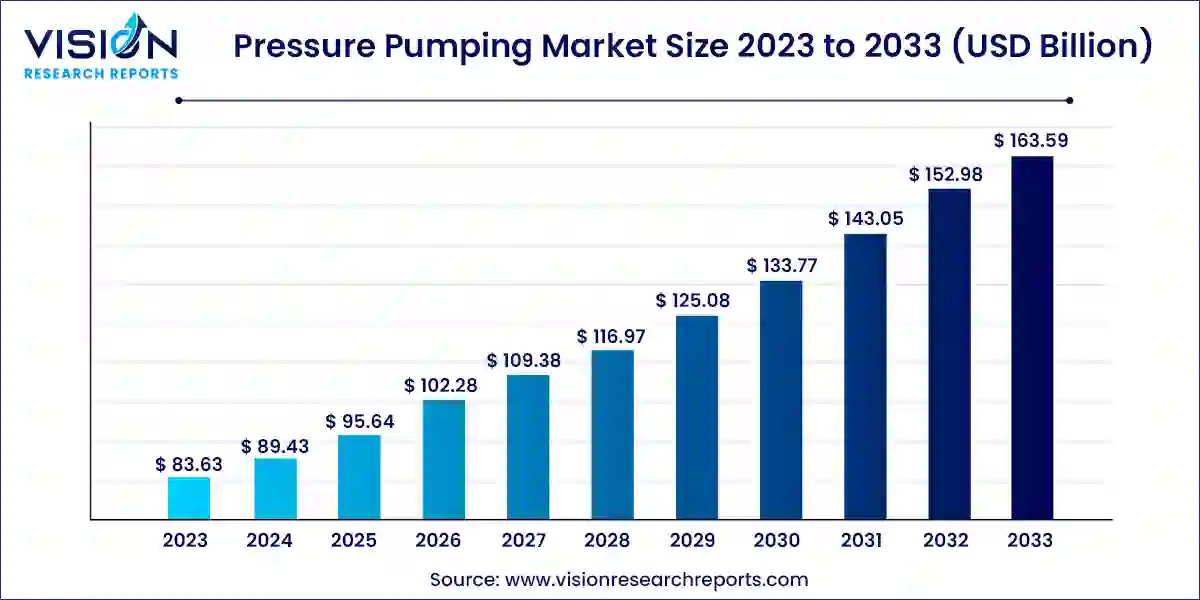
The pressure pumping market is a dynamic sector within the oil and gas industry, characterized by the injection of fluids into reservoirs to enhance hydrocarbon recovery. This process involves the use of high-pressure pumps to push fluids, such as water, chemicals, or proppants, into underground formations, thereby creating fractures and improving the flow of oil or natural gas.
The growth of the pressure pumping market is propelled by various factors. Firstly, the increasing global demand for energy, particularly oil and natural gas, is driving the exploration and production activities, thus boosting the need for pressure pumping services. Additionally, advancements in hydraulic fracturing technologies are enhancing the efficiency and effectiveness of pressure pumping operations, leading to improved extraction rates from reservoirs. Moreover, the exploration of unconventional resources such as shale gas and tight oil is expanding the scope of the pressure pumping market, creating new opportunities for service providers. Furthermore, regulatory changes and environmental concerns are driving the adoption of cleaner and more sustainable practices within the industry, thereby influencing the demand for pressure pumping solutions that adhere to stricter standards.
In 2023, the pressure pumping market saw the hydraulic fracturing segment emerge as the dominant force. This dominance is attributed to notable advancements in hydraulic fracturing techniques, which have significantly enhanced the efficiency and effectiveness of the process. These advancements have made hydraulic fracturing increasingly appealing to oil and gas companies. Techniques like horizontal drilling combined with hydraulic fracturing have revolutionized the extraction of gas and oil from previously inaccessible shale formations. Through hydraulic fracturing, previously untapped gas and oil reservoirs have become accessible. This process involves creating fissures in rock formations by injecting high-pressure fluids, thereby facilitating the smooth flow of hydrocarbons to production wells. As a result, oil and gas fields experience extended lifespans, maximizing resource extraction from existing wells and ultimately increasing overall recoverable reserves.
The cementing segment, on the other hand, is projected to experience the fastest growth in the pressure pumping market during the forecast period. With the increasing global demand for energy, driven by the exploration and production of oil and gas, cementing has become a crucial procedure during drilling and completion operations. Cement slurry is injected into the well to stabilize and seal the wellbore, prevent fluid migration between underground formations, and maintain well integrity. As businesses expand into new markets and offshore drilling, particularly in deepwater and ultra-deepwater areas, increases, the demand for cementing services is expected to rise significantly.
In 2023, the pressure pumping market witnessed the horizontal segment emerge as the dominant force. Horizontal drilling involves initially drilling a well vertically to a certain depth before bending the wellbore horizontally. This technique enhances reservoir contact, facilitating more efficient extraction of oil and gas. Advancements in drilling technology have made horizontal drilling both practical and cost-effective. Regulatory changes in various regions have also streamlined the permitting process for hydraulic fracturing and horizontal drilling, encouraging investment in these technologies.
The vertical segment is forecasted to be the fastest growing in the pressure pumping market. Vertical pressure pumping plays a crucial role in enhanced oil recovery methods like surfactant flooding and CO2 injection, enhancing efficiency. This demand is bolstered by increasing global energy consumption, particularly in Asia-Pacific and Latin American countries investing in vertical pressure pumping technology to boost oil and gas production capacity.
North America dominated the market with the largest revenue share % in 2023, boasting the largest market share. This can be attributed to the abundance of shale formations, which serve as prime sources for oil and natural gas extraction through hydraulic fracturing (fracking), particularly in the United States. Key basins such as the Marcellus Shale, Permian Basin, and Eagle Ford Shale drive the pressure pumping industry due to their vast reserves, necessitating continuous pressure pumping services to enhance extraction productivity and efficiency. Additionally, strategic alliances, mergers, and acquisitions among major competitors have facilitated resource sharing, knowledge exchange, and technology advancements, thus improving the effectiveness and economy of pressure pumping operations.
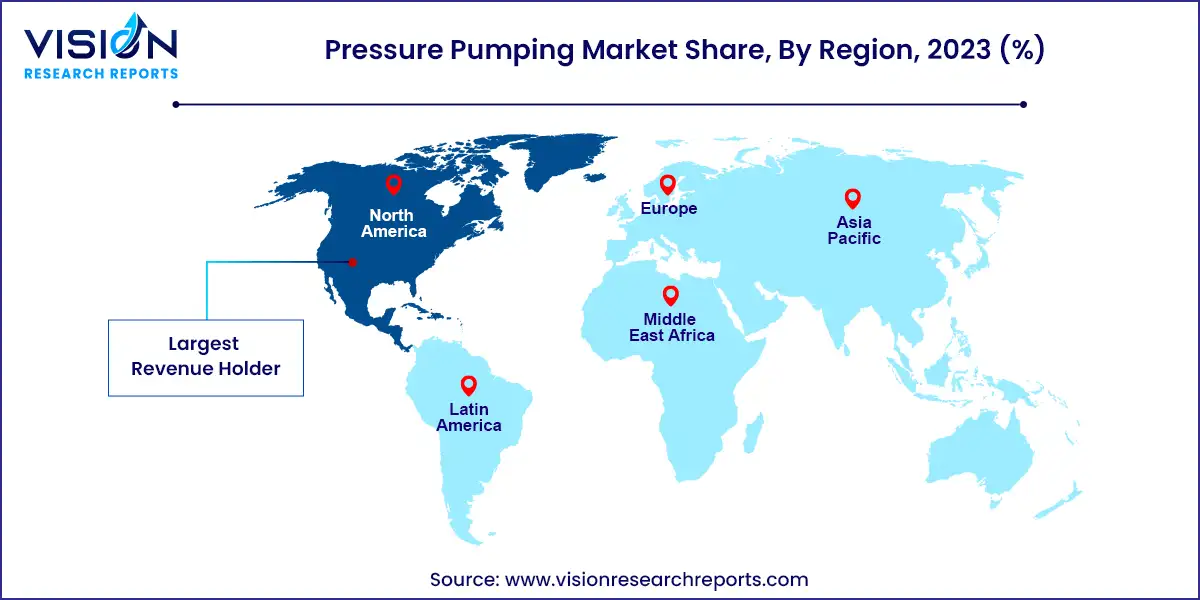
In contrast, Asia-Pacific is projected to be the fastest growing region in the pressure pumping market during the forecast period. This growth is fueled by the significant expansion of energy consumption in countries like China, India, and Southeast Asia, driven by rapid industrialization and urbanization. Substantial international investments are pouring into various Asian nations to bolster their gas and oil infrastructure, often resulting in technology transfers that enhance local pressure pumping capabilities. Furthermore, governments in the region are implementing favorable laws and regulations to incentivize investment in the oil and gas industry, such as India's legislation permitting 100% foreign direct investment in several oil and gas sectors.
By Service Type
By Well Type
By Region
Chapter 1. Introduction
1.1. Research Objective
1.2. Scope of the Study
1.3. Definition
Chapter 2. Research Methodology
2.1. Research Approach
2.2. Data Sources
2.3. Assumptions & Limitations
Chapter 3. Executive Summary
3.1. Market Snapshot
Chapter 4. Market Variables and Scope
4.1. Introduction
4.2. Market Classification and Scope
4.3. Industry Value Chain Analysis
4.3.1. Raw Material Procurement Analysis
4.3.2. Sales and Distribution Channel Analysis
4.3.3. Downstream Buyer Analysis
Chapter 5. COVID 19 Impact on Pressure Pumping Market
5.1. COVID-19 Landscape: Pressure Pumping Industry Impact
5.2. COVID 19 - Impact Assessment for the Industry
5.3. COVID 19 Impact: Global Major Government Policy
5.4. Market Trends and Opportunities in the COVID-19 Landscape
Chapter 6. Market Dynamics Analysis and Trends
6.1. Market Dynamics
6.1.1. Market Drivers
6.1.2. Market Restraints
6.1.3. Market Opportunities
6.2. Porter’s Five Forces Analysis
6.2.1. Bargaining power of suppliers
6.2.2. Bargaining power of buyers
6.2.3. Threat of substitute
6.2.4. Threat of new entrants
6.2.5. Degree of competition
Chapter 7. Competitive Landscape
7.1.1. Company Market Share/Positioning Analysis
7.1.2. Key Strategies Adopted by Players
7.1.3. Vendor Landscape
7.1.3.1. List of Suppliers
7.1.3.2. List of Buyers
Chapter 8. Global Pressure Pumping Market, By Service Type
8.1. Pressure Pumping Market, by Service Type, 2024-2033
8.1.1. Hydraulic Fracturing
8.1.1.1. Market Revenue and Forecast (2021-2033)
8.1.2. Cementing
8.1.2.1. Market Revenue and Forecast (2021-2033)
8.1.3. Others
8.1.3.1. Market Revenue and Forecast (2021-2033)
Chapter 9. Global Pressure Pumping Market, By Well Type
9.1. Pressure Pumping Market, by Well Type, 2024-2033
9.1.1. Horizontal
9.1.1.1. Market Revenue and Forecast (2021-2033)
9.1.2. Vertical
9.1.2.1. Market Revenue and Forecast (2021-2033)
Chapter 10. Global Pressure Pumping Market, Regional Estimates and Trend Forecast
10.1. North America
10.1.1. Market Revenue and Forecast, by Service Type (2021-2033)
10.1.2. Market Revenue and Forecast, by Well Type (2021-2033)
10.1.3. U.S.
10.1.3.1. Market Revenue and Forecast, by Service Type (2021-2033)
10.1.3.2. Market Revenue and Forecast, by Well Type (2021-2033)
10.1.4. Rest of North America
10.1.4.1. Market Revenue and Forecast, by Service Type (2021-2033)
10.1.4.2. Market Revenue and Forecast, by Well Type (2021-2033)
10.2. Europe
10.2.1. Market Revenue and Forecast, by Service Type (2021-2033)
10.2.2. Market Revenue and Forecast, by Well Type (2021-2033)
10.2.3. UK
10.2.3.1. Market Revenue and Forecast, by Service Type (2021-2033)
10.2.3.2. Market Revenue and Forecast, by Well Type (2021-2033)
10.2.4. Germany
10.2.4.1. Market Revenue and Forecast, by Service Type (2021-2033)
10.2.4.2. Market Revenue and Forecast, by Well Type (2021-2033)
10.2.5. France
10.2.5.1. Market Revenue and Forecast, by Service Type (2021-2033)
10.2.5.2. Market Revenue and Forecast, by Well Type (2021-2033)
10.2.6. Rest of Europe
10.2.6.1. Market Revenue and Forecast, by Service Type (2021-2033)
10.2.6.2. Market Revenue and Forecast, by Well Type (2021-2033)
10.3. APAC
10.3.1. Market Revenue and Forecast, by Service Type (2021-2033)
10.3.2. Market Revenue and Forecast, by Well Type (2021-2033)
10.3.3. India
10.3.3.1. Market Revenue and Forecast, by Service Type (2021-2033)
10.3.3.2. Market Revenue and Forecast, by Well Type (2021-2033)
10.3.4. China
10.3.4.1. Market Revenue and Forecast, by Service Type (2021-2033)
10.3.4.2. Market Revenue and Forecast, by Well Type (2021-2033)
10.3.5. Japan
10.3.5.1. Market Revenue and Forecast, by Service Type (2021-2033)
10.3.5.2. Market Revenue and Forecast, by Well Type (2021-2033)
10.3.6. Rest of APAC
10.3.6.1. Market Revenue and Forecast, by Service Type (2021-2033)
10.3.6.2. Market Revenue and Forecast, by Well Type (2021-2033)
10.4. MEA
10.4.1. Market Revenue and Forecast, by Service Type (2021-2033)
10.4.2. Market Revenue and Forecast, by Well Type (2021-2033)
10.4.3. GCC
10.4.3.1. Market Revenue and Forecast, by Service Type (2021-2033)
10.4.3.2. Market Revenue and Forecast, by Well Type (2021-2033)
10.4.4. North Africa
10.4.4.1. Market Revenue and Forecast, by Service Type (2021-2033)
10.4.4.2. Market Revenue and Forecast, by Well Type (2021-2033)
10.4.5. South Africa
10.4.5.1. Market Revenue and Forecast, by Service Type (2021-2033)
10.4.5.2. Market Revenue and Forecast, by Well Type (2021-2033)
10.4.6. Rest of MEA
10.4.6.1. Market Revenue and Forecast, by Service Type (2021-2033)
10.4.6.2. Market Revenue and Forecast, by Well Type (2021-2033)
10.5. Latin America
10.5.1. Market Revenue and Forecast, by Service Type (2021-2033)
10.5.2. Market Revenue and Forecast, by Well Type (2021-2033)
10.5.3. Brazil
10.5.3.1. Market Revenue and Forecast, by Service Type (2021-2033)
10.5.3.2. Market Revenue and Forecast, by Well Type (2021-2033)
10.5.4. Rest of LATAM
10.5.4.1. Market Revenue and Forecast, by Service Type (2021-2033)
10.5.4.2. Market Revenue and Forecast, by Well Type (2021-2033)
Chapter 11. Company Profiles
11.1. C&J Energy Services
11.1.1. Company Overview
11.1.2. Product Offerings
11.1.3. Financial Performance
11.1.4. Recent Initiatives
11.2. Calfrac Well Services
11.2.1. Company Overview
11.2.2. Product Offerings
11.2.3. Financial Performance
11.2.4. Recent Initiatives
11.3. FTS International
11.3.1. Company Overview
11.3.2. Product Offerings
11.3.3. Financial Performance
11.3.4. Recent Initiatives
11.4. Keane Group
11.4.1. Company Overview
11.4.2. Product Offerings
11.4.3. Financial Performance
11.4.4. LTE Scientific
11.5. Pro Petro Holding Corp.
11.5.1. Company Overview
11.5.2. Product Offerings
11.5.3. Financial Performance
11.5.4. Recent Initiatives
11.6. RPC Inc.
11.6.1. Company Overview
11.6.2. Product Offerings
11.6.3. Financial Performance
11.6.4. Recent Initiatives
11.7. Schlumberger
11.7.1. Company Overview
11.7.2. Product Offerings
11.7.3. Financial Performance
11.7.4. Recent Initiatives
11.8. Halliburton
11.8.1. Company Overview
11.8.2. Product Offerings
11.8.3. Financial Performance
11.8.4. Recent Initiatives
11.9. Baker Hughes
11.9.1. Company Overview
11.9.2. Product Offerings
11.9.3. Financial Performance
11.9.4. Recent Initiatives
11.10. Weatherford International
11.10.1. Company Overview
11.10.2. Product Offerings
11.10.3. Financial Performance
11.10.4. Recent Initiatives
Chapter 12. Research Methodology
12.1. Primary Research
12.2. Secondary Research
12.3. Assumptions
Chapter 13. Appendix
13.1. About Us
13.2. Glossary of Terms
 Cross-segment Market Size and Analysis for
Mentioned Segments
Additional Company Profiles (Upto 5 With No Cost)
Additional Countries (Apart From Mentioned Countries)
Country/Region-specific Report
Go To Market Strategy
Region Specific Market DynamicsRegion Level Market Share Import Export AnalysisProduction AnalysisOthers
Cross-segment Market Size and Analysis for
Mentioned Segments
Additional Company Profiles (Upto 5 With No Cost)
Additional Countries (Apart From Mentioned Countries)
Country/Region-specific Report
Go To Market Strategy
Region Specific Market DynamicsRegion Level Market Share Import Export AnalysisProduction AnalysisOthers