The global secondary battery market size was valued at USD 121.75 billion in 2024 and it is predicted to surpass around USD 301.72 billion by 2034 with a CAGR of 9.50% from 2025 to 2034.
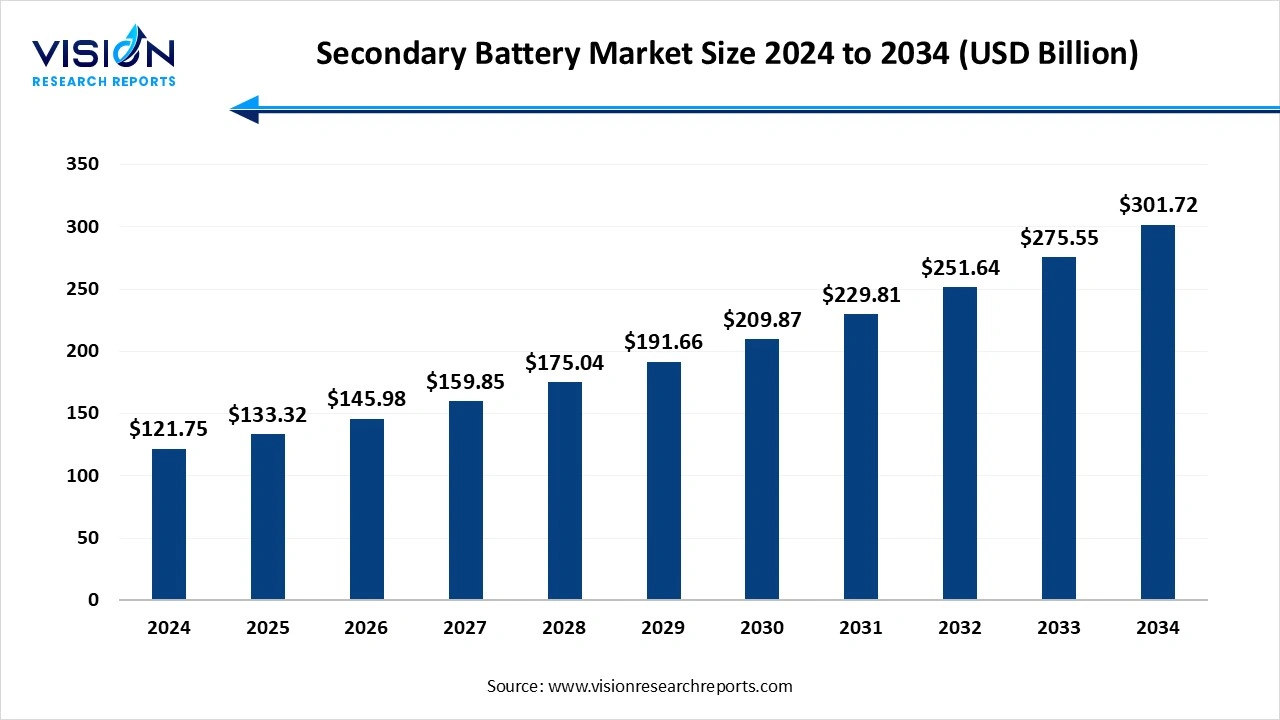
The secondary battery market, also known as the rechargeable battery market, is experiencing significant growth, driven by rising demand for energy storage solutions across diverse sectors such as consumer electronics, electric vehicles (EVs), and renewable energy systems. These batteries, including lithium-ion, nickel-metal hydride, and lead-acid types, offer the advantage of multiple charge-discharge cycles, making them economically and environmentally favorable. As global efforts intensify toward sustainability and carbon neutrality, secondary batteries are becoming essential components in supporting clean energy infrastructure and mobile power needs.
The rapid adoption of electric vehicles (EVs) is one of the primary growth drivers of the secondary battery market. With global initiatives focused on reducing carbon emissions and phasing out internal combustion engines, major automotive manufacturers are investing heavily in EV production. This surge in demand for efficient, high-capacity batteries, particularly lithium-ion, has led to significant advancements in battery technology, energy density, and cost efficiency. Government policies, subsidies, and the expansion of charging infrastructure are also playing a crucial role in accelerating market adoption worldwide.
Beyond transportation, the rise in renewable energy deployment is fueling demand for energy storage systems that rely on secondary batteries. As solar and wind power generation increase, the need for stable, scalable storage solutions becomes essential to balance grid reliability and energy availability. The proliferation of smart devices, consumer electronics, and industrial automation continues to bolster the market, while ongoing R&D investments are leading to the development of safer, longer-lasting, and more sustainable battery chemistries.
Asia-Pacific holds a dominant position in this market due to the presence of major battery manufacturers and high demand from automotive and consumer electronics sectors. Countries like China, Japan, and South Korea are at the forefront of innovation and production capacity, benefiting from substantial government support and extensive research activities. The rapid adoption of electric vehicles (EVs) and renewable energy storage solutions further propels market growth in this region.
The secondary battery market in Europe is propelled by the region's vigorous commitment to electric vehicle (EV) adoption, backed by strict emission standards and government incentives like subsidies and tax breaks. The European Union’s ambitious climate targets and the Green Deal initiative are driving substantial investments in renewable energy storage, significantly boosting demand for secondary batteries. Moreover, the strong presence of leading portable device manufacturers and battery producers, combined with growing consumer awareness of sustainability, is further accelerating the growth of Europe’s secondary battery market.
The lithium-ion segment holds a dominant position in the global secondary battery market, primarily due to its superior performance characteristics, including high energy density, long cycle life, and lightweight design. This battery type is widely adopted across various industries such as consumer electronics, electric vehicles (EVs), and renewable energy storage systems. The increasing penetration of electric mobility and the growing demand for portable electronic devices have significantly boosted the adoption of lithium-ion batteries. Moreover, advancements in battery chemistry, such as lithium iron phosphate (LFP) and nickel manganese cobalt (NMC), have enhanced safety, efficiency, and cost-effectiveness, further solidifying the market position of lithium-ion technology.
The widespread adoption of consumer electronics such as smartphones, laptops, and wearable devices continues to drive demand for lithium-ion batteries, as users increasingly prioritize extended battery life and rapid charging capabilities. These evolving consumer expectations, combined with technological advancements, reinforce the role of lithium-ion batteries as a pivotal component in the global shift toward sustainable energy solutions and next-generation technologies.
Governments around the world are enforcing strict emission regulations and providing various incentives to encourage the adoption of clean transportation, which is significantly boosting the demand for high-performance batteries, especially lithium-ion types. At the same time, ongoing advancements in battery technology—such as higher energy density and reduced charging times—are enhancing the appeal of electric vehicles among consumers. The expansion of EV charging infrastructure, along with substantial investments by portable device manufacturers in electrification and energy efficiency, is further reinforcing this upward trend.
Portable devices represent a significant application segment within the global secondary battery market, driven by the increasing reliance on mobile technology in daily life. Devices such as smartphones, tablets, laptops, digital cameras, and wearable technology require compact, lightweight, and long-lasting power sources, making secondary batteries, particularly lithium-ion, an ideal solution. The demand for enhanced battery performance, including longer usage time and faster recharging, continues to grow as consumers seek more convenience and efficiency from their portable electronics.
By Type
By Application
By Regional
Chapter 1. Introduction
1.1. Research Objective
1.2. Scope of the Study
1.3. Definition
Chapter 2. Research Methodology
2.1. Research Approach
2.2. Data Sources
2.3. Assumptions & Limitations
Chapter 3. Executive Summary
3.1. Market Snapshot
Chapter 4. Market Variables and Scope
4.1. Introduction
4.2. Market Classification and Scope
4.3. Industry Value Chain Analysis
4.3.1. Raw Material Procurement Analysis
4.3.2. Sales and Distribution Channel Analysis
4.3.3. Downstream Buyer Analysis
Chapter 5. COVID 19 Impact on Secondary Battery Market
5.1. COVID-19 Landscape: Secondary Battery Industry Impact
5.2. COVID 19 - Impact Assessment for the Industry
5.3. COVID 19 Impact: Major Government Policy
5.4. Market Trends and Opportunities in the COVID-19 Landscape
Chapter 6. Market Dynamics Analysis and Trends
6.1. Market Dynamics
6.1.1. Market Drivers
6.1.2. Market Restraints
6.1.3. Market Opportunities
6.2. Porter’s Five Forces Analysis
6.2.1. Bargaining power of suppliers
6.2.2. Bargaining power of buyers
6.2.3. Threat of substitute
6.2.4. Threat of new entrants
6.2.5. Degree of competition
Chapter 7. Competitive Landscape
7.1.1. Company Market Share/Positioning Analysis
7.1.2. Key Strategies Adopted by Players
7.1.3. Vendor Landscape
7.1.3.1. List of Suppliers
7.1.3.2. List of Buyers
Chapter 8. Secondary Battery Market, By Type
8.1. Secondary Battery Market, by Type
8.1.1. Lithium-ion
8.1.1.1. Market Revenue and Forecast
8.1.2. Lead Acid
8.1.2.1. Market Revenue and Forecast
8.1.3. Nickel Metal Hydride
8.1.3.1. Market Revenue and Forecast
8.1.4. Others
8.1.4.1. Market Revenue and Forecast
Chapter 9. Secondary Battery Market, By Application
9.1. Secondary Battery Market, by Application
9.1.1. Motor Vehicles
9.1.1.1. Market Revenue and Forecast
9.1.2. Industrial Batteries
9.1.2.1. Market Revenue and Forecast
9.1.3. Portable Devices
9.1.3.1. Market Revenue and Forecast
9.1.4. Electronics
9.1.4.1. Market Revenue and Forecast
9.1.5. Others
9.1.5.1. Market Revenue and Forecast
Chapter 10. Secondary Battery Market, Regional Estimates and Trend Forecast
10.1. U.S.
10.1.1. Market Revenue and Forecast, by Type
10.1.2. Market Revenue and Forecast, by Application
Chapter 11. Company Profiles
11.1. LG Energy Solution Ltd. (South Korea)
11.1.1. Company Overview
11.1.2. Product Offerings
11.1.3. Financial Performance
11.1.4. Recent Initiatives
11.2. Contemporary Amperex Technology Co. Ltd. (CATL) (China)
11.2.1. Company Overview
11.2.2. Product Offerings
11.2.3. Financial Performance
11.2.4. Recent Initiatives
11.3. Panasonic Holdings Corporation (Japan)
11.3.1. Company Overview
11.3.2. Product Offerings
11.3.3. Financial Performance
11.3.4. Recent Initiatives
11.4. Samsung SDI Co., Ltd. (South Korea)
11.4.1. Company Overview
11.4.2. Product Offerings
11.4.3. Financial Performance
11.4.4. LTE Scientific
11.5. BYD Company Ltd. (China)
11.5.1. Company Overview
11.5.2. Product Offerings
11.5.3. Financial Performance
11.5.4. Recent Initiatives
11.6. SK On Co., Ltd. (South Korea)
11.6.1. Company Overview
11.6.2. Product Offerings
11.6.3. Financial Performance
11.6.4. Recent Initiatives
11.7. Toshiba Corporation (Japan)
11.7.1. Company Overview
11.7.2. Product Offerings
11.7.3. Financial Performance
11.7.4. Recent Initiatives
11.8. GS Yuasa Corporation (Japan)
11.8.1. Company Overview
11.8.2. Product Offerings
11.8.3. Financial Performance
11.8.4. Recent Initiatives
11.9. Envision AESC Group Ltd. (China/Japan)
11.9.1. Company Overview
11.9.2. Product Offerings
11.9.3. Financial Performance
11.9.4. Recent Initiatives
11.10. Hitachi Chemical Co. Ltd
11.10.1. Company Overview
11.10.2. Product Offerings
11.10.3. Financial Performance
11.10.4. Recent Initiatives
Chapter 12. Research Methodology
12.1. Primary Research
12.2. Secondary Research
12.3. Assumptions
Chapter 13. Appendix
13.1. About Us
13.2. Glossary of Terms
 Cross-segment Market Size and Analysis for
Mentioned Segments
Additional Company Profiles (Upto 5 With No Cost)
Additional Countries (Apart From Mentioned Countries)
Country/Region-specific Report
Go To Market Strategy
Region Specific Market DynamicsRegion Level Market Share Import Export AnalysisProduction AnalysisOthers
Cross-segment Market Size and Analysis for
Mentioned Segments
Additional Company Profiles (Upto 5 With No Cost)
Additional Countries (Apart From Mentioned Countries)
Country/Region-specific Report
Go To Market Strategy
Region Specific Market DynamicsRegion Level Market Share Import Export AnalysisProduction AnalysisOthers