
South East Asia Advanced Wound Care Market Size, Share | Report 2023-2032
The South East Asia advanced wound care market size was estimated at around USD 221.30 million in 2022 and it is projected to hit around USD 402.72 million by 2032, growing at a CAGR of 6.17% from 2023 to 2032.
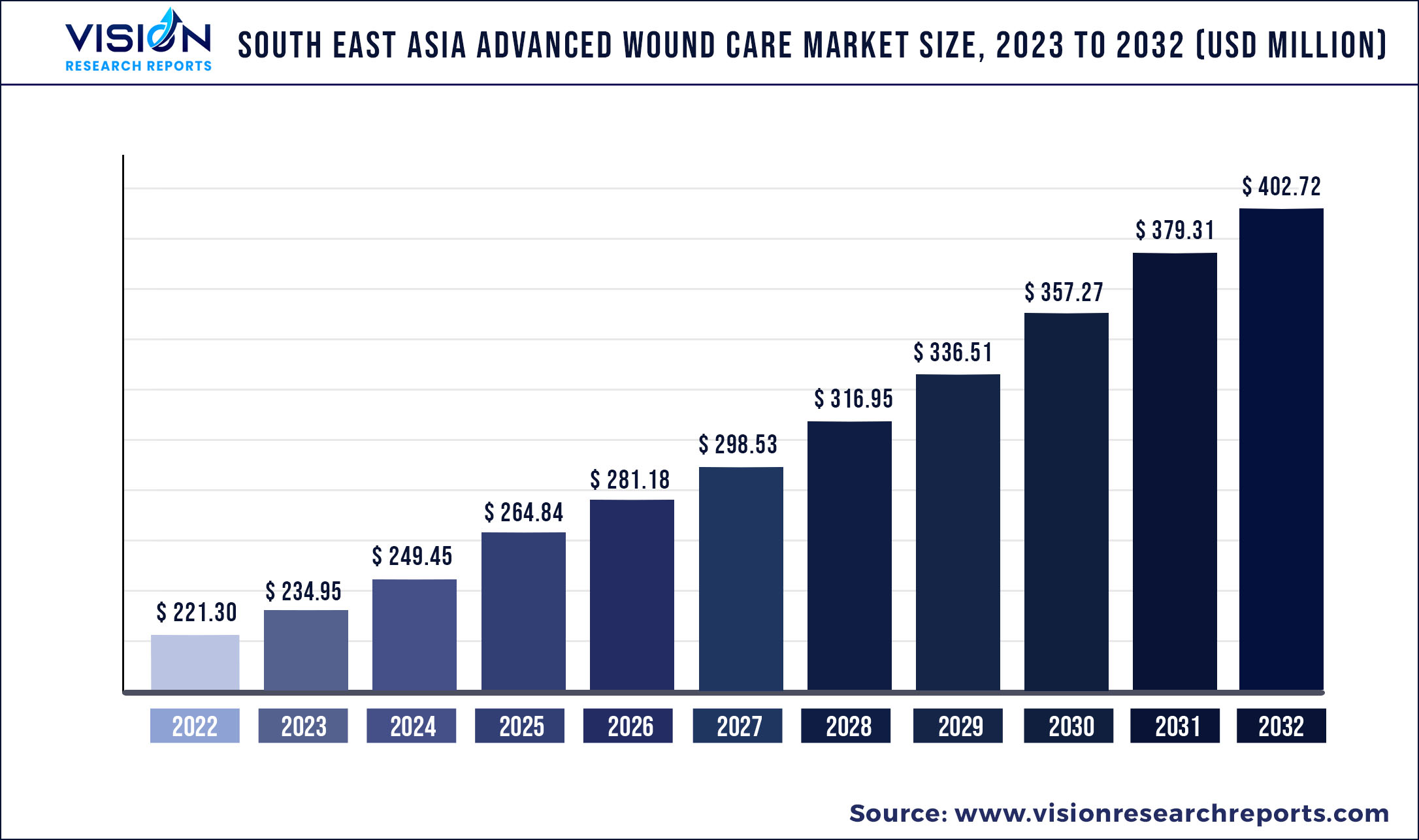
Key Pointers
| Report Coverage | Details |
| Market Size in 2022 | USD 221.30 million |
| Revenue Forecast by 2032 | USD 402.72 million |
| Growth rate from 2023 to 2032 | CAGR of 6.17% |
| Base Year | 2022 |
| Forecast Period | 2023 to 2032 |
| Companies Covered | Smith & Nephew; Molnlycke Health Care AB; ConvaTec Group PLC; Baxter International; URGO; Coloplast Corp.; Medtronic; 3M; Derma Sciences (Integra LifeSciences); Medline Industries |
The rising prevalence of chronic diseases, mainly, diabetes and obesity, is one of the key factors leading to an increase in the incidence of chronic wounds such as diabetic foot ulcers, venous leg ulcers, and pressure ulcers. For instance, as per data published by the government of Singapore (Ministry of Health), as of December 2021, a study showed that diabetes contributed to 87% of arterial insufficiency ulcers in the population of Singapore.
Similarly, according to IDF Diabetes Atlas, Indonesia ranked 5th in 2019 with around 7.9 million adults aged between 20 and 79 having undiagnosed diabetes. Healing of these chronic wounds requires advanced wound care products, thus, impelling the growth of the market over the forecast period.
The rising prevalence of obesity is another key factor likely to drive market growth, as it is associated with chronic wounds and lower extremity amputations. Obese people are at a higher risk of pressure ulcers, with reduced vascular activity in adipose tissue. The incapability of these patients to reposition themselves in bed acts as a precursor for pressure-related injuries.
Furthermore, the skin folds on their bodies provide ideal conditions for microorganisms to thrive. Ulcers are caused by the breakdown of skin caused by these microorganisms. Thus, this factor is likely to boost the demand for advanced wound care products, leading to market growth.
In recent times, the incidence of road accidents, trauma, and burn events has been rapidly increasing across Southeast Asian countries. For instance, according to WHO, in 2021, Thailand has the world's second-highest rate of traffic-incident-related fatalities. As per the same source, each year, an estimated 22,941 individuals die in Thailand as a result of traffic-related incidents, accounting for roughly 33% of all deaths in the country.
Moreover, according to WHO data, in 2018, there were around 41,862 deaths due to road traffic accidents in Indonesia. Such accidents frequently result in significant blood loss and other injuries, necessitating prompt medical treatment and surgical procedures to offer patients instant relief. Thus, the rising number of accidents is likely to boost the demand for advanced wound care, which is anticipated to lead to substantial market growth over the forecast period.
South East Asia Advanced Wound Care Market Segmentations:
By Product
By Application
By End-use
Chapter 1. Introduction
1.1. Research Objective
1.2. Scope of the Study
1.3. Definition
Chapter 2. Research Methodology
2.1. Research Approach
2.2. Data Sources
2.3. Assumptions & Limitations
Chapter 3. Executive Summary
3.1. Market Snapshot
Chapter 4. Market Variables and Scope
4.1. Introduction
4.2. Market Classification and Scope
4.3. Industry Value Chain Analysis
4.3.1. Raw Material Procurement Analysis
4.3.2. Sales and Distribution Channel Analysis
4.3.3. Downstream Buyer Analysis
Chapter 5. COVID 19 Impact on South East Asia Advanced Wound Care Market
5.1. COVID-19 Landscape: South East Asia Advanced Wound Care Industry Impact
5.2. COVID 19 - Impact Assessment for the Industry
5.3. COVID 19 Impact: Major Government Policy
5.4. Market Trends and Opportunities in the COVID-19 Landscape
Chapter 6. Market Dynamics Analysis and Trends
6.1. Market Dynamics
6.1.1. Market Drivers
6.1.2. Market Restraints
6.1.3. Market Opportunities
6.2. Porter’s Five Forces Analysis
6.2.1. Bargaining power of suppliers
6.2.2. Bargaining power of buyers
6.2.3. Threat of substitute
6.2.4. Threat of new entrants
6.2.5. Degree of competition
Chapter 7. Competitive Landscape
7.1.1. Company Market Share/Positioning Analysis
7.1.2. Key Strategies Adopted by Players
7.1.3. Vendor Landscape
7.1.3.1. List of Suppliers
7.1.3.2. List of Buyers
Chapter 8. South East Asia Advanced Wound Care Market, By Product
8.1. South East Asia Advanced Wound Care Market, by Product, 2023-2032
8.1.1 Moist Wound Care
8.1.1.1. Market Revenue and Forecast (2019-2032)
8.1.2. Antimicrobial Wound Care
8.1.2.1. Market Revenue and Forecast (2019-2032)
8.1.3. Active Wound Care
8.1.3.1. Market Revenue and Forecast (2019-2032)
Chapter 9. South East Asia Advanced Wound Care Market, By Application
9.1. South East Asia Advanced Wound Care Market, by Application, 2023-2032
9.1.1. Chronic Wounds
9.1.1.1. Market Revenue and Forecast (2019-2032)
9.1.2. Acute Wounds
9.1.2.1. Market Revenue and Forecast (2019-2032)
Chapter 10. South East Asia Advanced Wound Care Market, By End-use
10.1. South East Asia Advanced Wound Care Market, by End-use, 2023-2032
10.1.1. Hospitals
10.1.1.1. Market Revenue and Forecast (2019-2032)
10.1.2. Specialty Clinics
10.1.2.1. Market Revenue and Forecast (2019-2032)
10.1.3. Home Healthcare
10.1.3.1. Market Revenue and Forecast (2019-2032)
10.1.4. Others
10.1.4.1. Market Revenue and Forecast (2019-2032)
Chapter 11. South East Asia Advanced Wound Care Market, Regional Estimates and Trend Forecast
11.1. South East Asia
11.1.1. Market Revenue and Forecast, by Product (2019-2032)
11.1.2. Market Revenue and Forecast, by Application (2019-2032)
11.1.3. Market Revenue and Forecast, by End-use (2019-2032)
Chapter 12. Company Profiles
12.1. Smith & Nephew
12.1.1. Company Overview
12.1.2. Product Offerings
12.1.3. Financial Performance
12.1.4. Recent Initiatives
12.2. Molnlycke Health Care AB
12.2.1. Company Overview
12.2.2. Product Offerings
12.2.3. Financial Performance
12.2.4. Recent Initiatives
12.3. ConvaTec Group PLC
12.3.1. Company Overview
12.3.2. Product Offerings
12.3.3. Financial Performance
12.3.4. Recent Initiatives
12.4. Baxter International
12.4.1. Company Overview
12.4.2. Product Offerings
12.4.3. Financial Performance
12.4.4. Recent Initiatives
12.5. URGO
12.5.1. Company Overview
12.5.2. Product Offerings
12.5.3. Financial Performance
12.5.4. Recent Initiatives
12.6. Coloplast Corp.
12.6.1. Company Overview
12.6.2. Product Offerings
12.6.3. Financial Performance
12.6.4. Recent Initiatives
12.7. Medtronic
12.7.1. Company Overview
12.7.2. Product Offerings
12.7.3. Financial Performance
12.7.4. Recent Initiatives
12.8. 3M
12.8.1. Company Overview
12.8.2. Product Offerings
12.8.3. Financial Performance
12.8.4. Recent Initiatives
12.9. Derma Sciences (Integra LifeSciences)
12.9.1. Company Overview
12.9.2. Product Offerings
12.9.3. Financial Performance
12.9.4. Recent Initiatives
12.10. Medline Industries
12.10.1. Company Overview
12.10.2. Product Offerings
12.10.3. Financial Performance
12.10.4. Recent Initiatives
Chapter 13. Research Methodology
13.1. Primary Research
13.2. Secondary Research
13.3. Assumptions
Chapter 14. Appendix
14.1. About Us
14.2. Glossary of Terms
 Cross-segment Market Size and Analysis for
Mentioned Segments
Additional Company Profiles (Upto 5 With No Cost)
Additional Countries (Apart From Mentioned Countries)
Country/Region-specific Report
Go To Market Strategy
Region Specific Market DynamicsRegion Level Market Share Import Export AnalysisProduction AnalysisOthers
Cross-segment Market Size and Analysis for
Mentioned Segments
Additional Company Profiles (Upto 5 With No Cost)
Additional Countries (Apart From Mentioned Countries)
Country/Region-specific Report
Go To Market Strategy
Region Specific Market DynamicsRegion Level Market Share Import Export AnalysisProduction AnalysisOthers