
China Medical Imaging Market Size, Share, Report 2023-2032
The China medical imaging market was valued at USD 1.66 billion in 2022 and it is predicted to surpass around USD 3.04 billion by 2032 with a CAGR of 6.25% from 2023 to 2032.
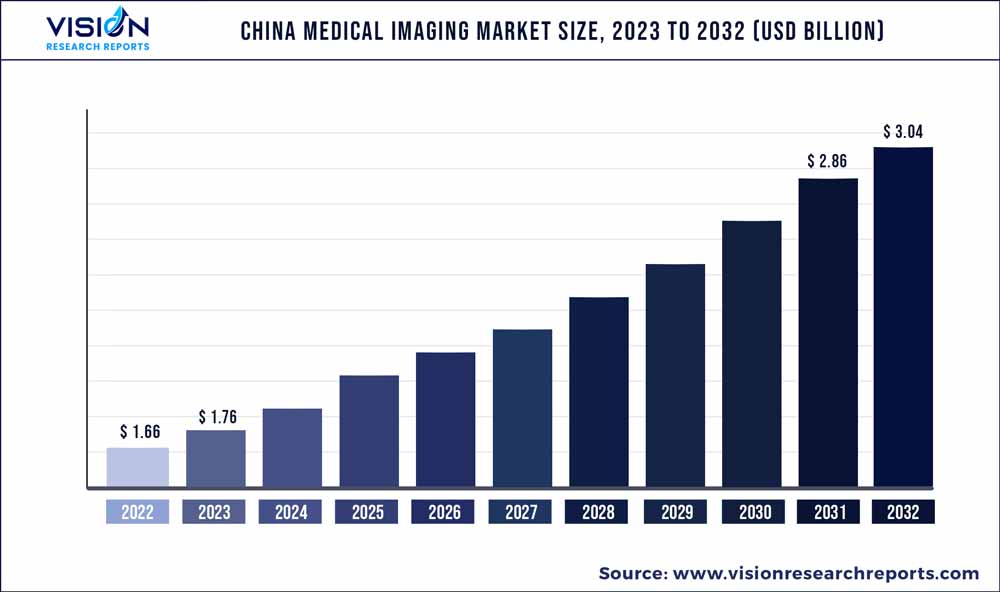
Key Pointers
Report Scope of the China Medical Imaging Market
| Report Coverage | Details |
| Market Size in 2022 | USD 1.66 billion |
| Revenue Forecast by 2032 | USD 3.04 billion |
| Growth rate from 2023 to 2032 | CAGR of 6.25% |
| Base Year | 2022 |
| Forecast Period | 2023 to 2032 |
| Market Analysis (Terms Used) | Value (US$ Million/Billion) or (Volume/Units) |
| Companies Covered | GE HealthCare; Siemens Healthcare GmbH; Koninklijke Philips N.V.; Canon Medical Systems Corporation; Shenzhen Mindray Bio-Medical Electronics Co., Ltd.; Shanghai United Imaging Healthcare Co., Ltd |
Key growth drivers for the market include an increasing demand for early detection & prevention of chronic diseases, as well as a growing geriatric population. Technological advancements in medical imaging further contribute to the utilization of advanced techniques to meet healthcare needs. For instance, in June 2023, GE HealthCare announced the FDA approval and launch of Sonic DL, a deep learning-based technology specifically designed to significantly accelerate MRI image acquisition.
The growing prevalence of chronic diseases plays a significant role in driving the demand for medical imaging devices in China. As chronic diseases such as diabetes, cancer, and cardiovascular conditions become more common, the need for accurate and timely diagnosis increases. Medical imaging devices, such as X-ray, MRI, and CT scans, provide valuable insights into the progression and severity of these chronic diseases. They aid healthcare professionals in detecting and monitoring disease markers, guiding treatment decisions, and evaluating treatment effectiveness. By enabling early detection, precise diagnosis, and effective disease management, medical imaging devices contribute to improved patient outcomes and better quality of life for individuals living with chronic diseases.
Government initiatives play a crucial role in promoting the use of medical imaging devices. By implementing policies and programs that prioritize healthcare infrastructure development, governments encourage the adoption and accessibility of advanced imaging technologies. Funding support, tax incentives, and reimbursement schemes encourage healthcare facilities to invest in medical imaging devices, leading to the improvement and establishment of imaging centers. These initiatives have a positive impact on patient care by increasing access to accurate and timely diagnoses, improving outcomes, and enhancing overall healthcare services for the population. For instance, the government of China has approved the Healthy China 2030 plan, which prioritizes health and aims to participate in global health governance. This initiative is also favorable to market growth.
Technological advancements are essential in driving the use of medical imaging devices. Continuous advancements in imaging technologies, such as better image quality and faster scans, help doctors diagnose patients more accurately. Advanced imaging methods, such as MRI, CT scans, and PET scans, provide detailed and precise information about the body's structures and any abnormalities present. This allows healthcare professionals to make better treatment plans and monitor progress effectively. Furthermore, advancements such as artificial intelligence (AI) and machine learning (ML) help automate processes and analyze images more efficiently. For instance, Koninklijke Philips N.V. launched Philips CT 3500 computed tomography scanner in May 2023 to expand the market by offering state-of-the-art solutions for routine radiology and high-volume screening programs.
Modality Insights
Ultrasound dominated the product segment with 30% of the China medical imaging market share in 2022. This segment is subdivided into 2D, 3D/4D, and Doppler. The 3D/4D segment held the largest revenue share of 38.9% in 2022. Ultrasound with 3D and 4D imaging is used in pregnancy to see a real-time picture of the baby's features and movements. Ultrasound is majorly used in gynecology for the screening and diagnosing of female reproductive organs and diseases such as endometriosis, pelvic inflammatory disease, and reproductive organ cancer.
The increasing demand for ultrasound imaging is driven by several factors. Ultrasound is a safe and non-invasive imaging technique that does not involve radiation exposure, making it preferred for pregnant women and children. It is also widely available and more affordable compared to other imaging methods, making it accessible to more people. Advancements in ultrasound technology have improved image quality, allowing better visualization of internal structures and accurate diagnosis of medical conditions.
Ultrasound is versatile and can be used to assess various body parts and systems, including the abdomen, heart, and blood vessels. With the rising prevalence of chronic diseases, there is a growing need for regular monitoring and early detection, driving the demand for ultrasound as a reliable and effective imaging tool. Its benefits in terms of safety, accessibility, versatility, and accuracy contribute to the increasing demand for ultrasound imaging.
The computed tomography (CT) scanners segment is expected to grow at the fastest CAGR of 8.34% during the forecast period. Technological advancements in CT technology, coupled with the growing prevalence of chronic disorders such as cancer, orthopedics, and cardiovascular and neurological conditions are expected to accelerate the market growth over the forecast period.
End-use Insights
Based on end-use, the China medical imaging market has been segmented into hospitals, diagnostic imaging centers, and others. The hospitals segment held the largest revenue share of around 40% in 2022. The growing demand for more accurate diagnostic tools, advancements in imaging technology, expanding healthcare infrastructure, increased awareness about the benefits of early disease detection, and the rising prevalence of chronic diseases. These factors collectively contribute to the rising utilization of medical imaging devices across various medical specialties and healthcare settings.
The diagnostic imaging centers segment is expected to witness the fastest CAGR of 6.18% over the forecast period. The increasing demand for timely and accurate diagnoses has led to a rise in the number of imaging tests performed at dedicated centers, diagnostic imaging centers often have access to advanced imaging technologies and specialized expertise, attracting patients seeking comprehensive diagnostic services. Additionally, advancements in imaging technology have made it more convenient and cost-effective for healthcare providers to outsource imaging services to these centers, further driving their growth.
China Medical Imaging Market Segmentations:
By Modality
By End-use
Chapter 1. Introduction
1.1. Research Objective
1.2. Scope of the Study
1.3. Definition
Chapter 2. Research Methodology
2.1. Research Approach
2.2. Data Sources
2.3. Assumptions & Limitations
Chapter 3. Executive Summary
3.1. Market Snapshot
Chapter 4. Market Variables and Scope
4.1. Introduction
4.2. Market Classification and Scope
4.3. Industry Value Chain Analysis
4.3.1. Raw Material Procurement Analysis
4.3.2. Sales and Distribution Channel Analysis
4.3.3. Downstream Buyer Analysis
Chapter 5. COVID 19 Impact on China Medical Imaging Market
5.1. COVID-19 Landscape: China Medical Imaging Industry Impact
5.2. COVID 19 - Impact Assessment for the Industry
5.3. COVID 19 Impact: Major Government Policy
5.4. Market Trends and Opportunities in the COVID-19 Landscape
Chapter 6. Market Dynamics Analysis and Trends
6.1. Market Dynamics
6.1.1. Market Drivers
6.1.2. Market Restraints
6.1.3. Market Opportunities
6.2. Porter’s Five Forces Analysis
6.2.1. Bargaining power of suppliers
6.2.2. Bargaining power of buyers
6.2.3. Threat of substitute
6.2.4. Threat of new entrants
6.2.5. Degree of competition
Chapter 7. Competitive Landscape
7.1.1. Company Market Share/Positioning Analysis
7.1.2. Key Strategies Adopted by Players
7.1.3. Vendor Landscape
7.1.3.1. List of Suppliers
7.1.3.2. List of Buyers
Chapter 8. China Medical Imaging Market, By Modality
8.1. China Medical Imaging Market, by Modality, 2023-2032
8.1.1. X-ray
8.1.1.1. Market Revenue and Forecast (2020-2032)
8.1.2. Ultrasound
8.1.2.1. Market Revenue and Forecast (2020-2032)
8.1.3. Computed Tomography (CT)
8.1.3.1. Market Revenue and Forecast (2020-2032)
8.1.4. Magnetic Resonance Imaging (MRI)
8.1.4.1. Market Revenue and Forecast (2020-2032)
8.1.5. Nuclear Medicine
8.1.5.1. Market Revenue and Forecast (2020-2032)
Chapter 9. China Medical Imaging Market, By End-use
9.1. China Medical Imaging Market, by End-use, 2023-2032
9.1.1. Hospitals
9.1.1.1. Market Revenue and Forecast (2020-2032)
9.1.2. Diagnostic Imaging Centers
9.1.2.1. Market Revenue and Forecast (2020-2032)
9.1.3. Others
9.1.3.1. Market Revenue and Forecast (2020-2032)
Chapter 10. China Medical Imaging Market, Regional Estimates and Trend Forecast
10.1. China
10.1.1. Market Revenue and Forecast, by Modality (2020-2032)
10.1.2. Market Revenue and Forecast, by End-use (2020-2032)
Chapter 11. Company Profiles
11.1. GE HealthCare
11.1.1. Company Overview
11.1.2. Product Offerings
11.1.3. Financial Performance
11.1.4. Recent Initiatives
11.2. Siemens Healthcare GmbH
11.2.1. Company Overview
11.2.2. Product Offerings
11.2.3. Financial Performance
11.2.4. Recent Initiatives
11.3. Koninklijke Philips N.V.
11.3.1. Company Overview
11.3.2. Product Offerings
11.3.3. Financial Performance
11.3.4. Recent Initiatives
11.4. Canon Medical Systems Corporation
11.4.1. Company Overview
11.4.2. Product Offerings
11.4.3. Financial Performance
11.4.4. LTE Scientific
11.5. Shenzhen Mindray Bio-Medical Electronics Co., Ltd.
11.5.1. Company Overview
11.5.2. Product Offerings
11.5.3. Financial Performance
11.5.4. Recent Initiatives
11.6. Shanghai United Imaging Healthcare Co., Ltd
11.6.1. Company Overview
11.6.2. Product Offerings
11.6.3. Financial Performance
11.6.4. Recent Initiatives
Chapter 12. Research Methodology
12.1. Primary Research
12.2. Secondary Research
12.3. Assumptions
Chapter 13. Appendix
13.1. About Us
13.2. Glossary of Terms
 Cross-segment Market Size and Analysis for
Mentioned Segments
Additional Company Profiles (Upto 5 With No Cost)
Additional Countries (Apart From Mentioned Countries)
Country/Region-specific Report
Go To Market Strategy
Region Specific Market DynamicsRegion Level Market Share Import Export AnalysisProduction AnalysisOthers
Cross-segment Market Size and Analysis for
Mentioned Segments
Additional Company Profiles (Upto 5 With No Cost)
Additional Countries (Apart From Mentioned Countries)
Country/Region-specific Report
Go To Market Strategy
Region Specific Market DynamicsRegion Level Market Share Import Export AnalysisProduction AnalysisOthers