
U.S. Dental Splint Market Size, Share | Report 2022-2030
The U.S. dental splint market was surpassed at USD 130.6 million in 2021 and is expected to hit around USD 220.6 million by 2030, growing at a CAGR of 6.0% from 2022 to 2030.
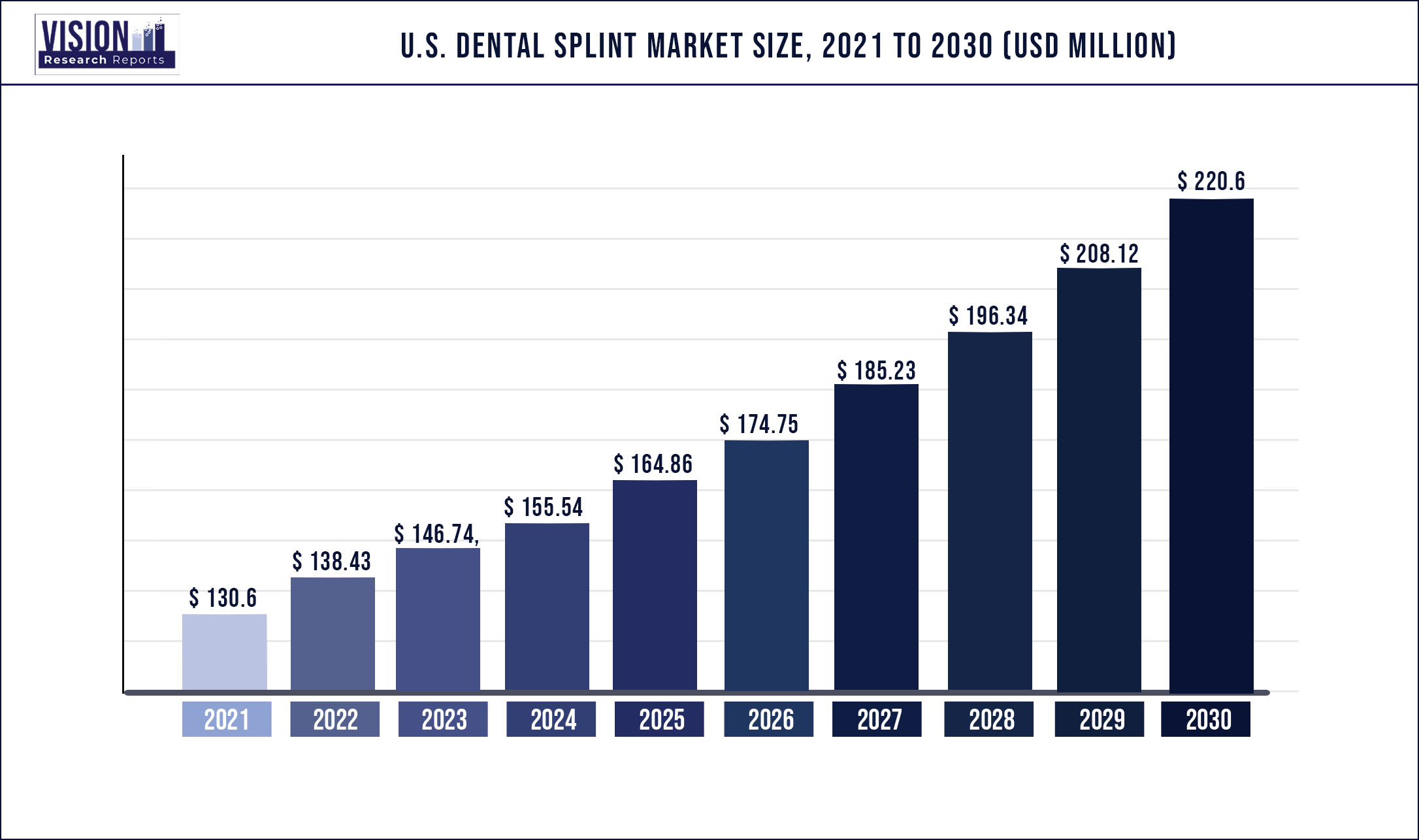
Report Highlights
It is widely accepted that oral health significantly affects overall health. Oral hygiene maintenance is equally as crucial as caring for other body components. People have just recently begun to realize how important keeping proper dental and oral hygiene is. For instance, more people are becoming aware of the function of the temporomandibular joint (TMJ) as well as other illnesses and possible treatments. The market for dental splints has expanded as a result.
In the United States, dentists are in charge of instructing their patients on how to properly prevent tooth decay, periodontal diseases, and other issues with oral health. The National Children's Dental Health Month, awareness program is sponsored by the American Dental Association in the United States in February to make parents and kids more conscious of the value of maintaining good oral health. The campaign's main goal is to educate young people on the value of routine teeth brushing and dental checkups to stave off dental issues.
After tension headaches and back pain, TMD pain is the third most common chronic pain disease globally. Because TMD pain can mirror other disorders, many TMD sufferers go misdiagnosed. Women are more prone than men to suffer from TMJ issues, and those who use oral contraceptives or more estrogen are more likely to seek treatment.
According to a recent study, between 11 and 12 million American adults suffer from temporomandibular joint pain. Women are twice as likely as males to get temporomandibular problems, especially if they are between the ages of 35 and 44. With a TMJ repositioning splint, one common treatment involves realigning the jaw into the right position. By cushioning your teeth, a dental splint can help with jaw alignment, ease face muscle strain, and improve jaw alignment. Hence, the demand for dental splints in the US will probably be driven by this.
The pandemic has decreased demand for dental supplies and equipment, which has had an impact on new investments in dental healthcare and education. Due to the product's disrupted supply chain and national lockdown regulations, sales and income for oral care items such as dental splints and mouth guards were also below average in the first half of 2020.
However, the market expanded significantly in 2021 as a result of the stress disorder linked to COVID-19. Dentistry was not exempt from the COVID-19 outbreak's impact on nearly every aspect of our way of life. Given that stress is one of the main causes of bruxism, the rise in cases over the previous two years is not surprising. Since the start of the COVID-19 epidemic, the majority of dental practitioners have observed a considerable increase in stress-related oral health conditions. This had a positive impact on the market for dental splints in 2021.
Scope of The Report
| Report Coverage | Details |
| Market Size in 2021 | USD 130.6 million |
| Revenue Forecast by 2030 | USD 220.6 million |
| Growth rate from 2022 to 2030 | CAGR of 6.0% |
| Base Year | 2021 |
| Forecast Period | 2022 to 2030 |
| Segmentation | Mobility degree, distribution channel |
| Companies Covered |
Aqualizer; Glidewell; Procter & Gamble; Dentek; Brux Night Guard; Sporting Smiles; Smile Brilliant; Chomper Labs; Sentinel Mouth Guards |
Mobility Degree Insights
Based on product, the rigid segment had the highest revenue share at 47.63% in 2021. This is attributed to the fact that a rigid splint is the most commonly used splint in the market as it reduces pain by ensuring no movement of the teeth. Rigid dental splints are easy availability in dental clinics that involve low material cost, and ease of modification.
The semi-rigid segment is anticipated to witness a sizable CAGR is anticipated during the forecast period. A semi-rigid splint is used to protect, support, and immobilize teeth that have been suffering from a dental issue. In a semi-rigid splint, the functional mobility of the traumatized tooth is comparable to a rigid splint. However, a semi-rigid splint is more favorable for the recovery of the periodontal ligament, which reduces the risk of ankyloses.
Distribution Channel Insights
Based on distribution channel, the offline segment accounted for the largest revenue share of 55.97% in 2021. Most of the customers prefer to buy a product only after physically examining a product, which may reduce the number of product returns for various businesses. In the dental industry, dentists are involved in buying and selling dental products.
The online segment is expected to witness the highest CAGR during the forecast period. The manufacturers of dental splints are distributing their products online and via other retail outlets, such as pharmacies and supermarkets. Some dentists are selling these products online through their websites directly to patients. People tend to look to online stores for buying dental products due to numerous advantages, such as ease of buying, price comparison, and free home delivery. Hence, these factors are responsible for the growth of the segment over the forecast period.
Key Players
Market Segmentation
Chapter 1. Introduction
1.1. Research Objective
1.2. Scope of the Study
1.3. Definition
Chapter 2. Research Methodology
2.1. Research Approach
2.2. Data Sources
2.3. Assumptions & Limitations
Chapter 3. Executive Summary
3.1. Market Snapshot
Chapter 4. Market Variables and Scope
4.1. Introduction
4.2. Market Classification and Scope
4.3. Industry Value Chain Analysis
4.3.1. Raw Material Procurement Analysis
4.3.2. Sales and Distribution Channel Analysis
4.3.3. Downstream Buyer Analysis
Chapter 5. COVID 19 Impact on U.S. Dental Splint Market
5.1. COVID-19 Landscape: U.S. Dental Splint Industry Impact
5.2. COVID 19 - Impact Assessment for the Industry
5.3. COVID 19 Impact: Major Government Policy
5.4. Market Trends and Opportunities in the COVID-19 Landscape
Chapter 6. Market Dynamics Analysis and Trends
6.1. Market Dynamics
6.1.1. Market Drivers
6.1.2. Market Restraints
6.1.3. Market Opportunities
6.2. Porter’s Five Forces Analysis
6.2.1. Bargaining power of suppliers
6.2.2. Bargaining power of buyers
6.2.3. Threat of substitute
6.2.4. Threat of new entrants
6.2.5. Degree of competition
Chapter 7. Competitive Landscape
7.1.1. Company Market Share/Positioning Analysis
7.1.2. Key Strategies Adopted by Players
7.1.3. Vendor Landscape
7.1.3.1. List of Suppliers
7.1.3.2. List of Buyers
Chapter 8. U.S. Dental Splint Market, By Mobility Degree
8.1. U.S. Dental Splint Market, by Mobility Degree, 2022-2030
8.1.1. Flexible
8.1.1.1. Market Revenue and Forecast (2017-2030)
8.1.2. Semi-rigid
8.1.2.1. Market Revenue and Forecast (2017-2030)
8.1.3. Rigid
8.1.3.1. Market Revenue and Forecast (2017-2030)
Chapter 9. U.S. Dental Splint Market, By Distribution Channel
9.1. U.S. Dental Splint Market, by Distribution Channel, 2022-2030
9.1.1. Online
9.1.1.1. Market Revenue and Forecast (2017-2030)
9.1.2. Offline (Through dental professionals)
9.1.2.1. Market Revenue and Forecast (2017-2030)
Chapter 10. U.S. Dental Splint Market, Regional Estimates and Trend Forecast
10.1. U.S.
10.1.1. Market Revenue and Forecast, by Mobility Degree (2017-2030)
10.1.2. Market Revenue and Forecast, by Distribution Channel (2017-2030)
Chapter 11. Company Profiles
11.1. Aqualizer
11.1.1. Company Overview
11.1.2. Product Offerings
11.1.3. Financial Performance
11.1.4. Recent Initiatives
11.2. Glidewell
11.2.1. Company Overview
11.2.2. Product Offerings
11.2.3. Financial Performance
11.2.4. Recent Initiatives
11.3. Procter & Gamble
11.3.1. Company Overview
11.3.2. Product Offerings
11.3.3. Financial Performance
11.3.4. Recent Initiatives
11.4. Dentek
11.4.1. Company Overview
11.4.2. Product Offerings
11.4.3. Financial Performance
11.4.4. LTE Scientific
11.5. Brux Night Guard
11.5.1. Company Overview
11.5.2. Product Offerings
11.5.3. Financial Performance
11.5.4. Recent Initiatives
11.6. Sporting Smiles
11.6.1. Company Overview
11.6.2. Product Offerings
11.6.3. Financial Performance
11.6.4. Recent Initiatives
11.7. Smile Brilliant
11.7.1. Company Overview
11.7.2. Product Offerings
11.7.3. Financial Performance
11.7.4. Recent Initiatives
11.8. Chomper Labs
11.8.1. Company Overview
11.8.2. Product Offerings
11.8.3. Financial Performance
11.8.4. Recent Initiatives
11.9. Sentinel Mouth Guards
11.9.1. Company Overview
11.9.2. Product Offerings
11.9.3. Financial Performance
11.9.4. Recent Initiatives
Chapter 12. Research Methodology
12.1. Primary Research
12.2. Secondary Research
12.3. Assumptions
Chapter 13. Appendix
13.1. About Us
13.2. Glossary of Terms
 Cross-segment Market Size and Analysis for
Mentioned Segments
Additional Company Profiles (Upto 5 With No Cost)
Additional Countries (Apart From Mentioned Countries)
Country/Region-specific Report
Go To Market Strategy
Region Specific Market DynamicsRegion Level Market Share Import Export AnalysisProduction AnalysisOthers
Cross-segment Market Size and Analysis for
Mentioned Segments
Additional Company Profiles (Upto 5 With No Cost)
Additional Countries (Apart From Mentioned Countries)
Country/Region-specific Report
Go To Market Strategy
Region Specific Market DynamicsRegion Level Market Share Import Export AnalysisProduction AnalysisOthers