
Virtual Content Creation Market Size, Growth, Trends, Report 2023-2032
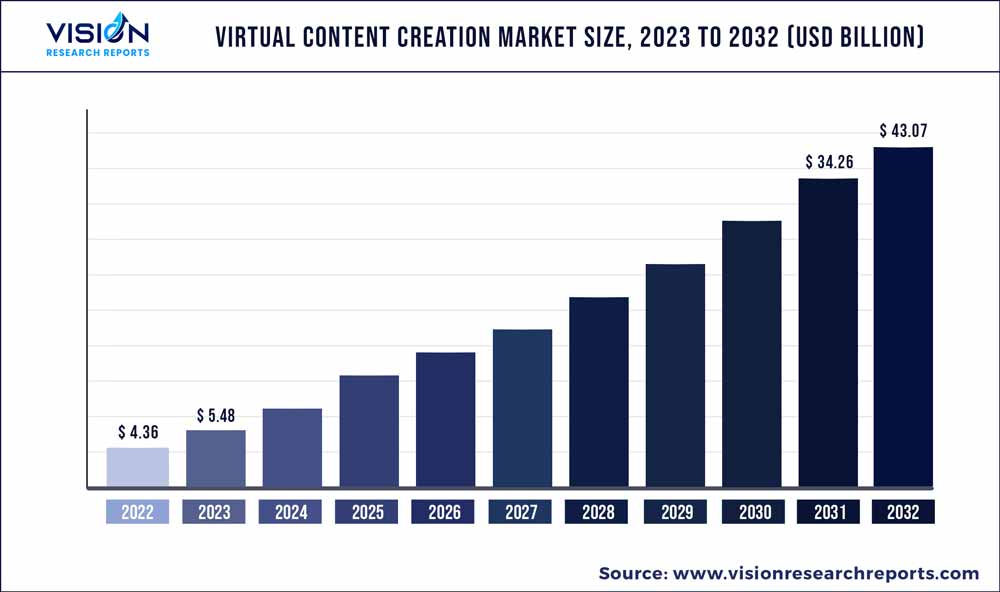
The global virtual content creation market was estimated at USD 4.36 billion in 2022 and it is expected to surpass around USD 43.07 billion by 2032, poised to grow at a CAGR of 25.74% from 2023 to 2032. The virtual content creation market in the United States was accounted for USD 0.9 billion in 2022.
Key Pointers
Report Scope of the Virtual Content Creation Market
| Report Coverage | Details |
| Revenue Share of Asia Pacific in 2022 | 40.05% |
| CAGR of North America from 2023 to 2032 | 26% |
| Revenue Forecast by 2032 | USD 43.07 billion |
| Growth Rate from 2023 to 2032 | CAGR of 25.74% |
| Base Year | 2022 |
| Forecast Period | 2023 to 2032 |
| Market Analysis (Terms Used) | Value (US$ Million/Billion) or (Volume/Units) |
| Companies Covered | Matteport, Inc.; Wevr; Vizor; KonceptVR LLC; Porcellus, Inc.; 360 Labs; Blippar Group Ltd.; Panedia Pty Ltd; Scapic Innovation Pvt. Ltd. (Flipkart); Subvrsive, Inc.; VIAR Inc.; WeMakeVR |
The increasing popularity of Virtual Reality (VR) along with other immersive technologies is accelerating the market expansion during the forecast period. Moreover, the demand for high-quality virtual content will likely grow as more businesses and consumers embrace these technologies, which is expected to drive global market growth. VR technology has gained prominence over the last few years owing to the advancement and launch of advanced VR headsets to augment the growth and experience in several industries.
The technology is under continuous research to develop low-cost, wearable solutions for the mass market. In addition, VR has an enormous potential to be incorporated into a wide range of applications, including content creation, healthcare, education, and industrial prototyping, which is anticipated to fuel the market further. Virtual content creation involves developing and designing digital content for virtual environments, such as VR simulations, video games, and other interactive experiences. This includes several stages, such as planning and concept development, 3D modeling and animation, programming & scripting, and testing & optimization that contribute to the virtual world.
These properties, in turn, are expected to boost the market growth over the forecast period. Moreover, the key market players are partnering and acquiring companies to diversify and expand their business to cater to a more significant customer base, which is expected to fuel the market growth further. For instance, in May 2022, DPVR, a VR device manufacturing and design company, partnered with FXG Video Science and Technology (FXG), a China-based VR production studio. This partnership is expected to combine its resources and technology to create richer, more convenient, and free VR content systems for end-users, which is expected to fuel the market growth over the forecast period.
Furthermore, virtual content is increasingly being used for training and education purposes, specifically in the fields, such as aviation, healthcare, and engineering, among others, which is estimated to augment the market demand. Virtual content is significantly being used in e-commerce applications, such as try-before-you-buy experiences and virtual product demos. This, in turn, is expected to drive the market growth further during the forecast period.
Solution Type Insights
The software segment witnessed the highest revenue share of more than 81% in 2022. The development of modern hardware for the consumption of VR content and games is anticipated to drive the segment growth for the compatibility factor between hardware and software. Similarly, there is expected to be a rising trend for custom VR software in industries, such as healthcare and retail, for collaboration and remote work capabilities. This, in turn, is expected to add to the segment growth in the coming years.
The services segment is expected to grow at the highest CAGR of around 30.05% over the forecast period. The segment growth can be attributed to the rising trend of fictional VR universes, such as Metaverse, which is anticipated to attract companies to develop software for content creation around these virtual worlds. Moreover, the high investment and high-end hardware requirement to develop and maintain VR offerings is a driving factor for the growth of companies offering VR as a service. Similarly, the trend of digitization and modernization is expected to push smaller companies to avail these services, thereby resulting insegment growth.
End-use Insights
The media & entertainment segment accounted for a significant market share of over 21% in 2022. The segment dominance can be attributed to the trend of VR movies & shows along with the prominence of VR in gaming. For instance, Valve Corporation’s video game store and platform Steam hosts more than 600 VR games and apps. In addition, the growing use of VR headsets has resulted in popular streaming platforms, such as Netflix, having launched their applications for use on Quest, Quest 2, and Meta Quest Pro VR headsets.
The gaming end-use segment is expected to grow at a notable CAGR of over 25.03% during the forecast period. The segment growth can be credited to the immense popularity of gaming across various age groups around the world. For instance, in May 2023, 38% of gamers in the U.S. were people aged between 18 to 34 years. In addition, the development of affordable VR headsets that do not require high-level hardware to run is anticipated to attract new users to the market as it is helping to reduce the entry barrier.
Content Type Insights
The videos segment accounted for a significant market share in 2022 and is anticipated to witness considerable growth from 2023 to 2032. The segment dominance is attributed to the immense popularity of 360-degree VR experience in videos. For instance, YouTube, a popular video-sharing platform, offers 360-degree VR videos that run on its mobile application and desktop browsers. Moreover, the popularity of VR in video content consumption has resulted in an increased demand for VR headsets offered by Oculus, PlayStation, and Google, among others, as they offer an added immersive experience to the viewers.
The gaming segment is expected to record a notable CAGR of more than 25.06% from 2023 to 2032. The segment growth can be attributed to the strong gaming industry and the development of modern hardware with VR support & capabilities. For instance, Nvidia Corporation’s new range of Graphics Processing Unit (GPU) RTX, can handle the demanding VR technology and produce immersive visual outputs. Moreover, GPU development companies integrate advanced technologies, such as super sampling, Ray Tracing, and PhysX, to deliver a realistic gaming experience in terms of lighting, character movement, and other physical characteristics.
Regional Insights
North America is anticipated to record a significant CAGR of over 26% over the forecast period. The regional dominance can be credited to the presence of legacy market players in the region. It is also expected that the high level of technology investment in the region will attribute to market growth. Similarly, the prominence of the media & entertainment, and gaming industries in North America coupled with a demanding fanbase is expected to subsequently increase the market demand in the region.
The Asia Pacific region accounted for the largest market share of around 40.05% in 2022. The growth of the regional market can be attributed to the increasing developments in VR technology in emerging countries, such as India and China. In addition, the presence of countries, such as China, which are major producers and suppliers of VR-related hardware is anticipated to support the growth of this regional market during the forecast period.
Virtual Content Creation Market Segmentations:
By Content Type
By Solution Type
By End-use
By Regional
Chapter 1. Introduction
1.1. Research Objective
1.2. Scope of the Study
1.3. Definition
Chapter 2. Research Methodology
2.1. Research Approach
2.2. Data Sources
2.3. Assumptions & Limitations
Chapter 3. Executive Summary
3.1. Market Snapshot
Chapter 4. Market Variables and Scope
4.1. Introduction
4.2. Market Classification and Scope
4.3. Industry Value Chain Analysis
4.3.1. Raw Material Procurement Analysis
4.3.2. Sales and Distribution Content Type Analysis
4.3.3. Downstream Buyer Analysis
Chapter 5. COVID 19 Impact on Virtual Content Creation Market
5.1. COVID-19 Landscape: Virtual Content Creation Industry Impact
5.2. COVID 19 - Impact Assessment for the Industry
5.3. COVID 19 Impact: Global Major Government Policy
5.4. Market Trends and Opportunities in the COVID-19 Landscape
Chapter 6. Market Dynamics Analysis and Trends
6.1. Market Dynamics
6.1.1. Market Drivers
6.1.2. Market Restraints
6.1.3. Market Opportunities
6.2. Porter’s Five Forces Analysis
6.2.1. Bargaining power of suppliers
6.2.2. Bargaining power of buyers
6.2.3. Threat of substitute
6.2.4. Threat of new entrants
6.2.5. Degree of competition
Chapter 7. Competitive Landscape
7.1.1. Company Market Share/Positioning Analysis
7.1.2. Key Strategies Adopted by Players
7.1.3. Vendor Landscape
7.1.3.1. List of Suppliers
7.1.3.2. List of Buyers
Chapter 8. Global Virtual Content Creation Market, By Content Type
8.1. Virtual Content Creation Market, by Content Type, 2023-2032
8.1.1 Videos
8.1.1.1. Market Revenue and Forecast (2020-2032)
8.1.2. 360-degree Videos
8.1.2.1. Market Revenue and Forecast (2020-2032)
8.1.3. Immersive Videos
8.1.3.1. Market Revenue and Forecast (2020-2032)
Chapter 9. Global Virtual Content Creation Market, By Solution Type
9.1. Virtual Content Creation Market, by Solution Type, 2023-2032
9.1.1. Software
9.1.1.1. Market Revenue and Forecast (2020-2032)
9.1.2. Services
9.1.2.1. Market Revenue and Forecast (2020-2032)
Chapter 10. Global Virtual Content Creation Market, By End-use
10.1. Virtual Content Creation Market, by End-use, 2023-2032
10.1.1. Automotive
10.1.1.1. Market Revenue and Forecast (2020-2032)
10.1.2. Media & Entertainment
10.1.2.1. Market Revenue and Forecast (2020-2032)
10.1.3. Travel & Hospitality
10.1.3.1. Market Revenue and Forecast (2020-2032)
10.1.4. Real Estate
10.1.4.1. Market Revenue and Forecast (2020-2032)
10.1.5. Retail
10.1.5.1. Market Revenue and Forecast (2020-2032)
10.1.6. Gaming
10.1.6.1. Market Revenue and Forecast (2020-2032)
10.1.7. Healthcare
10.1.7.1. Market Revenue and Forecast (2020-2032)
10.1.8. Others
10.1.8.1. Market Revenue and Forecast (2020-2032)
Chapter 11. Global Virtual Content Creation Market, Regional Estimates and Trend Forecast
11.1. North America
11.1.1. Market Revenue and Forecast, by Content Type (2020-2032)
11.1.2. Market Revenue and Forecast, by Solution Type (2020-2032)
11.1.3. Market Revenue and Forecast, by End-use (2020-2032)
11.1.4. U.S.
11.1.4.1. Market Revenue and Forecast, by Content Type (2020-2032)
11.1.4.2. Market Revenue and Forecast, by Solution Type (2020-2032)
11.1.4.3. Market Revenue and Forecast, by End-use (2020-2032)
11.1.5. Rest of North America
11.1.5.1. Market Revenue and Forecast, by Content Type (2020-2032)
11.1.5.2. Market Revenue and Forecast, by Solution Type (2020-2032)
11.1.5.3. Market Revenue and Forecast, by End-use (2020-2032)
11.2. Europe
11.2.1. Market Revenue and Forecast, by Content Type (2020-2032)
11.2.2. Market Revenue and Forecast, by Solution Type (2020-2032)
11.2.3. Market Revenue and Forecast, by End-use (2020-2032)
11.2.4. UK
11.2.4.1. Market Revenue and Forecast, by Content Type (2020-2032)
11.2.4.2. Market Revenue and Forecast, by Solution Type (2020-2032)
11.2.4.3. Market Revenue and Forecast, by End-use (2020-2032)
11.2.5. Germany
11.2.5.1. Market Revenue and Forecast, by Content Type (2020-2032)
11.2.5.2. Market Revenue and Forecast, by Solution Type (2020-2032)
11.2.5.3. Market Revenue and Forecast, by End-use (2020-2032)
11.2.6. France
11.2.6.1. Market Revenue and Forecast, by Content Type (2020-2032)
11.2.6.2. Market Revenue and Forecast, by Solution Type (2020-2032)
11.2.6.3. Market Revenue and Forecast, by End-use (2020-2032)
11.2.7. Rest of Europe
11.2.7.1. Market Revenue and Forecast, by Content Type (2020-2032)
11.2.7.2. Market Revenue and Forecast, by Solution Type (2020-2032)
11.2.7.3. Market Revenue and Forecast, by End-use (2020-2032)
11.3. APAC
11.3.1. Market Revenue and Forecast, by Content Type (2020-2032)
11.3.2. Market Revenue and Forecast, by Solution Type (2020-2032)
11.3.3. Market Revenue and Forecast, by End-use (2020-2032)
11.3.4. India
11.3.4.1. Market Revenue and Forecast, by Content Type (2020-2032)
11.3.4.2. Market Revenue and Forecast, by Solution Type (2020-2032)
11.3.4.3. Market Revenue and Forecast, by End-use (2020-2032)
11.3.5. China
11.3.5.1. Market Revenue and Forecast, by Content Type (2020-2032)
11.3.5.2. Market Revenue and Forecast, by Solution Type (2020-2032)
11.3.5.3. Market Revenue and Forecast, by End-use (2020-2032)
11.3.6. Japan
11.3.6.1. Market Revenue and Forecast, by Content Type (2020-2032)
11.3.6.2. Market Revenue and Forecast, by Solution Type (2020-2032)
11.3.6.3. Market Revenue and Forecast, by End-use (2020-2032)
11.3.7. Rest of APAC
11.3.7.1. Market Revenue and Forecast, by Content Type (2020-2032)
11.3.7.2. Market Revenue and Forecast, by Solution Type (2020-2032)
11.3.7.3. Market Revenue and Forecast, by End-use (2020-2032)
11.4. MEA
11.4.1. Market Revenue and Forecast, by Content Type (2020-2032)
11.4.2. Market Revenue and Forecast, by Solution Type (2020-2032)
11.4.3. Market Revenue and Forecast, by End-use (2020-2032)
11.4.4. GCC
11.4.4.1. Market Revenue and Forecast, by Content Type (2020-2032)
11.4.4.2. Market Revenue and Forecast, by Solution Type (2020-2032)
11.4.4.3. Market Revenue and Forecast, by End-use (2020-2032)
11.4.5. North Africa
11.4.5.1. Market Revenue and Forecast, by Content Type (2020-2032)
11.4.5.2. Market Revenue and Forecast, by Solution Type (2020-2032)
11.4.5.3. Market Revenue and Forecast, by End-use (2020-2032)
11.4.6. South Africa
11.4.6.1. Market Revenue and Forecast, by Content Type (2020-2032)
11.4.6.2. Market Revenue and Forecast, by Solution Type (2020-2032)
11.4.6.3. Market Revenue and Forecast, by End-use (2020-2032)
11.4.7. Rest of MEA
11.4.7.1. Market Revenue and Forecast, by Content Type (2020-2032)
11.4.7.2. Market Revenue and Forecast, by Solution Type (2020-2032)
11.4.7.3. Market Revenue and Forecast, by End-use (2020-2032)
11.5. Latin America
11.5.1. Market Revenue and Forecast, by Content Type (2020-2032)
11.5.2. Market Revenue and Forecast, by Solution Type (2020-2032)
11.5.3. Market Revenue and Forecast, by End-use (2020-2032)
11.5.4. Brazil
11.5.4.1. Market Revenue and Forecast, by Content Type (2020-2032)
11.5.4.2. Market Revenue and Forecast, by Solution Type (2020-2032)
11.5.4.3. Market Revenue and Forecast, by End-use (2020-2032)
11.5.5. Rest of LATAM
11.5.5.1. Market Revenue and Forecast, by Content Type (2020-2032)
11.5.5.2. Market Revenue and Forecast, by Solution Type (2020-2032)
11.5.5.3. Market Revenue and Forecast, by End-use (2020-2032)
Chapter 12. Company Profiles
12.1. Matteport, Inc.
12.1.1. Company Overview
12.1.2. Product Offerings
12.1.3. Financial Performance
12.1.4. Recent Initiatives
12.2. Wevr.
12.2.1. Company Overview
12.2.2. Product Offerings
12.2.3. Financial Performance
12.2.4. Recent Initiatives
12.3. Vizor.
12.3.1. Company Overview
12.3.2. Product Offerings
12.3.3. Financial Performance
12.3.4. Recent Initiatives
12.4. KonceptVR LLC
12.4.1. Company Overview
12.4.2. Product Offerings
12.4.3. Financial Performance
12.4.4. Recent Initiatives
12.5. Porcellus, Inc.
12.5.1. Company Overview
12.5.2. Product Offerings
12.5.3. Financial Performance
12.5.4. Recent Initiatives
12.6. 360 Labs
12.6.1. Company Overview
12.6.2. Product Offerings
12.6.3. Financial Performance
12.6.4. Recent Initiatives
12.7. Blippar Group Ltd.
12.7.1. Company Overview
12.7.2. Product Offerings
12.7.3. Financial Performance
12.7.4. Recent Initiatives
12.8. Panedia Pty Ltd
12.8.1. Company Overview
12.8.2. Product Offerings
12.8.3. Financial Performance
12.8.4. Recent Initiatives
12.9. Scapic Innovation Pvt. Ltd. (Flipkart).
12.9.1. Company Overview
12.9.2. Product Offerings
12.9.3. Financial Performance
12.9.4. Recent Initiatives
12.10. Subvrsive, Inc.
12.10.1. Company Overview
12.10.2. Product Offerings
12.10.3. Financial Performance
12.10.4. Recent Initiatives
Chapter 13. Research Methodology
13.1. Primary Research
13.2. Secondary Research
13.3. Assumptions
Chapter 14. Appendix
14.1. About Us
14.2. Glossary of Terms
 Cross-segment Market Size and Analysis for
Mentioned Segments
Additional Company Profiles (Upto 5 With No Cost)
Additional Countries (Apart From Mentioned Countries)
Country/Region-specific Report
Go To Market Strategy
Region Specific Market DynamicsRegion Level Market Share Import Export AnalysisProduction AnalysisOthers
Cross-segment Market Size and Analysis for
Mentioned Segments
Additional Company Profiles (Upto 5 With No Cost)
Additional Countries (Apart From Mentioned Countries)
Country/Region-specific Report
Go To Market Strategy
Region Specific Market DynamicsRegion Level Market Share Import Export AnalysisProduction AnalysisOthers