The global weather forecasting services market size was surpassed at USD 2.76 billion in 2024 and is anticipated to reach around USD 5.43 billion by 2034, growing at a CAGR of 7% from 2025 to 2034.
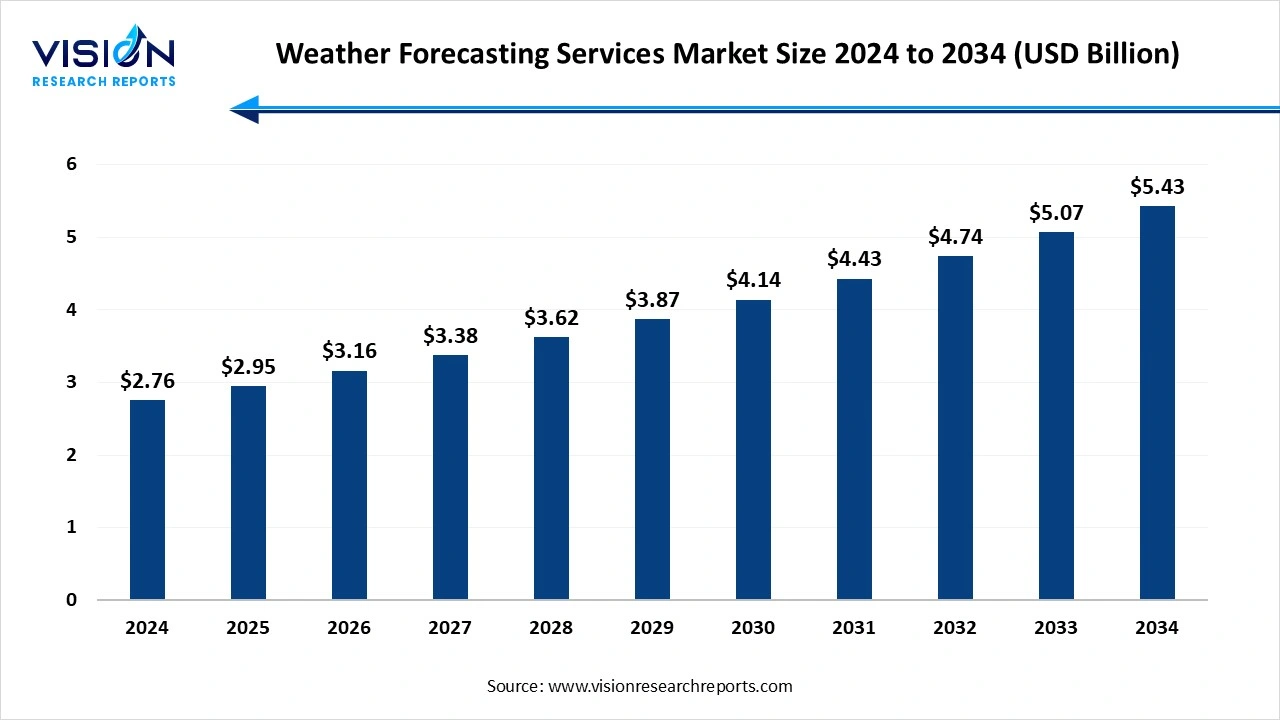
The global weather forecasting services market has witnessed significant growth in recent years, driven by the rising demand for accurate and timely weather information across various industries such as agriculture, aviation, energy, transportation, and marine. These services play a critical role in minimizing weather-related disruptions, enhancing safety, and optimizing operational efficiency. Advancements in data analytics, machine learning, and satellite technologies have further strengthened forecasting accuracy, enabling more precise short- and long-term predictions. As climate change continues to impact global weather patterns, the need for reliable forecasting solutions is expected to rise, prompting increased investment in innovative meteorological tools and platforms.
One of the primary growth drivers of the weather forecasting services market is the increasing frequency and intensity of extreme weather events, such as hurricanes, floods, and wildfires, fueled by climate change. These events pose substantial risks to life, infrastructure, and economies, prompting governments and organizations to invest heavily in advanced forecasting technologies. Additionally, sectors like agriculture, aviation, and energy depend heavily on accurate weather predictions to optimize operations, reduce losses, and ensure safety further amplifying the demand for high-precision meteorological services.
Another significant growth factor is the rapid advancement of technologies such as artificial intelligence (AI), big data analytics, and Internet of Things (IoT) devices, which have enhanced the accuracy, speed, and accessibility of weather data. The proliferation of mobile applications and real-time weather tracking tools has also expanded the consumer base beyond traditional industries to include individuals and small businesses. As digital transformation accelerates across sectors, integration of forecasting services into operational systems will continue to fuel market expansion and innovation.
North America led the weather forecasting services market, accounting for the largest revenue share at 28% in 2024. The region has developed a mature ecosystem of meteorological research, data analytics, and service delivery, making it a hub for innovation in the forecasting space. The United States, in particular, stands at the forefront, benefiting from extensive government support through agencies like the National Oceanic and Atmospheric Administration (NOAA) and the National Weather Service (NWS). These organizations collaborate closely with private firms and academic institutions to enhance forecasting accuracy and expand the commercial applications of weather data.
The weather forecasting services market in the Asia Pacific region is projected to experience the highest compound annual growth rate (CAGR) of 7% between 2025 and 2034. Countries such as China, India, and Japan are investing heavily in weather forecasting capabilities to address challenges posed by natural disasters, agriculture planning, and energy management. Government-led initiatives and private sector collaborations are expanding access to real-time weather data and improving forecast accuracy across the region. Meanwhile, Latin America and the Middle East & Africa are gradually expanding their market presence, driven by growing awareness of the economic impacts of weather variability and a rising emphasis on infrastructure resilience and agricultural sustainability.
The large enterprises segment dominated the market in 2024 In the global weather forecasting services market, large enterprises continue to dominate due to their substantial investment capabilities, access to advanced technologies, and the critical need for precise weather data in their operations. Industries such as aviation, maritime, energy, and large-scale agriculture rely heavily on high-quality forecasting services to ensure safety, optimize logistics, and minimize weather-related disruptions. These organizations often integrate customized forecasting solutions into their operational frameworks, leveraging real-time data and predictive analytics to enhance decision-making processes. Their demand for high-frequency, hyperlocal, and industry-specific forecasts drives innovation and scalability within the sector.
The small and medium enterprises (SMEs) segment is projected to experience the fastest compound annual growth rate (CAGR) from 2025 to 2034. The rise of cloud-based platforms, subscription-based models, and mobile applications has lowered the entry barrier for smaller businesses. SMEs in agriculture, tourism, construction, and event management sectors are particularly benefiting from affordable, user-friendly forecasting tools that help mitigate risk and improve planning. While they may not require the same level of customization as large enterprises, SMEs are a growing segment that demands flexible, scalable, and reliable solutions, contributing to the diversification and expansion of the weather forecasting services market.
The medium-range segment dominated the market, capturing the largest revenue share at 29% in 2024. This growth is driven by the rising demand for dependable forecasts in weather-sensitive sectors like agriculture, construction, and logistics. Covering a period of 3 to 10 days, medium-range forecasts offer a crucial timeframe for operational decision-making and resource management. To meet this demand, the weather forecasting services industry is advancing model accuracy and adopting probabilistic forecasting methods to better handle uncertainty and risk. As businesses strive to balance immediate responsiveness with strategic foresight, this segment continues to gain momentum.
The short-range segment is projected to experience the highest compound annual growth rate (CAGR) of 7.1% during the period from 2025 to 2034. Short-range weather forecasting segment, typically covering predictions up to three days, holds a significant share in the global market due to its critical role in immediate decision-making across multiple sectors. Industries such as aviation, logistics, agriculture, and emergency services rely heavily on short-range forecasts to plan daily operations, manage resources, and respond swiftly to changing weather conditions. With advancements in radar systems, satellite imaging, and real-time data analytics, the accuracy and reliability of short-term forecasts have improved substantially, driving widespread adoption.
The media segment held market in 2024. In the media industry, weather forecasting services play a crucial role in delivering accurate, timely, and engaging content to audiences across television, radio, digital platforms, and mobile applications. As public interest in real-time weather updates, severe weather alerts, and climate trends continues to grow, media organizations rely heavily on advanced forecasting tools to maintain credibility and relevance. High-resolution visuals, dynamic mapping, and interactive features enabled by modern forecasting technologies enhance viewer engagement and content personalization. The increasing competition among media outlets has further intensified the demand for reliable weather data, with many partnering directly with meteorological service providers to ensure exclusive, up-to-date reporting. ather-related risks in advance. The increasing sophistication of numerical weather prediction models and ensemble forecasting techniques has enhanced the credibility of medium-range forecasts.
The renewables sector is projected to experience the highest CAGR between 2025 and 2034. renewables industry, particularly in solar and wind energy, has emerged as one of the most important end users of weather forecasting services. Accurate weather predictions are essential for managing energy production, optimizing grid integration, and minimizing operational downtime. For solar energy producers, forecasts on sunlight duration and intensity help in predicting energy yields, while wind energy operators depend on wind speed and direction data to plan turbine operation and maintenance. As the world accelerates its transition to clean energy, the demand for highly localized, short- and medium-term weather forecasts tailored for renewable energy applications is growing rapidly.
By Forecast
By Organization Size
By Industry
By Regional
Chapter 1. Introduction
1.1. Research Objective
1.2. Scope of the Study
1.3. Definition
Chapter 2. Research Methodology
2.1. Research Approach
2.2. Data Sources
2.3. Assumptions & Limitations
Chapter 3. Executive Summary
3.1. Market Snapshot
Chapter 4. Market Variables and Scope
4.1. Introduction
4.2. Market Classification and Scope
4.3. Industry Value Chain Analysis
4.3.1. Raw Material Procurement Analysis
4.3.2. Sales and Distribution Organization Size Analysis
4.3.3. Downstream Buyer Analysis
Chapter 5. COVID 19 Impact on Weather Forecasting Services Market
5.1. COVID-19 Landscape: Weather Forecasting Services Industry Impact
5.2. COVID 19 - Impact Assessment for the Industry
5.3. COVID 19 Impact: Global Major Government Policy
5.4. Market Trends and Opportunities in the COVID-19 Landscape
Chapter 6. Market Dynamics Analysis and Trends
6.1. Market Dynamics
6.1.1. Market Drivers
6.1.2. Market Restraints
6.1.3. Market Opportunities
6.2. Porter’s Five Forces Analysis
6.2.1. Bargaining power of suppliers
6.2.2. Bargaining power of buyers
6.2.3. Threat of substitute
6.2.4. Threat of new entrants
6.2.5. Degree of competition
Chapter 7. Competitive Landscape
7.1.1. Company Market Share/Positioning Analysis
7.1.2. Key Strategies Adopted by Players
7.1.3. Vendor Landscape
7.1.3.1. List of Suppliers
7.1.3.2. List of Buyers
Chapter 8. Global Weather Forecasting Services Market, By Organization Size
8.1. Weather Forecasting Services Market, by Organization Size
8.1.1 Large Enterprises
8.1.1.1. Market Revenue and Forecast
8.1.2. Small & Medium Enterprises
8.1.2.1. Market Revenue and Forecast
Chapter 9. Global Weather Forecasting Services Market, By Forecast
9.1. Weather Forecasting Services Market, by Forecast
9.1.1. Nowcasting
9.1.1.1. Market Revenue and Forecast
9.1.2. Short-range
9.1.2.1. Market Revenue and Forecast
9.1.3. Medium-range
9.1.3.1. Market Revenue and Forecast
9.1.4. Long-range
9.1.4.1. Market Revenue and Forecast
Chapter 10. Global Weather Forecasting Services Market, By Industry
10.1. Weather Forecasting Services Market, by Industry
10.1.1. Agriculture
10.1.1.1. Market Revenue and Forecast
10.1.2. Aviation
10.1.2.1. Market Revenue and Forecast
10.1.3. Energy & Utilities
10.1.3.1. Market Revenue and Forecast
10.1.4. Renewables
10.1.4.1. Market Revenue and Forecast
10.1.5. Retail
10.1.5.1. Market Revenue and Forecast
10.1.6. Manufacturing
10.1.6.1. Market Revenue and Forecast
10.1.7. Media
10.1.7.1. Market Revenue and Forecast
10.1.8. Logistics & Transportation
10.1.8.1. Market Revenue and Forecast
10.1.9. Marine
10.1.9.1. Market Revenue and Forecast
10.1.10. Others
10.1.10.1. Market Revenue and Forecast
Chapter 11. Global Weather Forecasting Services Market, Regional Estimates and Trend Forecast
11.1. North America
11.1.1. Market Revenue and Forecast, by Organization Size
11.1.2. Market Revenue and Forecast, by Forecast
11.1.3. Market Revenue and Forecast, by Industry
11.1.4. U.S.
11.1.4.1. Market Revenue and Forecast, by Organization Size
11.1.4.2. Market Revenue and Forecast, by Forecast
11.1.4.3. Market Revenue and Forecast, by Industry
11.1.5. Rest of North America
11.1.5.1. Market Revenue and Forecast, by Organization Size
11.1.5.2. Market Revenue and Forecast, by Forecast
11.1.5.3. Market Revenue and Forecast, by Industry
11.2. Europe
11.2.1. Market Revenue and Forecast, by Organization Size
11.2.2. Market Revenue and Forecast, by Forecast
11.2.3. Market Revenue and Forecast, by Industry
11.2.4. UK
11.2.4.1. Market Revenue and Forecast, by Organization Size
11.2.4.2. Market Revenue and Forecast, by Forecast
11.2.4.3. Market Revenue and Forecast, by Industry
11.2.5. Germany
11.2.5.1. Market Revenue and Forecast, by Organization Size
11.2.5.2. Market Revenue and Forecast, by Forecast
11.2.5.3. Market Revenue and Forecast, by Industry
11.2.6. France
11.2.6.1. Market Revenue and Forecast, by Organization Size
11.2.6.2. Market Revenue and Forecast, by Forecast
11.2.6.3. Market Revenue and Forecast, by Industry
11.2.7. Rest of Europe
11.2.7.1. Market Revenue and Forecast, by Organization Size
11.2.7.2. Market Revenue and Forecast, by Forecast
11.2.7.3. Market Revenue and Forecast, by Industry
11.3. APAC
11.3.1. Market Revenue and Forecast, by Organization Size
11.3.2. Market Revenue and Forecast, by Forecast
11.3.3. Market Revenue and Forecast, by Industry
11.3.4. India
11.3.4.1. Market Revenue and Forecast, by Organization Size
11.3.4.2. Market Revenue and Forecast, by Forecast
11.3.4.3. Market Revenue and Forecast, by Industry
11.3.5. China
11.3.5.1. Market Revenue and Forecast, by Organization Size
11.3.5.2. Market Revenue and Forecast, by Forecast
11.3.5.3. Market Revenue and Forecast, by Industry
11.3.6. Japan
11.3.6.1. Market Revenue and Forecast, by Organization Size
11.3.6.2. Market Revenue and Forecast, by Forecast
11.3.6.3. Market Revenue and Forecast, by Industry
11.3.7. Rest of APAC
11.3.7.1. Market Revenue and Forecast, by Organization Size
11.3.7.2. Market Revenue and Forecast, by Forecast
11.3.7.3. Market Revenue and Forecast, by Industry
11.4. MEA
11.4.1. Market Revenue and Forecast, by Organization Size
11.4.2. Market Revenue and Forecast, by Forecast
11.4.3. Market Revenue and Forecast, by Industry
11.4.4. GCC
11.4.4.1. Market Revenue and Forecast, by Organization Size
11.4.4.2. Market Revenue and Forecast, by Forecast
11.4.4.3. Market Revenue and Forecast, by Industry
11.4.5. North Africa
11.4.5.1. Market Revenue and Forecast, by Organization Size
11.4.5.2. Market Revenue and Forecast, by Forecast
11.4.5.3. Market Revenue and Forecast, by Industry
11.4.6. South Africa
11.4.6.1. Market Revenue and Forecast, by Organization Size
11.4.6.2. Market Revenue and Forecast, by Forecast
11.4.6.3. Market Revenue and Forecast, by Industry
11.4.7. Rest of MEA
11.4.7.1. Market Revenue and Forecast, by Organization Size
11.4.7.2. Market Revenue and Forecast, by Forecast
11.4.7.3. Market Revenue and Forecast, by Industry
11.5. Latin America
11.5.1. Market Revenue and Forecast, by Organization Size
11.5.2. Market Revenue and Forecast, by Forecast
11.5.3. Market Revenue and Forecast, by Industry
11.5.4. Brazil
11.5.4.1. Market Revenue and Forecast, by Organization Size
11.5.4.2. Market Revenue and Forecast, by Forecast
11.5.4.3. Market Revenue and Forecast, by Industry
11.5.5. Rest of LATAM
11.5.5.1. Market Revenue and Forecast, by Organization Size
11.5.5.2. Market Revenue and Forecast, by Forecast
11.5.5.3. Market Revenue and Forecast, by Industry
Chapter 12. Company Profiles
12.1. AccuWeather, Inc.
12.1.1. Company Overview
12.1.2. Product Offerings
12.1.3. Financial Performance
12.1.4. Recent Initiatives
12.2. The Weather Company (an IBM Business).
12.2.1. Company Overview
12.2.2. Product Offerings
12.2.3. Financial Performance
12.2.4. Recent Initiatives
12.3. DTN (Data Transmission Network).
12.3.1. Company Overview
12.3.2. Product Offerings
12.3.3. Financial Performance
12.3.4. Recent Initiatives
12.4. StormGeo (a part of Alfa Laval).
12.4.1. Company Overview
12.4.2. Product Offerings
12.4.3. Financial Performance
12.4.4. Recent Initiatives
12.5. Fugro.
12.5.1. Company Overview
12.5.2. Product Offerings
12.5.3. Financial Performance
12.5.4. Recent Initiatives
12.6. Global Weather Corporation
12.6.1. Company Overview
12.6.2. Product Offerings
12.6.3. Financial Performance
12.6.4. Recent Initiatives
12.7. BMT Group Ltd.
12.7.1. Company Overview
12.7.2. Product Offerings
12.7.3. Financial Performance
12.7.4. Recent Initiatives
12.8. Met Office (UK)
12.8.1. Company Overview
12.8.2. Product Offerings
12.8.3. Financial Performance
12.8.4. Recent Initiatives
12.9. Skyview Systems Ltd.
12.9.1. Company Overview
12.9.2. Product Offerings
12.9.3. Financial Performance
12.9.4. Recent Initiatives
12.10. Enav S.p.A.
12.10.1. Company Overview
12.10.2. Product Offerings
12.10.3. Financial Performance
12.10.4. Recent Initiatives
Chapter 13. Research Methodology
13.1. Primary Research
13.2. Secondary Research
13.3. Assumptions
Chapter 14. Appendix
14.1. About Us
14.2. Glossary of Terms
 Cross-segment Market Size and Analysis for
Mentioned Segments
Additional Company Profiles (Upto 5 With No Cost)
Additional Countries (Apart From Mentioned Countries)
Country/Region-specific Report
Go To Market Strategy
Region Specific Market DynamicsRegion Level Market Share Import Export AnalysisProduction AnalysisOthers
Cross-segment Market Size and Analysis for
Mentioned Segments
Additional Company Profiles (Upto 5 With No Cost)
Additional Countries (Apart From Mentioned Countries)
Country/Region-specific Report
Go To Market Strategy
Region Specific Market DynamicsRegion Level Market Share Import Export AnalysisProduction AnalysisOthers