
Wound Cleanser Products Market Size, Share, Growth, Trends | Report 2022-2030
The global wound cleanser products market was estimated at USD 1.87 billion in 2021 and it is expected to surpass around USD 2.61 billion by 2030, poised to grow at a CAGR of 3.76% from 2022 to 2030.
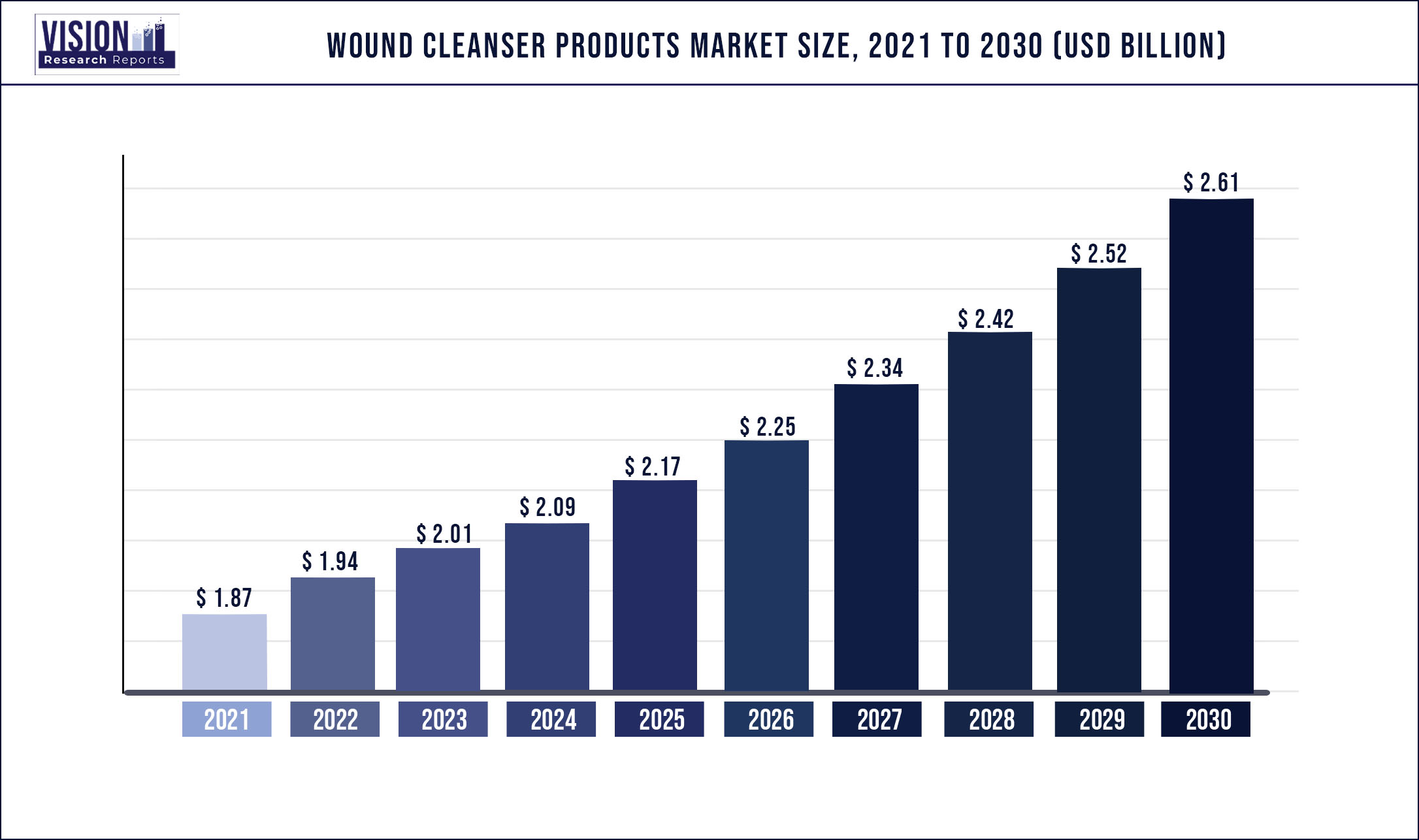
The need for wound cleanser products is growing as a result of the rising incidence of chronic diseases and the increase in the number of surgical procedures worldwide. One of the main drivers of market expansion is the rising incidence of diabetes driven by sedentary lifestyles. For instance, the American Diabetes Association estimates that 34.2 million Americans, or 10.5% of the nation's population, had diabetes in 2018. Additionally, roughly 1.6 million Americans, including about 187,000 children and adolescents, had type 1 diabetes.
Diabetic patients frequently develop diabetic foot ulcers, which can be treated with wound-cleansing products. For instance, as per, ScienceDirect, around 20% of individuals suffering from diabetic foot ulcers may need to have their foot amputated. Diabetic foot ulcers may impact more than 25% of the diabetic population. Wound cleanser products provide a quick and effective way to keep the environment around the wound moist and hasten the healing of diabetic foot ulcers.
Additionally, the market for wound cleanser products is anticipated to grow as more people suffer traumatic injuries globally. For instance, according to the WHO (2018), over 1,000,000 people in India suffer severe or moderate burns every year. Likewise, according to NCBI, an increase in the number of burn injuries was reported in 2017 in nations like Bulgaria, Finland, the Netherlands, China, Australia, and the United Kingdom.
Furthermore, according to the WHO, traffic-related accidents are thought to be the cause of 22,941 deaths in Thailand each year or around 33% of all fatalities there. Wound cleanser products are advised for the treatment of simple burns, and wounds. Thus, as a result of above-mentioned factors, the wound cleanser products market may witness lucrative growth in the forecast duration.
The market is expected to further grow over the next few years as a result of factors like the increasing focus on awareness programs by various healthcare facilities for the incorporation of wound care facilities. Moreover, strategies such as product launch, acquisitions, FDA approvals, and Medicaid reimbursements is further anticipated to boost the market growth.
A significant factor boosting market expansion is also the rising elderly population base. For instance, the United Nations Organization estimates that there were approximately 962.0 million elderly people in 2017 and has projected the number to rise to almost 2.1 billion by the year 2050. The aging population is more prone to injuries, that could boost the market during the forecast period.
Additionally, a rise in the number of ambulatory surgical centers (ASCs) is anticipated to fuel the wound cleanser products market growth. ASCs provide a range of treatments, including surgical treatment, diagnostic tests, and wellness checks. Ambulatory surgery centers also perform procedures related to the gastrointestinal (GI) system, urology, orthopedics, restorative, reconstructive, or alternative plastic surgery. Further, the number of ASCs is increasing globally. According to Advancing Surgical Care estimates there were 6,023 ASCs in the United States as of March 2021. The number of surgical procedures is predicted to rise in these surgical centers, which in turn will increase the use of wound cleanser products, thereby driving the growth of the wound cleanser products market in the forecast duration.
Scope of The Report
| Report Coverage | Details |
| Market Size in 2021 | USD 1.87 billion |
| Revenue Forecast by 2030 | USD 2.61 billion |
| Growth rate from 2022 to 2030 | CAGR of 3.76% |
| Base Year | 2021 |
| Forecast Period | 2022 to 2030 |
| Segmentation | Product, Form, Wound Type, End User, Region |
| Companies Covered |
ConvaTec Group plc, Smith & Nephew plc, B. Braun Melsungen AG, Coloplast Corp., Ethicon (Johnson & Johnson), 3M, Molnlycke Healthcare AB, Integra LifeSciences, McKesson Corporation, Medline Industries. |
Key Players
Market Segmentation
Chapter 1. Introduction
1.1. Research Objective
1.2. Scope of the Study
1.3. Definition
Chapter 2. Research Methodology
2.1. Research Approach
2.2. Data Sources
2.3. Assumptions & Limitations
Chapter 3. Executive Summary
3.1. Market Snapshot
Chapter 4. Market Variables and Scope
4.1. Introduction
4.2. Market Classification and Scope
4.3. Industry Value Chain Analysis
4.3.1. Raw Material Procurement Analysis
4.3.2. Sales and Distribution Channel Analysis
4.3.3. Downstream Buyer Analysis
Chapter 5. COVID 19 Impact on Wound Cleanser Products Market
5.1. COVID-19 Landscape: Wound Cleanser Products Industry Impact
5.2. COVID 19 - Impact Assessment for the Industry
5.3. COVID 19 Impact: Global Major Government Policy
5.4. Market Trends and Opportunities in the COVID-19 Landscape
Chapter 6. Market Dynamics Analysis and Trends
6.1. Market Dynamics
6.1.1. Market Drivers
6.1.2. Market Restraints
6.1.3. Market Opportunities
6.2. Porter’s Five Forces Analysis
6.2.1. Bargaining power of suppliers
6.2.2. Bargaining power of buyers
6.2.3. Threat of substitute
6.2.4. Threat of new entrants
6.2.5. Degree of competition
Chapter 7. Competitive Landscape
7.1.1. Company Market Share/Positioning Analysis
7.1.2. Key Strategies Adopted by Players
7.1.3. Vendor Landscape
7.1.3.1. List of Suppliers
7.1.3.2. List of Buyers
Chapter 8. Global Wound Cleanser Products Market, By Product
8.1. Wound Cleanser Products Market, by Product, 2022-2030
8.1.1. Wetting Agents
8.1.1.1. Market Revenue and Forecast (2017-2030)
8.1.2. Antiseptic
8.1.2.1. Market Revenue and Forecast (2017-2030)
8.1.3. Moisturizers
8.1.3.1. Market Revenue and Forecast (2017-2030)
8.1.4. Others
8.1.4.1. Market Revenue and Forecast (2017-2030)
Chapter 9. Global Wound Cleanser Products Market, By Form
9.1. Wound Cleanser Products Market, by Form, 2022-2030
9.1.1. Sprays
9.1.1.1. Market Revenue and Forecast (2017-2030)
9.1.2. Solutions
9.1.2.1. Market Revenue and Forecast (2017-2030)
9.1.3. Foam
9.1.3.1. Market Revenue and Forecast (2017-2030)
9.1.4. Wipes
9.1.4.1. Market Revenue and Forecast (2017-2030)
9.1.5. Gels
9.1.5.1. Market Revenue and Forecast (2017-2030)
Chapter 10. Global Wound Cleanser Products Market, By Wound Type
10.1. Wound Cleanser Products Market, by Wound Type, 2022-2030
10.1.1. Acute Wounds
10.1.1.1. Market Revenue and Forecast (2017-2030)
10.1.2. Chronic Wounds
10.1.2.1. Market Revenue and Forecast (2017-2030)
10.1.3. Surgical Wounds
10.1.3.1. Market Revenue and Forecast (2017-2030)
10.1.4. Burns
10.1.4.1. Market Revenue and Forecast (2017-2030)
10.1.5. Others
10.1.5.1. Market Revenue and Forecast (2017-2030)
Chapter 11. Global Wound Cleanser Products Market, By End User
11.1. Wound Cleanser Products Market, by End User, 2022-2030
11.1.1. Hospitals
11.1.1.1. Market Revenue and Forecast (2017-2030)
11.1.2. Ambulatory Surgical Centers
11.1.2.1. Market Revenue and Forecast (2017-2030)
11.1.3. Clinics
11.1.3.1. Market Revenue and Forecast (2017-2030)
11.1.4. Long-term Care Centers
11.1.4.1. Market Revenue and Forecast (2017-2030)
11.1.5. Home Care Settings
11.1.5.1. Market Revenue and Forecast (2017-2030)
Chapter 12. Global Wound Cleanser Products Market, Regional Estimates and Trend Forecast
12.1. North America
12.1.1. Market Revenue and Forecast, by Product (2017-2030)
12.1.2. Market Revenue and Forecast, by Form (2017-2030)
12.1.3. Market Revenue and Forecast, by Wound Type (2017-2030)
12.1.4. Market Revenue and Forecast, by End User (2017-2030)
12.1.5. U.S.
12.1.5.1. Market Revenue and Forecast, by Product (2017-2030)
12.1.5.2. Market Revenue and Forecast, by Form (2017-2030)
12.1.5.3. Market Revenue and Forecast, by Wound Type (2017-2030)
12.1.5.4. Market Revenue and Forecast, by End User (2017-2030)
12.1.6. Rest of North America
12.1.6.1. Market Revenue and Forecast, by Product (2017-2030)
12.1.6.2. Market Revenue and Forecast, by Form (2017-2030)
12.1.6.3. Market Revenue and Forecast, by Wound Type (2017-2030)
12.1.6.4. Market Revenue and Forecast, by End User (2017-2030)
12.2. Europe
12.2.1. Market Revenue and Forecast, by Product (2017-2030)
12.2.2. Market Revenue and Forecast, by Form (2017-2030)
12.2.3. Market Revenue and Forecast, by Wound Type (2017-2030)
12.2.4. Market Revenue and Forecast, by End User (2017-2030)
12.2.5. UK
12.2.5.1. Market Revenue and Forecast, by Product (2017-2030)
12.2.5.2. Market Revenue and Forecast, by Form (2017-2030)
12.2.5.3. Market Revenue and Forecast, by Wound Type (2017-2030)
12.2.5.4. Market Revenue and Forecast, by End User (2017-2030)
12.2.6. Germany
12.2.6.1. Market Revenue and Forecast, by Product (2017-2030)
12.2.6.2. Market Revenue and Forecast, by Form (2017-2030)
12.2.6.3. Market Revenue and Forecast, by Wound Type (2017-2030)
12.2.6.4. Market Revenue and Forecast, by End User (2017-2030)
12.2.7. France
12.2.7.1. Market Revenue and Forecast, by Product (2017-2030)
12.2.7.2. Market Revenue and Forecast, by Form (2017-2030)
12.2.7.3. Market Revenue and Forecast, by Wound Type (2017-2030)
12.2.7.4. Market Revenue and Forecast, by End User (2017-2030)
12.2.8. Rest of Europe
12.2.8.1. Market Revenue and Forecast, by Product (2017-2030)
12.2.8.2. Market Revenue and Forecast, by Form (2017-2030)
12.2.8.3. Market Revenue and Forecast, by Wound Type (2017-2030)
12.2.8.4. Market Revenue and Forecast, by End User (2017-2030)
12.3. APAC
12.3.1. Market Revenue and Forecast, by Product (2017-2030)
12.3.2. Market Revenue and Forecast, by Form (2017-2030)
12.3.3. Market Revenue and Forecast, by Wound Type (2017-2030)
12.3.4. Market Revenue and Forecast, by End User (2017-2030)
12.3.5. India
12.3.5.1. Market Revenue and Forecast, by Product (2017-2030)
12.3.5.2. Market Revenue and Forecast, by Form (2017-2030)
12.3.5.3. Market Revenue and Forecast, by Wound Type (2017-2030)
12.3.5.4. Market Revenue and Forecast, by End User (2017-2030)
12.3.6. China
12.3.6.1. Market Revenue and Forecast, by Product (2017-2030)
12.3.6.2. Market Revenue and Forecast, by Form (2017-2030)
12.3.6.3. Market Revenue and Forecast, by Wound Type (2017-2030)
12.3.6.4. Market Revenue and Forecast, by End User (2017-2030)
12.3.7. Japan
12.3.7.1. Market Revenue and Forecast, by Product (2017-2030)
12.3.7.2. Market Revenue and Forecast, by Form (2017-2030)
12.3.7.3. Market Revenue and Forecast, by Wound Type (2017-2030)
12.3.7.4. Market Revenue and Forecast, by End User (2017-2030)
12.3.8. Rest of APAC
12.3.8.1. Market Revenue and Forecast, by Product (2017-2030)
12.3.8.2. Market Revenue and Forecast, by Form (2017-2030)
12.3.8.3. Market Revenue and Forecast, by Wound Type (2017-2030)
12.3.8.4. Market Revenue and Forecast, by End User (2017-2030)
12.4. MEA
12.4.1. Market Revenue and Forecast, by Product (2017-2030)
12.4.2. Market Revenue and Forecast, by Form (2017-2030)
12.4.3. Market Revenue and Forecast, by Wound Type (2017-2030)
12.4.4. Market Revenue and Forecast, by End User (2017-2030)
12.4.5. GCC
12.4.5.1. Market Revenue and Forecast, by Product (2017-2030)
12.4.5.2. Market Revenue and Forecast, by Form (2017-2030)
12.4.5.3. Market Revenue and Forecast, by Wound Type (2017-2030)
12.4.5.4. Market Revenue and Forecast, by End User (2017-2030)
12.4.6. North Africa
12.4.6.1. Market Revenue and Forecast, by Product (2017-2030)
12.4.6.2. Market Revenue and Forecast, by Form (2017-2030)
12.4.6.3. Market Revenue and Forecast, by Wound Type (2017-2030)
12.4.6.4. Market Revenue and Forecast, by End User (2017-2030)
12.4.7. South Africa
12.4.7.1. Market Revenue and Forecast, by Product (2017-2030)
12.4.7.2. Market Revenue and Forecast, by Form (2017-2030)
12.4.7.3. Market Revenue and Forecast, by Wound Type (2017-2030)
12.4.7.4. Market Revenue and Forecast, by End User (2017-2030)
12.4.8. Rest of MEA
12.4.8.1. Market Revenue and Forecast, by Product (2017-2030)
12.4.8.2. Market Revenue and Forecast, by Form (2017-2030)
12.4.8.3. Market Revenue and Forecast, by Wound Type (2017-2030)
12.4.8.4. Market Revenue and Forecast, by End User (2017-2030)
12.5. Latin America
12.5.1. Market Revenue and Forecast, by Product (2017-2030)
12.5.2. Market Revenue and Forecast, by Form (2017-2030)
12.5.3. Market Revenue and Forecast, by Wound Type (2017-2030)
12.5.4. Market Revenue and Forecast, by End User (2017-2030)
12.5.5. Brazil
12.5.5.1. Market Revenue and Forecast, by Product (2017-2030)
12.5.5.2. Market Revenue and Forecast, by Form (2017-2030)
12.5.5.3. Market Revenue and Forecast, by Wound Type (2017-2030)
12.5.5.4. Market Revenue and Forecast, by End User (2017-2030)
12.5.6. Rest of LATAM
12.5.6.1. Market Revenue and Forecast, by Product (2017-2030)
12.5.6.2. Market Revenue and Forecast, by Form (2017-2030)
12.5.6.3. Market Revenue and Forecast, by Wound Type (2017-2030)
12.5.6.4. Market Revenue and Forecast, by End User (2017-2030)
Chapter 13. Company Profiles
13.1. ConvaTec Group plc
13.1.1. Company Overview
13.1.2. Product Offerings
13.1.3. Financial Performance
13.1.4. Recent Initiatives
13.2. Smith & Nephew plc
13.2.1. Company Overview
13.2.2. Product Offerings
13.2.3. Financial Performance
13.2.4. Recent Initiatives
13.3. B. Braun Melsungen AG
13.3.1. Company Overview
13.3.2. Product Offerings
13.3.3. Financial Performance
13.3.4. Recent Initiatives
13.4. Coloplast Corp.
13.4.1. Company Overview
13.4.2. Product Offerings
13.4.3. Financial Performance
13.4.4. Recent Initiatives
13.5. Ethicon (Johnson & Johnson)
13.5.1. Company Overview
13.5.2. Product Offerings
13.5.3. Financial Performance
13.5.4. Recent Initiatives
13.6. 3M
13.6.1. Company Overview
13.6.2. Product Offerings
13.6.3. Financial Performance
13.6.4. Recent Initiatives
13.7. Molnlycke Healthcare AB
13.7.1. Company Overview
13.7.2. Product Offerings
13.7.3. Financial Performance
13.7.4. Recent Initiatives
13.8. Integra LifeSciences
13.8.1. Company Overview
13.8.2. Product Offerings
13.8.3. Financial Performance
13.8.4. Recent Initiatives
13.9. McKesson Corporation
13.9.1. Company Overview
13.9.2. Product Offerings
13.9.3. Financial Performance
13.9.4. Recent Initiatives
13.10. Medline Industries.
13.10.1. Company Overview
13.10.2. Product Offerings
13.10.3. Financial Performance
13.10.4. Recent Initiatives
Chapter 14. Research Methodology
14.1. Primary Research
14.2. Secondary Research
14.3. Assumptions
Chapter 15. Appendix
15.1. About Us
15.2. Glossary of Terms
 Cross-segment Market Size and Analysis for
Mentioned Segments
Additional Company Profiles (Upto 5 With No Cost)
Additional Countries (Apart From Mentioned Countries)
Country/Region-specific Report
Go To Market Strategy
Region Specific Market DynamicsRegion Level Market Share Import Export AnalysisProduction AnalysisOthers
Cross-segment Market Size and Analysis for
Mentioned Segments
Additional Company Profiles (Upto 5 With No Cost)
Additional Countries (Apart From Mentioned Countries)
Country/Region-specific Report
Go To Market Strategy
Region Specific Market DynamicsRegion Level Market Share Import Export AnalysisProduction AnalysisOthers