The global digital oilfield market size was surpassed at around USD 29.04 billion in 2024 and it is projected to hit around USD 53.50 billion by 2034, growing at a CAGR of 6.30% from 2025 to 2034.
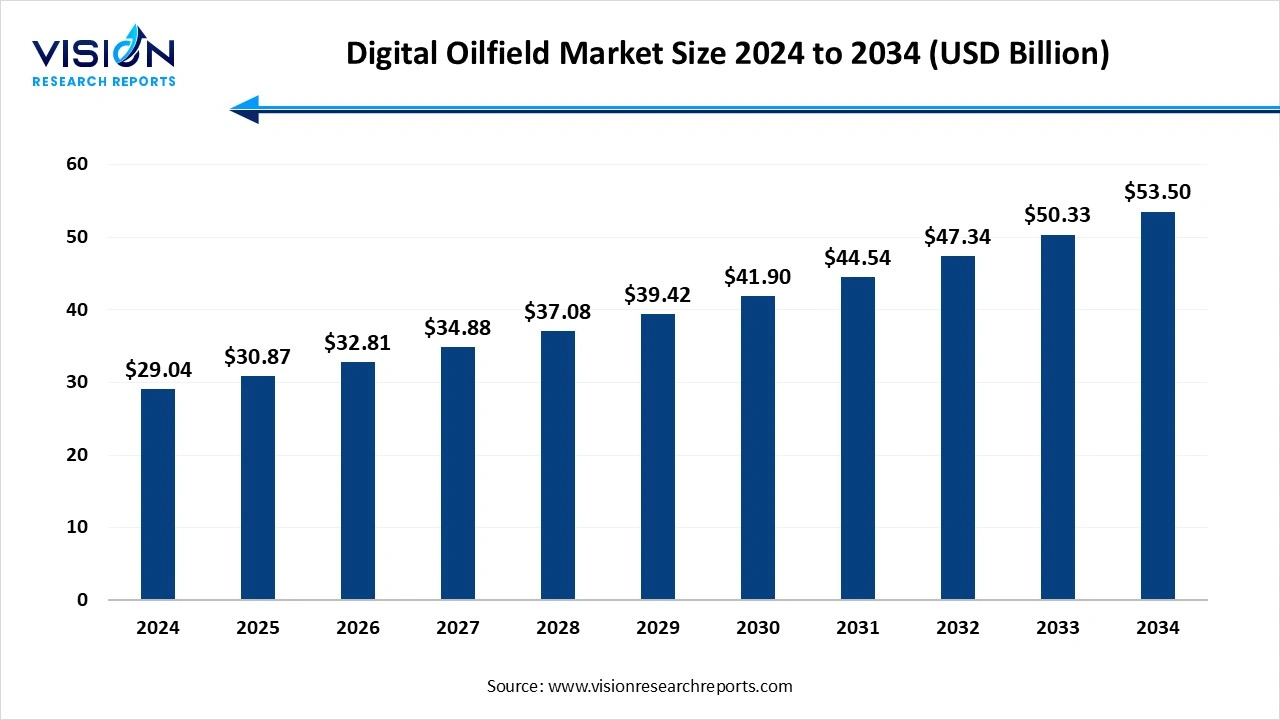
The digital oilfield market represents a transformative evolution in the oil and gas sector, integrating advanced digital technologies such as automation, data analytics, artificial intelligence (AI), and the Internet of Things (IoT) to optimize operations. These technologies enable real-time monitoring, predictive maintenance, enhanced decision-making, and improved production efficiency across upstream, midstream, and downstream segments. The adoption of digital oilfield solutions is helping companies increase output while reducing operational costs and minimizing environmental impact.
One of the key growth factors driving the digital oilfield market is the increasing demand for operational efficiency and cost reduction in oil and gas operations. With fluctuating oil prices and rising exploration costs, companies are turning to digital technologies to optimize their resources. Advanced solutions such as real-time data analytics, automated drilling, and remote monitoring allow operators to make faster, more accurate decisions, leading to improved productivity and lower downtime. Additionally, digital tools help extend asset lifespans and reduce unplanned maintenance costs, offering a clear return on investment.
Another significant driver is the growing integration of IoT and artificial intelligence in oilfield operations. These technologies facilitate predictive maintenance, enhance reservoir modeling, and improve safety through early risk detection. Governments and industry regulators are also encouraging the adoption of digital technologies to ensure better compliance and environmental monitoring.
The digital oilfield market is witnessing a strong shift towards the adoption of cloud-based platforms and advanced analytics. Cloud computing allows for centralized data storage, seamless collaboration across geographically dispersed teams, and real-time access to operational insights. Combined with big data analytics, it enables companies to analyze vast volumes of operational and geological data to identify patterns, predict equipment failures, and make proactive decisions.
Another emerging trend is the integration of artificial intelligence (AI), machine learning (ML), and robotics to automate complex processes and enhance decision-making. AI-powered systems are being used to optimize drilling operations, forecast production rates, and detect anomalies in equipment behavior.
One of the primary challenges facing the digital oilfield market is the high initial investment and infrastructure requirements. Implementing digital solutions such as IoT sensors, advanced analytics platforms, and automation systems can involve significant capital expenditure, particularly for small and mid-sized oil companies. Additionally, integrating new technologies with legacy equipment often demands specialized expertise and customized solutions, which can increase implementation complexity and cost.
Another major challenge is the concern over data security and cyber threats. As oilfield operations become more connected and reliant on digital systems, they become increasingly vulnerable to cyberattacks and data breaches. The industry handles critical infrastructure and sensitive information, making cybersecurity a top priority. However, many companies lack the in-house capabilities to implement robust cybersecurity measures.
North America led the global digital oilfield market, accounting for a 35% share of the total revenue in 2024. The United States, in particular, is at the forefront of adopting digital oilfield technologies, driven by its extensive shale operations, high exploration activity, and early adoption of automation and analytics. Favorable government policies, a mature energy sector, and investments in digital transformation further support the market’s growth in this region.
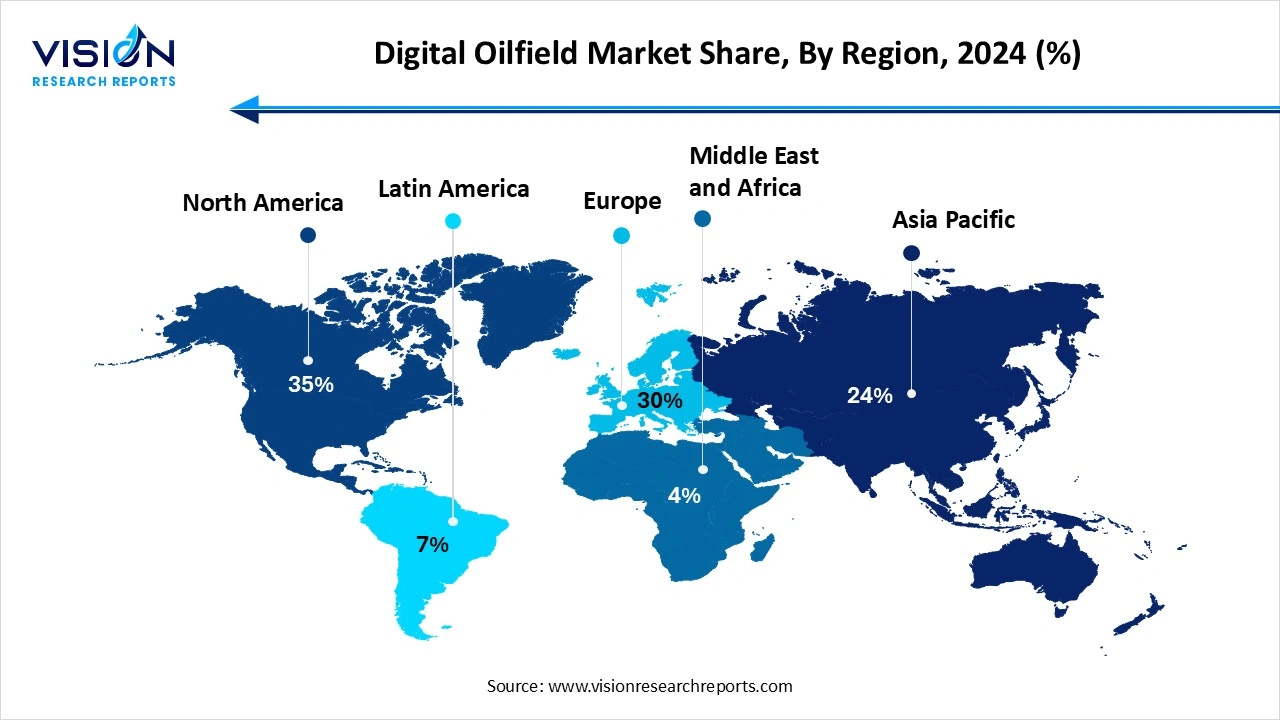 The digital oilfield industry in Asia Pacific is projected to witness the fastest growth, with a CAGR of 7.3% over the forecast period. In the Asia-Pacific region, rapid industrialization, rising energy demand, and increasing oil and gas exploration activities in countries like China, India, and Australia are propelling the adoption of digital technologies.
The Product optimization led the digital oilfield industry in generating a revenue share of 31% in 2024, Through the integration of real-time data analytics, machine learning algorithms, and advanced control systems, oil and gas companies can fine-tune production strategies to improve well performance and reservoir management. Digital tools enable the continuous monitoring of pressure, temperature, flow rates, and other key metrics, allowing operators to make informed decisions and respond swiftly to changes in field conditions.
The safety management is another vital aspect of digital oilfield processes, where technology is leveraged to mitigate risks and ensure compliance with health, safety, and environmental regulations. Advanced monitoring systems, including IoT-enabled sensors and predictive analytics, help detect anomalies and hazardous conditions before they escalate into critical failures. Remote operations and automated safety protocols reduce the need for human intervention in high-risk environments, thereby minimizing the likelihood of workplace accidents.
The hardware solutions accounted for the largest market share at 50% in 2024. Key hardware components include sensors, control systems, industrial computers, distributed control systems (DCS), programmable logic controllers (PLCs), and field instruments that are strategically deployed across drilling sites and production facilities. These devices facilitate the continuous monitoring of parameters such as pressure, temperature, flow, and equipment performance.
The data storage solutions segment is projected to record the fastest CAGR of 7.4% throughout the forecast period. The oil and gas sector generates massive amounts of data daily from various sources such as sensors, seismic surveys, drilling logs, and production equipment. Efficient storage solutions, including cloud-based systems and on-premise data centers, are essential for capturing, organizing, and securing this information. Cloud storage, in particular, enables scalability, remote accessibility, and collaboration across multiple teams and geographic locations.
The onshore application segment led the digital oilfield market, capturing a revenue share of 66% in 2024. Digital technologies are increasingly being adopted across onshore fields to enhance production efficiency, reduce operational costs, and improve asset management. Onshore operations benefit from the deployment of real-time monitoring systems, automated drilling technologies, and predictive maintenance solutions, which collectively enable better resource allocation and improved decision-making.
The offshore application is expected to register the fastest CAGR of 6.7% during the forecast period. Offshore platforms rely heavily on real-time data analytics, remote monitoring, and automated control systems to manage complex operations, ensure safety, and reduce human intervention in hazardous areas. The use of digital twins, robotics, and subsea sensors allows for efficient management of deepwater drilling and production activities, minimizing downtime and optimizing reservoir performance.
By Process
By Solution
By Application
By Regional
Chapter 1. Introduction
1.1. Research Objective
1.2. Scope of the Study
1.3. Definition
Chapter 2. Research Methodology
2.1. Research Approach
2.2. Data Sources
2.3. Assumptions & Limitations
Chapter 3. Executive Summary
3.1. Market Snapshot
Chapter 4. Market Variables and Scope
4.1. Introduction
4.2. Market Classification and Scope
4.3. Industry Value Chain Analysis
4.3.1. Raw Material Procurement Analysis
4.3.2. Sales and Distribution Process Analysis
4.3.3. Downstream Buyer Analysis
Chapter 5. COVID 19 Impact on Digital Oilfield Market
5.1. COVID-19 Landscape: Digital Oilfield Industry Impact
5.2. COVID 19 - Impact Assessment for the Industry
5.3. COVID 19 Impact: Global Major Government Policy
5.4. Market Trends and Opportunities in the COVID-19 Landscape
Chapter 6. Market Dynamics Analysis and Trends
6.1. Market Dynamics
6.1.1. Market Drivers
6.1.2. Market Restraints
6.1.3. Market Opportunities
6.2. Porter’s Five Forces Analysis
6.2.1. Bargaining power of suppliers
6.2.2. Bargaining power of buyers
6.2.3. Threat of substitute
6.2.4. Threat of new entrants
6.2.5. Degree of competition
Chapter 7. Competitive Landscape
7.1.1. Company Market Share/Positioning Analysis
7.1.2. Key Strategies Adopted by Players
7.1.3. Vendor Landscape
7.1.3.1. List of Suppliers
7.1.3.2. List of Buyers
Chapter 8. Global Digital Oilfield Market, By Process
8.1. Digital Oilfield Market, by Process
8.1.1 Product Optimization
8.1.1.1. Market Revenue and Forecast
8.1.2. Drilling Optimization
8.1.2.1. Market Revenue and Forecast
8.1.3. Reservoir Optimization
8.1.3.1. Market Revenue and Forecast
8.1.4. Safety Management
8.1.4.1. Market Revenue and Forecast
8.1.5. Asset Management
8.1.5.1. Market Revenue and Forecast
Chapter 9. Global Digital Oilfield Market, By Solution
9.1. Digital Oilfield Market, by Solution
9.1.1. Hardware Solutions
9.1.1.1. Market Revenue and Forecast
9.1.2. Software & Service Solutions
9.1.2.1. Market Revenue and Forecast
9.1.3. Data Storage Solutions
9.1.3.1. Market Revenue and Forecast
Chapter 10. Global Digital Oilfield Market, By Application
10.1. Digital Oilfield Market, by Application
10.1.1. Onshore
10.1.1.1. Market Revenue and Forecast
10.1.2. Offshore
10.1.2.1. Market Revenue and Forecast
Chapter 11. Global Digital Oilfield Market, Regional Estimates and Trend Forecast
11.1. North America
11.1.1. Market Revenue and Forecast, by Process
11.1.2. Market Revenue and Forecast, by Solution
11.1.3. Market Revenue and Forecast, by Application
11.1.4. U.S.
11.1.4.1. Market Revenue and Forecast, by Process
11.1.4.2. Market Revenue and Forecast, by Solution
11.1.4.3. Market Revenue and Forecast, by Application
11.1.5. Rest of North America
11.1.5.1. Market Revenue and Forecast, by Process
11.1.5.2. Market Revenue and Forecast, by Solution
11.1.5.3. Market Revenue and Forecast, by Application
11.2. Europe
11.2.1. Market Revenue and Forecast, by Process
11.2.2. Market Revenue and Forecast, by Solution
11.2.3. Market Revenue and Forecast, by Application
11.2.4. UK
11.2.4.1. Market Revenue and Forecast, by Process
11.2.4.2. Market Revenue and Forecast, by Solution
11.2.4.3. Market Revenue and Forecast, by Application
11.2.5. Germany
11.2.5.1. Market Revenue and Forecast, by Process
11.2.5.2. Market Revenue and Forecast, by Solution
11.2.5.3. Market Revenue and Forecast, by Application
11.2.6. France
11.2.6.1. Market Revenue and Forecast, by Process
11.2.6.2. Market Revenue and Forecast, by Solution
11.2.6.3. Market Revenue and Forecast, by Application
11.2.7. Rest of Europe
11.2.7.1. Market Revenue and Forecast, by Process
11.2.7.2. Market Revenue and Forecast, by Solution
11.2.7.3. Market Revenue and Forecast, by Application
11.3. APAC
11.3.1. Market Revenue and Forecast, by Process
11.3.2. Market Revenue and Forecast, by Solution
11.3.3. Market Revenue and Forecast, by Application
11.3.4. India
11.3.4.1. Market Revenue and Forecast, by Process
11.3.4.2. Market Revenue and Forecast, by Solution
11.3.4.3. Market Revenue and Forecast, by Application
11.3.5. China
11.3.5.1. Market Revenue and Forecast, by Process
11.3.5.2. Market Revenue and Forecast, by Solution
11.3.5.3. Market Revenue and Forecast, by Application
11.3.6. Japan
11.3.6.1. Market Revenue and Forecast, by Process
11.3.6.2. Market Revenue and Forecast, by Solution
11.3.6.3. Market Revenue and Forecast, by Application
11.3.7. Rest of APAC
11.3.7.1. Market Revenue and Forecast, by Process
11.3.7.2. Market Revenue and Forecast, by Solution
11.3.7.3. Market Revenue and Forecast, by Application
11.4. MEA
11.4.1. Market Revenue and Forecast, by Process
11.4.2. Market Revenue and Forecast, by Solution
11.4.3. Market Revenue and Forecast, by Application
11.4.4. GCC
11.4.4.1. Market Revenue and Forecast, by Process
11.4.4.2. Market Revenue and Forecast, by Solution
11.4.4.3. Market Revenue and Forecast, by Application
11.4.5. North Africa
11.4.5.1. Market Revenue and Forecast, by Process
11.4.5.2. Market Revenue and Forecast, by Solution
11.4.5.3. Market Revenue and Forecast, by Application
11.4.6. South Africa
11.4.6.1. Market Revenue and Forecast, by Process
11.4.6.2. Market Revenue and Forecast, by Solution
11.4.6.3. Market Revenue and Forecast, by Application
11.4.7. Rest of MEA
11.4.7.1. Market Revenue and Forecast, by Process
11.4.7.2. Market Revenue and Forecast, by Solution
11.4.7.3. Market Revenue and Forecast, by Application
11.5. Latin America
11.5.1. Market Revenue and Forecast, by Process
11.5.2. Market Revenue and Forecast, by Solution
11.5.3. Market Revenue and Forecast, by Application
11.5.4. Brazil
11.5.4.1. Market Revenue and Forecast, by Process
11.5.4.2. Market Revenue and Forecast, by Solution
11.5.4.3. Market Revenue and Forecast, by Application
11.5.5. Rest of LATAM
11.5.5.1. Market Revenue and Forecast, by Process
11.5.5.2. Market Revenue and Forecast, by Solution
11.5.5.3. Market Revenue and Forecast, by Application
Chapter 12. Company Profiles
12.1. Schlumberger Limited.
12.1.1. Company Overview
12.1.2. Product Offerings
12.1.3. Financial Performance
12.1.4. Recent Initiatives
12.2. Halliburton Company.
12.2.1. Company Overview
12.2.2. Product Offerings
12.2.3. Financial Performance
12.2.4. Recent Initiatives
12.3. Baker Hughes Company.
12.3.1. Company Overview
12.3.2. Product Offerings
12.3.3. Financial Performance
12.3.4. Recent Initiatives
12.4. Weatherford International plc.
12.4.1. Company Overview
12.4.2. Product Offerings
12.4.3. Financial Performance
12.4.4. Recent Initiatives
12.5. Siemens AG.
12.5.1. Company Overview
12.5.2. Product Offerings
12.5.3. Financial Performance
12.5.4. Recent Initiatives
12.6. ABB Ltd.
12.6.1. Company Overview
12.6.2. Product Offerings
12.6.3. Financial Performance
12.6.4. Recent Initiatives
12.7. Emerson Electric Co..
12.7.1. Company Overview
12.7.2. Product Offerings
12.7.3. Financial Performance
12.7.4. Recent Initiatives
12.8 Honeywell International Inc.
12.8.1. Company Overview
12.8.2. Product Offerings
12.8.3. Financial Performance
12.8.4. Recent Initiatives
12.9. Rockwell Automation, Inc.
12.9.1. Company Overview
12.9.2. Product Offerings
12.9.3. Financial Performance
12.9.4. Recent Initiatives
12.10. Kongsberg Gruppen ASA
12.10.1. Company Overview
12.10.2. Product Offerings
12.10.3. Financial Performance
12.10.4. Recent Initiatives
Chapter 13. Research Methodology
13.1. Primary Research
13.2. Secondary Research
13.3. Assumptions
Chapter 14. Appendix
14.1. About Us
14.2. Glossary of Terms
 Cross-segment Market Size and Analysis for
Mentioned Segments
Additional Company Profiles (Upto 5 With No Cost)
Additional Countries (Apart From Mentioned Countries)
Country/Region-specific Report
Go To Market Strategy
Region Specific Market DynamicsRegion Level Market Share Import Export AnalysisProduction AnalysisOthers
Cross-segment Market Size and Analysis for
Mentioned Segments
Additional Company Profiles (Upto 5 With No Cost)
Additional Countries (Apart From Mentioned Countries)
Country/Region-specific Report
Go To Market Strategy
Region Specific Market DynamicsRegion Level Market Share Import Export AnalysisProduction AnalysisOthers