
Platelet Aggregation Devices Market Size to Surpass USD 1.43 Bn by 2033
The global platelet aggregation devices market size was estimated at around USD 0.83 billion in 2023 and it is projected to hit around USD 1.43 billion by 2033, growing at a CAGR of 5.62% from 2024 to 2033. The increasing prevalence of chronic illness, technological developments, and growing knowledge of platelet-related problems and their significance in a range of medical ailments are all considered contributing factors to the market's expansion.
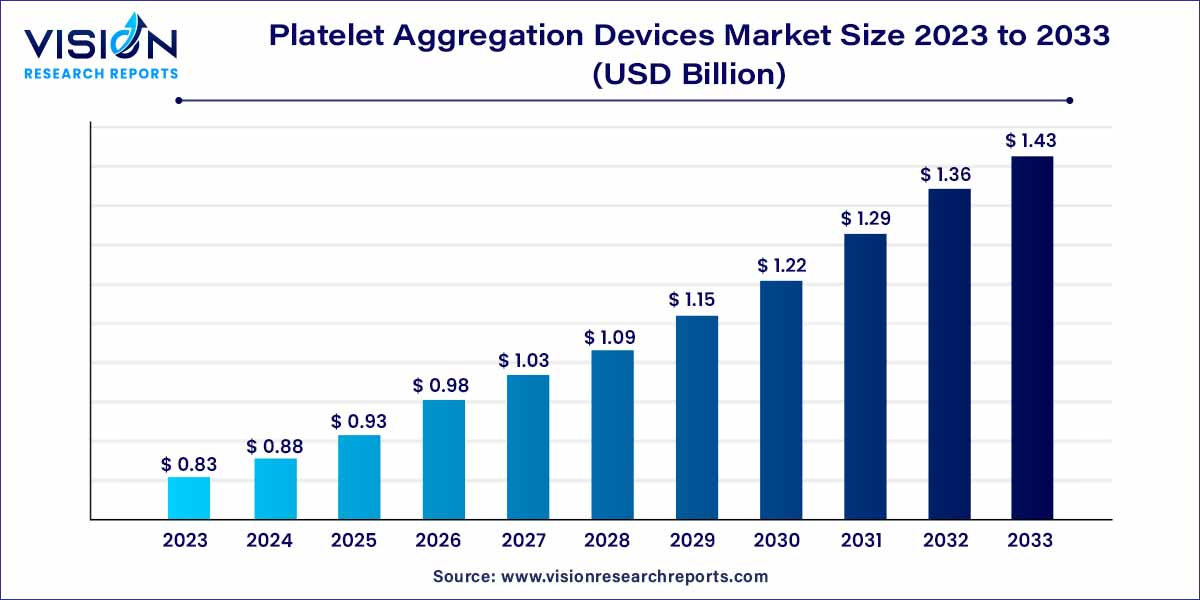
The platelet aggregation devices market has witnessed substantial growth in recent years, driven by a rising prevalence of cardiovascular diseases and an increasing demand for advanced diagnostic tools. This comprehensive overview delves into the key facets of the platelet aggregation devices market, providing valuable insights into its dynamics, trends, and market players.
The platelet aggregation devices market is experiencing robust growth, propelled by several key factors. A notable driver is the escalating prevalence of cardiovascular diseases, necessitating advanced diagnostic tools for accurate and timely assessments. The increasing geriatric population, coupled with lifestyle changes, contributes to a higher incidence of chronic diseases, further augmenting the demand for platelet aggregation devices. Technological advancements in medical devices play a pivotal role, with innovations such as optical platelet aggregometers and impedance platelet aggregometers enhancing diagnostic precision. Additionally, a growing awareness among healthcare professionals regarding the importance of platelet function testing drives the market's expansion. The trend towards point-of-care testing solutions and strategic collaborations between market players and research institutions also fuel the market's upward trajectory. Despite facing challenges like stringent regulatory approval processes and the high cost of advanced devices, the platelet aggregation devices market remains poised for continued growth, presenting significant opportunities for stakeholders in the healthcare sector.
The market is segmented into systems & instruments and consumables & accessories based on the product category. In 2023, the consumables and accessories segment claimed the largest market share at 77% in the platelet aggregation devices market and is expected to exhibit the fastest growth rate throughout the forecast period. The dominance of this segment can be attributed to various factors. The continual demand for reagents, test kits, and disposable components, fueled by diagnostic and research requirements in healthcare, ensures a consistent revenue stream for manufacturers. Additionally, the segment benefits from ongoing technological advancements and the expanding applications of platelet aggregation testing, driving demand for specialized consumables. For example, in February 2022, Futura Surgicare Pvt Ltd introduced Hemostax under the Dolphin Hemostats brand, expanding its product portfolio.
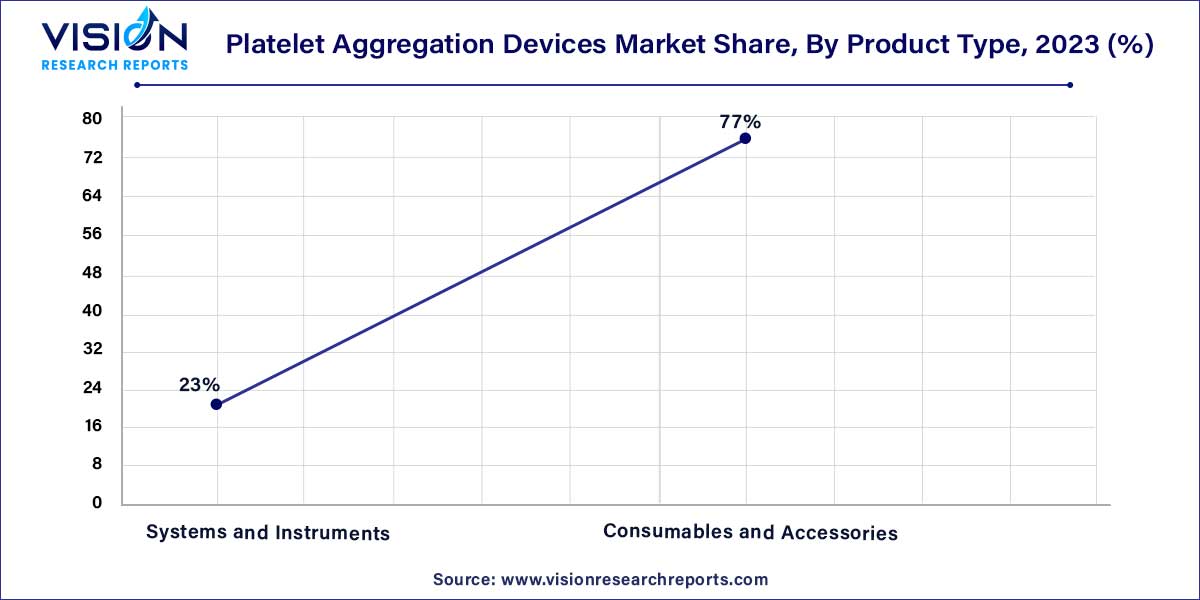
The systems and instruments segment also held a substantial market share in 2023. This segment provides automation and a wide parameter range for accurate platelet function assessment, crucial for both research and clinical applications in thrombosis and hemostasis studies. Ongoing technological advancements, including real-time data analysis and user-friendly interfaces, further reinforce the dominance of systems and instruments. Key market players employ strategies such as new product launches, innovation, and expansion to maintain their market position. For instance, in July 2021, Sysmex Europe GmbH introduced the CN-3500 and CN-6500 blood coagulation analyzers using CLEIA methodology, streamlining testing workflows for diverse needs.
The market is categorized by application into clinical and research segments, with the research segment holding the largest share in 2023. The dominance of the research segment can be attributed to the increasing research and development initiatives aimed at diagnosing various chronic conditions, utilizing platelet aggregation devices. These devices are primarily employed in the screening of new drug formulations and toxicity assessment.
Conversely, the clinical applications segment is projected to experience the fastest growth rate throughout the forecast period. This acceleration is propelled by the growing prevalence of cardiovascular diseases and bleeding disorders, necessitating precise platelet function testing for both diagnosis and treatment monitoring. Advancements in platelet aggregation device technology have heightened their accuracy and efficiency, positioning them as indispensable tools in clinical settings. Additionally, the heightened awareness among healthcare professionals and patients regarding the advantages of early diagnosis and personalized treatment strategies further fuels the demand for platelet aggregation devices, contributing to the rapid growth of the clinical applications segment.
The market is segmented based on end use into hospitals, diagnostic centers, and research and academic institutes, with the research and academic institutes segment holding the largest share in 2023. The dominance of research and academic institutes can be attributed to their pivotal role in groundbreaking research. An illustrative example is the October 2023 breakthrough at the University of Birmingham, where researchers created nanobodies that control platelet clumping, providing invaluable insights. These nanobodies present opportunities for advanced platelet aggregation devices, enhancing diagnostic precision and therapeutic potential. Consequently, the market is poised for significant growth, driven by the increasing demand for more effective tools in managing platelet-related conditions.
Conversely, the hospital segment is projected to experience the fastest growth rate throughout the forecast period. Hospitals serve as primary healthcare institutions for patient care, and the growing prevalence of cardiovascular diseases and bleeding disorders underscores the necessity of using platelet aggregation devices for diagnosis and treatment. Additionally, hospitals boast advanced infrastructure and specialized medical staff, making them well-equipped to handle complex cases requiring platelet aggregation testing. The heightened demand for accurate diagnosis and patient care within hospital settings propels the robust growth of platelet aggregation devices in this end-use segment.
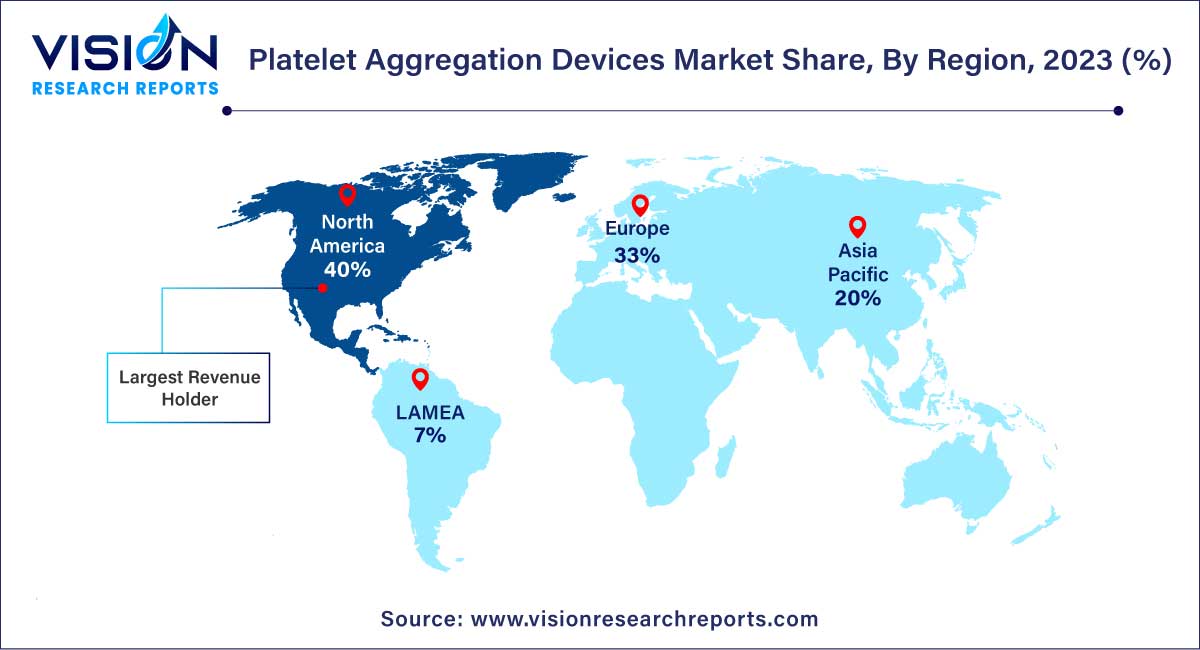
North America secured the largest market share at 40% in 2023, driven by the heightened prevalence of diseases such as leukemia, lymphoma, and other blood-related disorders in the region. The increasing incidence of these diseases has generated a growing demand for diagnostic and treatment solutions. Platelet aggregation devices play a pivotal role in monitoring and managing these conditions, facilitating the development of personalized treatment plans and enhancing overall patient care.
Illustratively, data from the Leukemia & Lymphoma Society reveals that new cases of leukemia, lymphoma, and myeloma are expected to constitute 9.4 percent of the estimated 1,958,310 new cancer cases in the U.S. in 2023. Additionally, insights from the American Cancer Society highlight non-Hodgkin lymphoma (NHL) as a prevalent cancer in the U.S., comprising about 4% of all cancers. These statistics underscore the rising demand for platelet aggregation devices in the North American market.
In contrast, the Asia Pacific region is poised for the fastest growth rate during the forecast period. The surge in population, coupled with an increasing prevalence of cardiovascular diseases, necessitates advanced diagnostic and monitoring tools like platelet aggregation devices. Moreover, the region is experiencing a rise in healthcare infrastructure and awareness, leading to a greater demand for medical devices. Emerging economies in the Asia Pacific are witnessing investments in healthcare, fostering technological advancements. This convergence of factors propels substantial market growth, positioning the Asia Pacific as a promising hub for platelet aggregation device manufacturers and providers in the forecast period.
By Product Type
By Application
By End-use
By Region
Chapter 1. Introduction
1.1. Research Objective
1.2. Scope of the Study
1.3. Definition
Chapter 2. Research Methodology
2.1. Research Approach
2.2. Data Sources
2.3. Assumptions & Limitations
Chapter 3. Executive Summary
3.1. Market Snapshot
Chapter 4. Market Variables and Scope
4.1. Introduction
4.2. Market Classification and Scope
4.3. Industry Value Chain Analysis
4.3.1. Raw Material Procurement Analysis
4.3.2. Sales and Distribution Product Type Analysis
4.3.3. Downstream Buyer Analysis
Chapter 5. COVID 19 Impact on Platelet Aggregation Devices Market
5.1. COVID-19 Landscape: Platelet Aggregation Devices Industry Impact
5.2. COVID 19 - Impact Assessment for the Industry
5.3. COVID 19 Impact: Global Major Government Policy
5.4. Market Trends and Opportunities in the COVID-19 Landscape
Chapter 6. Market Dynamics Analysis and Trends
6.1. Market Dynamics
6.1.1. Market Drivers
6.1.2. Market Restraints
6.1.3. Market Opportunities
6.2. Porter’s Five Forces Analysis
6.2.1. Bargaining power of suppliers
6.2.2. Bargaining power of buyers
6.2.3. Threat of substitute
6.2.4. Threat of new entrants
6.2.5. Degree of competition
Chapter 7. Competitive Landscape
7.1.1. Company Market Share/Positioning Analysis
7.1.2. Key Strategies Adopted by Players
7.1.3. Vendor Landscape
7.1.3.1. List of Suppliers
7.1.3.2. List of Buyers
Chapter 8. Global Platelet Aggregation Devices Market, By Product Type
8.1. Platelet Aggregation Devices Market, by Product Type, 2024-2033
8.1.1 Systems and Instruments
8.1.1.1. Market Revenue and Forecast (2021-2033)
8.1.2. Consumables and Accessories
8.1.2.1. Market Revenue and Forecast (2021-2033)
Chapter 9. Global Platelet Aggregation Devices Market, By Application
9.1. Platelet Aggregation Devices Market, by Application, 2024-2033
9.1.1. Clinical Applications
9.1.1.1. Market Revenue and Forecast (2021-2033)
9.1.2. Research Applications
9.1.2.1. Market Revenue and Forecast (2021-2033)
Chapter 10. Global Platelet Aggregation Devices Market, By End-use
10.1. Platelet Aggregation Devices Market, by End-use, 2024-2033
10.1.1. Hospital
10.1.1.1. Market Revenue and Forecast (2021-2033)
10.1.2. Diagnostic Centers
10.1.2.1. Market Revenue and Forecast (2021-2033)
10.1.3. Research and Academic Institutes
10.1.3.1. Market Revenue and Forecast (2021-2033)
Chapter 11. Global Platelet Aggregation Devices Market, Regional Estimates and Trend Forecast
11.1. North America
11.1.1. Market Revenue and Forecast, by Product Type (2021-2033)
11.1.2. Market Revenue and Forecast, by Application (2021-2033)
11.1.3. Market Revenue and Forecast, by End-use (2021-2033)
11.1.4. U.S.
11.1.4.1. Market Revenue and Forecast, by Product Type (2021-2033)
11.1.4.2. Market Revenue and Forecast, by Application (2021-2033)
11.1.4.3. Market Revenue and Forecast, by End-use (2021-2033)
11.1.5. Rest of North America
11.1.5.1. Market Revenue and Forecast, by Product Type (2021-2033)
11.1.5.2. Market Revenue and Forecast, by Application (2021-2033)
11.1.5.3. Market Revenue and Forecast, by End-use (2021-2033)
11.2. Europe
11.2.1. Market Revenue and Forecast, by Product Type (2021-2033)
11.2.2. Market Revenue and Forecast, by Application (2021-2033)
11.2.3. Market Revenue and Forecast, by End-use (2021-2033)
11.2.4. UK
11.2.4.1. Market Revenue and Forecast, by Product Type (2021-2033)
11.2.4.2. Market Revenue and Forecast, by Application (2021-2033)
11.2.4.3. Market Revenue and Forecast, by End-use (2021-2033)
11.2.5. Germany
11.2.5.1. Market Revenue and Forecast, by Product Type (2021-2033)
11.2.5.2. Market Revenue and Forecast, by Application (2021-2033)
11.2.5.3. Market Revenue and Forecast, by End-use (2021-2033)
11.2.6. France
11.2.6.1. Market Revenue and Forecast, by Product Type (2021-2033)
11.2.6.2. Market Revenue and Forecast, by Application (2021-2033)
11.2.6.3. Market Revenue and Forecast, by End-use (2021-2033)
11.2.7. Rest of Europe
11.2.7.1. Market Revenue and Forecast, by Product Type (2021-2033)
11.2.7.2. Market Revenue and Forecast, by Application (2021-2033)
11.2.7.3. Market Revenue and Forecast, by End-use (2021-2033)
11.3. APAC
11.3.1. Market Revenue and Forecast, by Product Type (2021-2033)
11.3.2. Market Revenue and Forecast, by Application (2021-2033)
11.3.3. Market Revenue and Forecast, by End-use (2021-2033)
11.3.4. India
11.3.4.1. Market Revenue and Forecast, by Product Type (2021-2033)
11.3.4.2. Market Revenue and Forecast, by Application (2021-2033)
11.3.4.3. Market Revenue and Forecast, by End-use (2021-2033)
11.3.5. China
11.3.5.1. Market Revenue and Forecast, by Product Type (2021-2033)
11.3.5.2. Market Revenue and Forecast, by Application (2021-2033)
11.3.5.3. Market Revenue and Forecast, by End-use (2021-2033)
11.3.6. Japan
11.3.6.1. Market Revenue and Forecast, by Product Type (2021-2033)
11.3.6.2. Market Revenue and Forecast, by Application (2021-2033)
11.3.6.3. Market Revenue and Forecast, by End-use (2021-2033)
11.3.7. Rest of APAC
11.3.7.1. Market Revenue and Forecast, by Product Type (2021-2033)
11.3.7.2. Market Revenue and Forecast, by Application (2021-2033)
11.3.7.3. Market Revenue and Forecast, by End-use (2021-2033)
11.4. MEA
11.4.1. Market Revenue and Forecast, by Product Type (2021-2033)
11.4.2. Market Revenue and Forecast, by Application (2021-2033)
11.4.3. Market Revenue and Forecast, by End-use (2021-2033)
11.4.4. GCC
11.4.4.1. Market Revenue and Forecast, by Product Type (2021-2033)
11.4.4.2. Market Revenue and Forecast, by Application (2021-2033)
11.4.4.3. Market Revenue and Forecast, by End-use (2021-2033)
11.4.5. North Africa
11.4.5.1. Market Revenue and Forecast, by Product Type (2021-2033)
11.4.5.2. Market Revenue and Forecast, by Application (2021-2033)
11.4.5.3. Market Revenue and Forecast, by End-use (2021-2033)
11.4.6. South Africa
11.4.6.1. Market Revenue and Forecast, by Product Type (2021-2033)
11.4.6.2. Market Revenue and Forecast, by Application (2021-2033)
11.4.6.3. Market Revenue and Forecast, by End-use (2021-2033)
11.4.7. Rest of MEA
11.4.7.1. Market Revenue and Forecast, by Product Type (2021-2033)
11.4.7.2. Market Revenue and Forecast, by Application (2021-2033)
11.4.7.3. Market Revenue and Forecast, by End-use (2021-2033)
11.5. Latin America
11.5.1. Market Revenue and Forecast, by Product Type (2021-2033)
11.5.2. Market Revenue and Forecast, by Application (2021-2033)
11.5.3. Market Revenue and Forecast, by End-use (2021-2033)
11.5.4. Brazil
11.5.4.1. Market Revenue and Forecast, by Product Type (2021-2033)
11.5.4.2. Market Revenue and Forecast, by Application (2021-2033)
11.5.4.3. Market Revenue and Forecast, by End-use (2021-2033)
11.5.5. Rest of LATAM
11.5.5.1. Market Revenue and Forecast, by Product Type (2021-2033)
11.5.5.2. Market Revenue and Forecast, by Application (2021-2033)
11.5.5.3. Market Revenue and Forecast, by End-use (2021-2033)
Chapter 12. Company Profiles
12.1. AggreDyne, Inc.
12.1.1. Company Overview
12.1.2. Product Offerings
12.1.3. Financial Performance
12.1.4. Recent Initiatives
12.2. Bio/Data Corporation.
12.2.1. Company Overview
12.2.2. Product Offerings
12.2.3. Financial Performance
12.2.4. Recent Initiatives
12.3. Chrono-Log Corporation.
12.3.1. Company Overview
12.3.2. Product Offerings
12.3.3. Financial Performance
12.3.4. Recent Initiatives
12.4. F. Hoffmann-La Roche Ltd.
12.4.1. Company Overview
12.4.2. Product Offerings
12.4.3. Financial Performance
12.4.4. Recent Initiatives
12.5. Haemonetics Corporation.
12.5.1. Company Overview
12.5.2. Product Offerings
12.5.3. Financial Performance
12.5.4. Recent Initiatives
12.6. Siemens Healthcare GmbH
12.6.1. Company Overview
12.6.2. Product Offerings
12.6.3. Financial Performance
12.6.4. Recent Initiatives
12.7. Werfen.
12.7.1. Company Overview
12.7.2. Product Offerings
12.7.3. Financial Performance
12.7.4. Recent Initiatives
12.8. Sysmex Corporation
12.8.1. Company Overview
12.8.2. Product Offerings
12.8.3. Financial Performance
12.8.4. Recent Initiatives
12.9. Sienco, Inc.
12.9.1. Company Overview
12.9.2. Product Offerings
12.9.3. Financial Performance
12.9.4. Recent Initiatives
12.10. Drucker Diagnostics
12.10.1. Company Overview
12.10.2. Product Offerings
12.10.3. Financial Performance
12.10.4. Recent Initiatives
Chapter 13. Research Methodology
13.1. Primary Research
13.2. Secondary Research
13.3. Assumptions
Chapter 14. Appendix
14.1. About Us
14.2. Glossary of Terms
 Cross-segment Market Size and Analysis for
Mentioned Segments
Additional Company Profiles (Upto 5 With No Cost)
Additional Countries (Apart From Mentioned Countries)
Country/Region-specific Report
Go To Market Strategy
Region Specific Market DynamicsRegion Level Market Share Import Export AnalysisProduction AnalysisOthers
Cross-segment Market Size and Analysis for
Mentioned Segments
Additional Company Profiles (Upto 5 With No Cost)
Additional Countries (Apart From Mentioned Countries)
Country/Region-specific Report
Go To Market Strategy
Region Specific Market DynamicsRegion Level Market Share Import Export AnalysisProduction AnalysisOthers