The global solar PV market size was reached at around USD 334.25 billion in 2024 and it is projected to hit around USD 923.74 billion by 2034, growing at a CAGR of 10.70% from 2025 to 2034. The market growth is driven by declining solar panel costs, government incentives, and growing environmental concerns, the Solar PV market is experiencing robust growth.
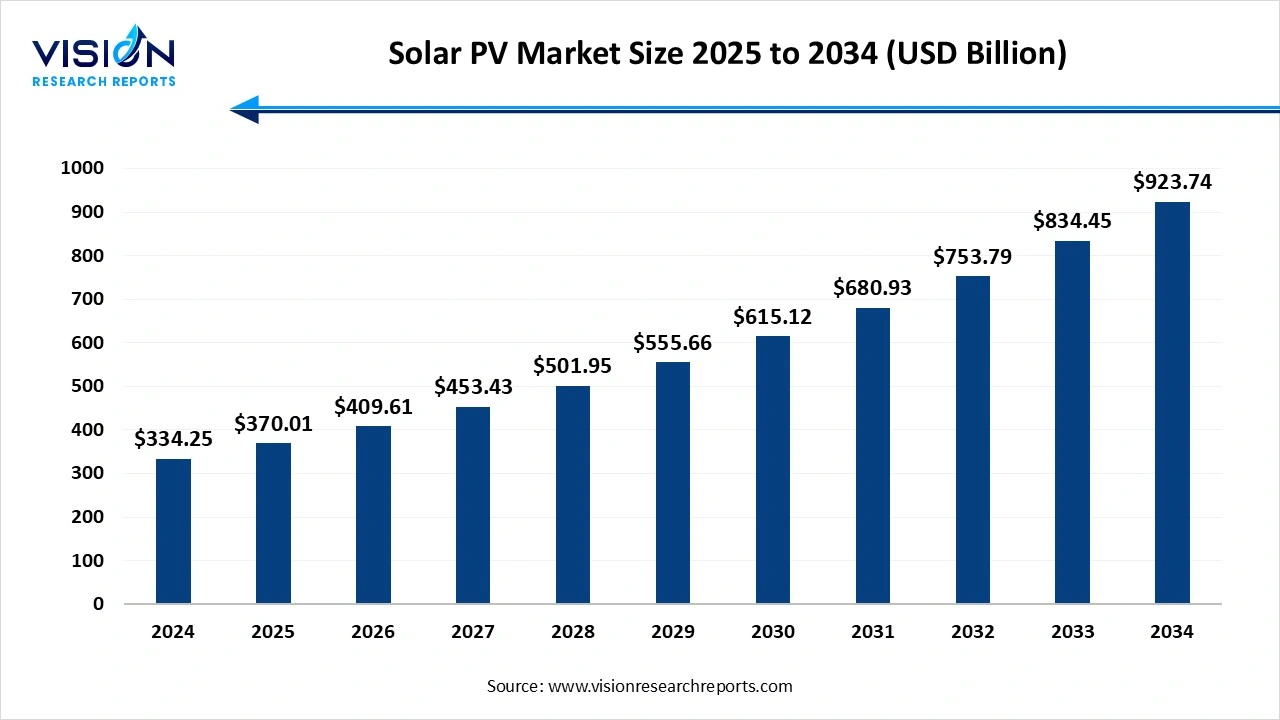
The global Solar Photovoltaic (PV) market has witnessed robust growth over the past decade, driven by increasing demand for clean and sustainable energy sources, rapid advancements in PV technology, and supportive government policies across various regions. Solar PV systems, which convert sunlight directly into electricity using semiconductor materials, have become a key component of the renewable energy transition. Falling installation costs, improved energy conversion efficiency, and growing awareness of climate change have significantly accelerated the adoption of solar PV solutions in both developed and emerging economies.
The growth of the solar photovoltaic (PV) market is primarily driven by the increasing global focus on clean energy and sustainability. Governments across the world are implementing favorable policies, subsidies, and tax incentives to promote the adoption of solar energy, thereby accelerating the deployment of solar PV systems. International commitments to reduce carbon emissions, such as those outlined in the Paris Agreement, have further encouraged investments in solar infrastructure.
Technological advancements also play a crucial role in the market's expansion. Innovations such as high-efficiency solar cells, bifacial panels, and energy storage integration are enhancing system performance and reliability. Furthermore, the growing need for decentralized power generation, especially in remote or off-grid areas, is fueling demand for compact and portable solar PV solutions. The rising awareness among consumers about energy independence and the environmental benefits of solar energy is also contributing to increased adoption.
Despite its rapid growth, the solar PV market faces several challenges that could hinder its widespread adoption. One of the primary concerns is the intermittency of solar power generation, which depends heavily on weather conditions and daylight availability. Without efficient energy storage systems or robust grid infrastructure, maintaining a consistent and reliable energy supply can be difficult.
Another significant challenge lies in supply chain constraints and material dependency. The production of solar PV modules requires critical raw materials such as polysilicon, silver, and rare earth elements, which are subject to price volatility and geopolitical tensions. Environmental concerns related to the disposal and recycling of end-of-life solar panels also pose a long-term sustainability issue.
The Asia Pacific led the global solar PV market in 2024, capturing the largest revenue share of 56% in 2024. Countries such as China, India, Japan, and South Korea are making significant investments in solar infrastructure to diversify their energy mix and reduce carbon emissions. China, in particular, dominates both manufacturing and deployment, accounting for a substantial share of global solar PV installations.
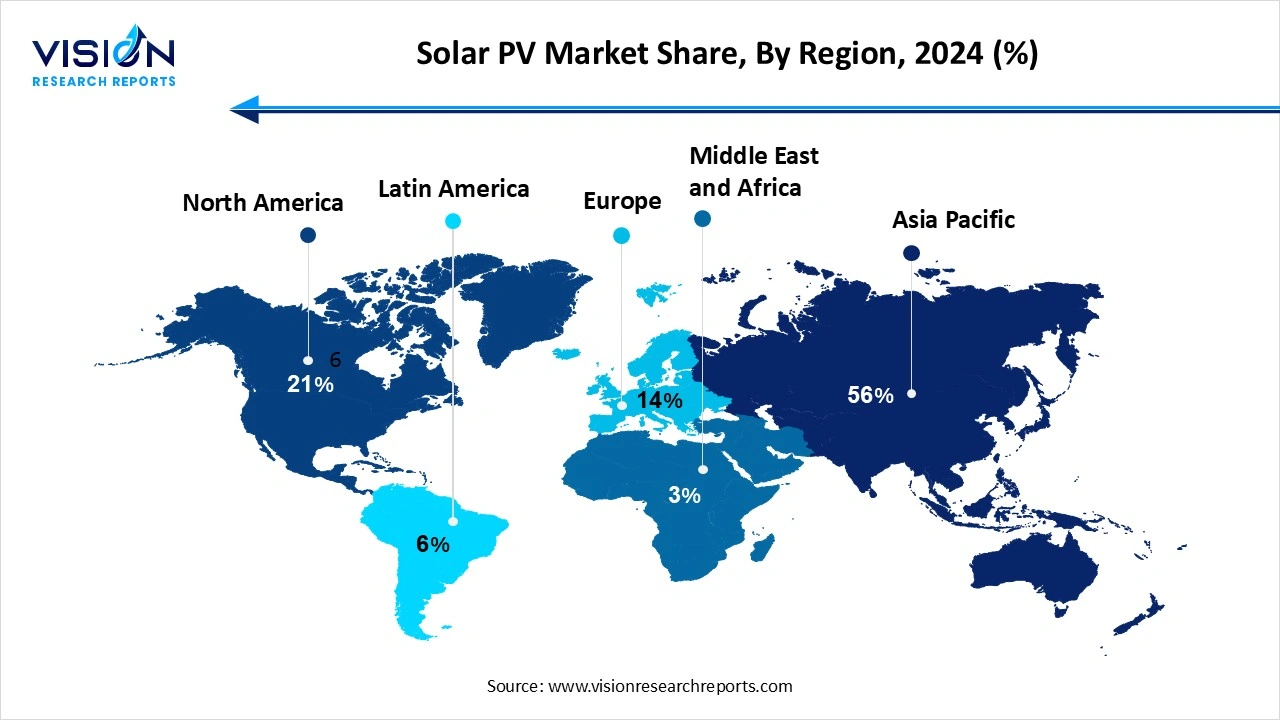 The solar PV market in North America is projected to experience substantial growth over the forecast period. Supportive regulatory frameworks, tax incentives such as the Investment Tax Credit (ITC), and increasing adoption of residential and commercial solar systems are key drivers of market growth in the region. Canada and Mexico are also expanding their solar capacities through utility-scale projects and clean energy initiatives aimed at reducing greenhouse gas emissions. The region is witnessing a growing trend of integrating solar PV systems with energy storage solutions, enhancing grid reliability and consumer energy independence.
The on-grid connectivity segment accounted for the largest revenue share of 75% in 2024, dominating the market. On-grid solar PV systems are directly linked to the public electricity grid and are widely adopted in urban, industrial, and utility-scale applications due to their ability to deliver surplus power back to the grid. This connectivity allows consumers to benefit from net metering and feed-in tariff policies, making solar installations more economically attractive.
The off-grid segment is projected to register the fastest CAGR of 13.5% during the forecast period. These systems operate independently of the grid and often include battery storage to ensure uninterrupted power supply. Off-grid solar is particularly vital in regions of Africa, Asia, and Latin America, where it plays a crucial role in electrifying underserved communities and supporting decentralized energy models.
The ground-mounted systems dominated the market, capturing the largest revenue share of 63% in 2024. These systems are typically installed on open land and allow for the deployment of a large number of solar panels, making them ideal for generating high volumes of electricity. Ground-mounted installations offer flexibility in design and orientation, which can be optimized for maximum sunlight exposure using fixed tilt or tracking systems.
The rooftop segment is anticipated to grow at a CAGR of 13.8% over the forecast period, driven by increasing adoption of rooftop-mounted solar PV systems. Rooftop solar systems offer the advantage of utilizing existing building spaces, reducing the need for additional land and infrastructure. These installations are increasingly popular in urban areas where land availability is limited, and they provide consumers with the opportunity to reduce electricity bills and gain energy independence.
The utility segment dominated the market, securing the largest revenue share of 58% in 2024. Utility-scale solar projects involve the deployment of extensive ground-mounted solar farms that are directly connected to the power grid, supplying electricity to public utilities or wholesale electricity markets. Governments and private sector players across the globe are investing heavily in utility-scale solar infrastructure to reduce reliance on fossil fuels, achieve climate goals, and enhance energy security.
The commercial and industrial segment is projected to witness the fastest CAGR of 12.2% between 2025 and 2034. Businesses and manufacturing facilities are increasingly adopting solar PV systems to reduce their carbon footprint, lower operational costs, and meet environmental, social, and governance (ESG) targets. Rooftop and ground-mounted solar installations in commercial buildings, warehouses, and industrial complexes enable companies to generate their own electricity and hedge against volatile energy prices.
By Connectivity
By Mounting
By End Use
By Regional
Chapter 1. Introduction
1.1. Research Objective
1.2. Scope of the Study
1.3. Definition
Chapter 2. Research Methodology
2.1. Research Approach
2.2. Data Sources
2.3. Assumptions & Limitations
Chapter 3. Executive Summary
3.1. Market Snapshot
Chapter 4. Market Variables and Scope
4.1. Introduction
4.2. Market Classification and Scope
4.3. Industry Value Chain Analysis
4.3.1. Raw Material Procurement Analysis
4.3.2. Sales and Distribution Connectivity Analysis
4.3.3. Downstream Buyer Analysis
Chapter 5. COVID 19 Impact on Solar PV Market
5.1. COVID-19 Landscape: Solar PV Industry Impact
5.2. COVID 19 - Impact Assessment for the Industry
5.3. COVID 19 Impact: Global Major Government Policy
5.4. Market Trends and Opportunities in the COVID-19 Landscape
Chapter 6. Market Dynamics Analysis and Trends
6.1. Market Dynamics
6.1.1. Market Drivers
6.1.2. Market Restraints
6.1.3. Market Opportunities
6.2. Porter’s Five Forces Analysis
6.2.1. Bargaining power of suppliers
6.2.2. Bargaining power of buyers
6.2.3. Threat of substitute
6.2.4. Threat of new entrants
6.2.5. Degree of competition
Chapter 7. Competitive Landscape
7.1.1. Company Market Share/Positioning Analysis
7.1.2. Key Strategies Adopted by Players
7.1.3. Vendor Landscape
7.1.3.1. List of Suppliers
7.1.3.2. List of Buyers
Chapter 8. Global Solar PV Market, By Connectivity
8.1. Solar PV Market, by Connectivity
8.1.1 On Grid
8.1.1.1. Market Revenue and Forecast
8.1.2. Off Grid
8.1.2.1. Market Revenue and Forecast
Chapter 9. Global Solar PV Market, By Mounting
9.1. Solar PV Market, by Mounting
9.1.1. Ground Mounted
9.1.1.1. Market Revenue and Forecast
9.1.2. Roof Top
9.1.2.1. Market Revenue and Forecast
Chapter 10. Global Solar PV Market, By End Use
10.1. Solar PV Market, by End Use
10.1.1. Residential
10.1.1.1. Market Revenue and Forecast
10.1.2. Commercial & Industrial
10.1.2.1. Market Revenue and Forecast
10.1.3. Utility
10.1.3.1. Market Revenue and Forecast
Chapter 11. Global Solar PV Market, Regional Estimates and Trend Forecast
11.1. North America
11.1.1. Market Revenue and Forecast, by Connectivity
11.1.2. Market Revenue and Forecast, by Mounting
11.1.3. Market Revenue and Forecast, by End Use
11.1.4. U.S.
11.1.4.1. Market Revenue and Forecast, by Connectivity
11.1.4.2. Market Revenue and Forecast, by Mounting
11.1.4.3. Market Revenue and Forecast, by End Use
11.1.5. Rest of North America
11.1.5.1. Market Revenue and Forecast, by Connectivity
11.1.5.2. Market Revenue and Forecast, by Mounting
11.1.5.3. Market Revenue and Forecast, by End Use
11.2. Europe
11.2.1. Market Revenue and Forecast, by Connectivity
11.2.2. Market Revenue and Forecast, by Mounting
11.2.3. Market Revenue and Forecast, by End Use
11.2.4. UK
11.2.4.1. Market Revenue and Forecast, by Connectivity
11.2.4.2. Market Revenue and Forecast, by Mounting
11.2.4.3. Market Revenue and Forecast, by End Use
11.2.5. Germany
11.2.5.1. Market Revenue and Forecast, by Connectivity
11.2.5.2. Market Revenue and Forecast, by Mounting
11.2.5.3. Market Revenue and Forecast, by End Use
11.2.6. France
11.2.6.1. Market Revenue and Forecast, by Connectivity
11.2.6.2. Market Revenue and Forecast, by Mounting
11.2.6.3. Market Revenue and Forecast, by End Use
11.2.7. Rest of Europe
11.2.7.1. Market Revenue and Forecast, by Connectivity
11.2.7.2. Market Revenue and Forecast, by Mounting
11.2.7.3. Market Revenue and Forecast, by End Use
11.3. APAC
11.3.1. Market Revenue and Forecast, by Connectivity
11.3.2. Market Revenue and Forecast, by Mounting
11.3.3. Market Revenue and Forecast, by End Use
11.3.4. India
11.3.4.1. Market Revenue and Forecast, by Connectivity
11.3.4.2. Market Revenue and Forecast, by Mounting
11.3.4.3. Market Revenue and Forecast, by End Use
11.3.5. China
11.3.5.1. Market Revenue and Forecast, by Connectivity
11.3.5.2. Market Revenue and Forecast, by Mounting
11.3.5.3. Market Revenue and Forecast, by End Use
11.3.6. Japan
11.3.6.1. Market Revenue and Forecast, by Connectivity
11.3.6.2. Market Revenue and Forecast, by Mounting
11.3.6.3. Market Revenue and Forecast, by End Use
11.3.7. Rest of APAC
11.3.7.1. Market Revenue and Forecast, by Connectivity
11.3.7.2. Market Revenue and Forecast, by Mounting
11.3.7.3. Market Revenue and Forecast, by End Use
11.4. MEA
11.4.1. Market Revenue and Forecast, by Connectivity
11.4.2. Market Revenue and Forecast, by Mounting
11.4.3. Market Revenue and Forecast, by End Use
11.4.4. GCC
11.4.4.1. Market Revenue and Forecast, by Connectivity
11.4.4.2. Market Revenue and Forecast, by Mounting
11.4.4.3. Market Revenue and Forecast, by End Use
11.4.5. North Africa
11.4.5.1. Market Revenue and Forecast, by Connectivity
11.4.5.2. Market Revenue and Forecast, by Mounting
11.4.5.3. Market Revenue and Forecast, by End Use
11.4.6. South Africa
11.4.6.1. Market Revenue and Forecast, by Connectivity
11.4.6.2. Market Revenue and Forecast, by Mounting
11.4.6.3. Market Revenue and Forecast, by End Use
11.4.7. Rest of MEA
11.4.7.1. Market Revenue and Forecast, by Connectivity
11.4.7.2. Market Revenue and Forecast, by Mounting
11.4.7.3. Market Revenue and Forecast, by End Use
11.5. Latin America
11.5.1. Market Revenue and Forecast, by Connectivity
11.5.2. Market Revenue and Forecast, by Mounting
11.5.3. Market Revenue and Forecast, by End Use
11.5.4. Brazil
11.5.4.1. Market Revenue and Forecast, by Connectivity
11.5.4.2. Market Revenue and Forecast, by Mounting
11.5.4.3. Market Revenue and Forecast, by End Use
11.5.5. Rest of LATAM
11.5.5.1. Market Revenue and Forecast, by Connectivity
11.5.5.2. Market Revenue and Forecast, by Mounting
11.5.5.3. Market Revenue and Forecast, by End Use
Chapter 12. Company Profiles
12.1. First Solar, Inc.
12.1.1. Company Overview
12.1.2. Product Offerings
12.1.3. Financial Performance
12.1.4. Recent Initiatives
12.2. LONGi Green Energy Technology Co., Ltd.
12.2.1. Company Overview
12.2.2. Product Offerings
12.2.3. Financial Performance
12.2.4. Recent Initiatives
12.3. Trina Solar Limited.
12.3.1. Company Overview
12.3.2. Product Offerings
12.3.3. Financial Performance
12.3.4. Recent Initiatives
12.4. JA Solar Technology Co., Ltd.
12.4.1. Company Overview
12.4.2. Product Offerings
12.4.3. Financial Performance
12.4.4. Recent Initiatives
12.5. Canadian Solar Inc.
12.5.1. Company Overview
12.5.2. Product Offerings
12.5.3. Financial Performance
12.5.4. Recent Initiatives
12.6. Risen Energy Co., Ltd.
12.6.1. Company Overview
12.6.2. Product Offerings
12.6.3. Financial Performance
12.6.4. Recent Initiatives
12.7. SunPower Corporation.
12.7.1. Company Overview
12.7.2. Product Offerings
12.7.3. Financial Performance
12.7.4. Recent Initiatives
12.8. Talesun Solar Technologies Co., Ltd.
12.8.1. Company Overview
12.8.2. Product Offerings
12.8.3. Financial Performance
12.8.4. Recent Initiatives
Chapter 13. Research Methodology
13.1. Primary Research
13.2. Secondary Research
13.3. Assumptions
Chapter 14. Appendix
14.1. About Us
14.2. Glossary of Terms
 Cross-segment Market Size and Analysis for
Mentioned Segments
Additional Company Profiles (Upto 5 With No Cost)
Additional Countries (Apart From Mentioned Countries)
Country/Region-specific Report
Go To Market Strategy
Region Specific Market DynamicsRegion Level Market Share Import Export AnalysisProduction AnalysisOthers
Cross-segment Market Size and Analysis for
Mentioned Segments
Additional Company Profiles (Upto 5 With No Cost)
Additional Countries (Apart From Mentioned Countries)
Country/Region-specific Report
Go To Market Strategy
Region Specific Market DynamicsRegion Level Market Share Import Export AnalysisProduction AnalysisOthers