
Surgical Instrument Tracking Systems Market to Reach USD 888.3 Mn by 2034
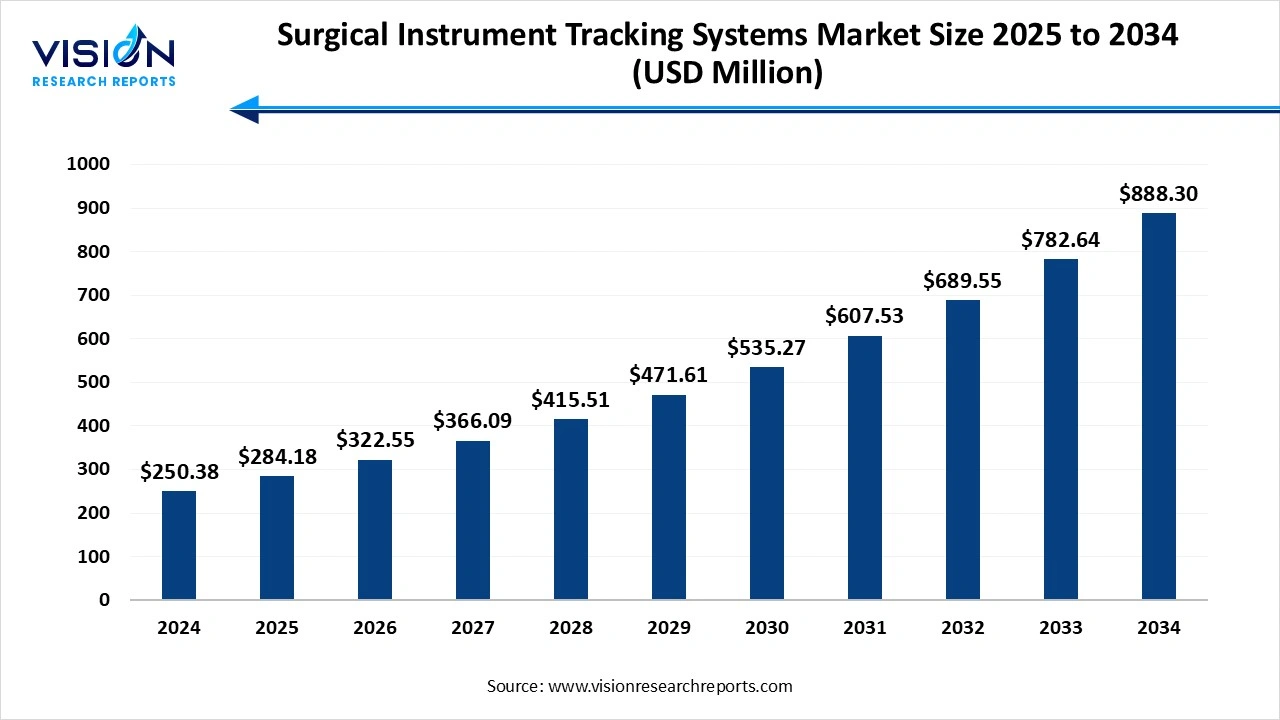
The global surgical instrument tracking systems market size was valued USD 250.38 million in 2024 and is estimated to reach USD 284.18 million in 2025 to approximately USD 888.30 million by 2034, growing at a CAGR of 13.5% over the forecast period. The rising need to improve patient safety, increase operational efficiency in hospitals, and rising surgical volumes.
A digital solution used in hospitals and surgical centres to monitor, manage, and track surgical instruments and trays throughout their entire lifecycle, from sterilization and storage to use in the operating room and return for reprocessing. The market growth is driven by the reduced risk of retained surgical items; an automated tracking system helps surgical teams maintain an accurate count of all instruments before and after a surgery, significantly reducing this risk. It prevents hospital-acquired infections and enhances accountability and audits. The technological advancement in the integration of RFID, barcode systems, and real-time data analytics drives the market growth.
The prevention of retained surgical items, a higher volume of surgeries means more instruments must pass through the sterile processing department. Tracking systems monitor and record every stage of the sterilization cycle, ensuring each instrument is properly cleaned and processed before its next use. It can improve inventory management and streamline workflows it minimize manual workload, and streamline the sterilization, assembly, and delivery of surgical trays, improving the turnaround time between procedures and preventing operational bottlenecks.
RSIs are persistent, dangerous, and costly problems in surgery. Despite manually counting protocols, they remain the most frequently reported. The increasing pressure to enhance patient safety and adhere to strict regulatory compliance. These systems offer an automated, highly accurate method to replace manual processes, which are prone to human error and pose substantial risk.
The National Quality Forum includes retained foreign objects on its list of Serious Reportable Events. The legal and reputational damage from such incidents makes investments in preventive tracking technology a practical necessity for risk management.
| Report Coverage | Details |
| Market Size in 2024 | USD 250.38 million |
| Revenue Forecast by 2034 | USD 888.30 million |
| Growth rate from 2025 to 2034 | CAGR of 13.5% |
| Base Year | 2024 |
| Forecast Period | 2025 to 2034 |
| Regions | North America, Europe, Asia Pacific, Latin America, Middle East & Africa |
| Companies Covered | Becton, Dickinson and Company (BD), Stryker Corporation, Getinge AB, STERIS plc, Fortive Corporation (Censis Technologies, Inc.), Haldor Advanced Technologies, STANLEY Healthcare (a division of Stanley Black & Decker), Scanlan International, Inc., Xerafy |
Expansion in emerging economies and integration with hospital information systems, an opportunity for the surgical instrument tracking systems market
The government initiatives that emerging economies are actively pursuing are government-backed digital health missions. These initiatives drive the need for technology that ensures patient safety and operational efficiency.
Integrating SITS with other hospital information systems, like electronic health records, is a major opportunity that creates a more comprehensive and efficient healthcare ecosystem. It enhances patient safety, improves operational efficiency, and improves regulatory compliance.
High upfront cost and technological limitations of the surgical instrument tracking systems market
Implementing a surgical instrument tracking system, especially RFID-based technology, requires significant capital. This includes the cost for hardware, such as scanners and readers, software platforms, and tags for each instrument. For smaller clinics or hospitals with tight budgets, this initial outlay can be prohibitive. Long return on investment, while more advanced, RFID systems are susceptible to interference from metals and liquids, which are common in a surgical setting. This can comprehensively signal reliability and data accuracy, hindering market growth.
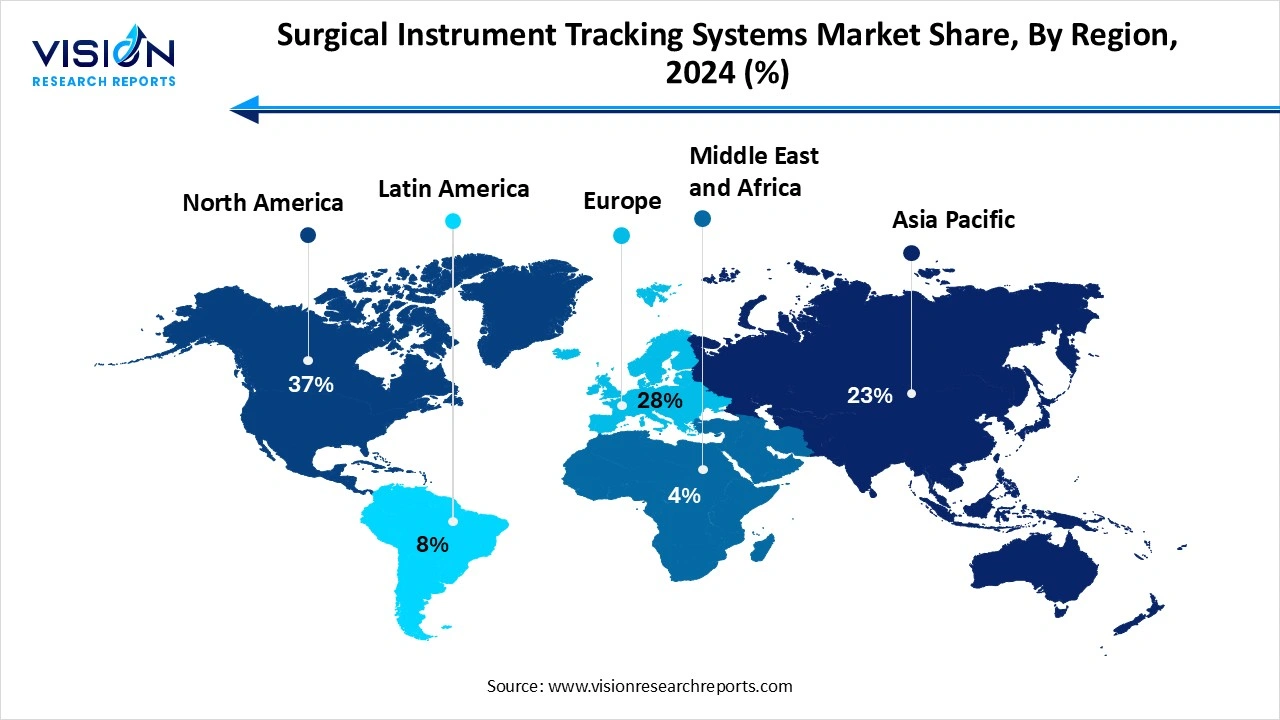
North America dominated the surgical instrument tracking systems industry, accounting for the largest revenue share of 37% in 2024. The region in which well-developed medical devices, such as surgical instruments, carry a unique identifier. This mandate provides a powerful incentive for hospitals to adopt automated tracking solutions that ensure compliance and traceability. The rising infection control protocols, highly developed healthcare infrastructure, with technologically advanced hospitals and ambulatory surgical centers. This allows for the integration and adoption of complex tracking systems more easily than in less developed regions. The high-volume facilities and large hospital network in this region are focused on improving operational efficiency. The region's early technology adoption, presence of key players, and rising demand from high surgical volumes drive market growth.
United States Surgical Instrument Tracking Systems Market Trends
The United States is a major contributor to the surgical instrument tracking systems market. The region's strong regulatory framework, the U.S. Food & Drug Administration's Unique Device Identification regulation, requires that all medical devices, including surgical instruments, drive the adoption of tracking systems. The robust healthcare system, high demand for advanced technologies, and high volume of surgical procedures.
Why is Asia Pacific Significantly Growing in the Surgical Instrument Tracking Systems Market?
Asia Pacific expects significant growth in the market during the forecast period. The region with which growing aging population that is more susceptible to chronic disease, which is driving a surgical procedures. This growing demand for surgeries creates a greater need for efficient inventory management and process tracking in hospitals. The expansion of healthcare facilities, rising investment in public and private healthcare infrastructure. The increasing disposable income is fuelling healthcare spending and increasing demand for higher standards of care. The growth in medical tourism also drives the need for high-quality, efficient healthcare services to attract and retain patients.
China Surgical Instrument Tracking Systems Market Trends
China is growing in the surgical instrument tracking systems market. The barcode tracking currently holds a larger market share; radio frequency identification systems are projected to be the fastest-growing technology segment in China. RFID offers significant advantages in automating inventory counts and reducing manual errors. Major hospitals in China are piloting RFID-based tracking systems to improve workflow efficiency and patient safety. The integration of AI and data analytics, and the integration of tracking systems, is becoming more advanced. AI-powered robots drive the market growth.
Why did the Hardware Segment Dominate the Surgical Instrument Tracking Systems Market?
The hardware segment held the largest revenue share, exceeding 46% in 2024. The necessity of hardware for any kind of tracking system, whether low-cost barcode or more advanced RFID, can automatically capture data without requiring a direct line of sight. This capability is crucial in preventing retained surgical items and ensuring patient safety. The hardware-enhanced inventory management in real-time data tracing of instruments, preventing loss or theft, and improving asset utilization. The growing emphasis on patient safety, rising digitalization in healthcare, and expanding healthcare infrastructure drive the market growth.
The services segment is the fastest-growing in the surgical instrument tracking systems market during the forecast period. The rising adoption of advanced tracking technologies, hospitals, and surgical centers is increasing the adoption of RFID and systems for better inventory management and enhancing patient safety. Growing need for expert services, such as seamless implementation, staff training, regulatory compliance, and ongoing system optimization. The services focus on patient safety and operational efficiency, with the increasing cloud-based tracking solutions. The rising investment in healthcare infrastructure, particularly in developing economies, is creating new opportunities for the adoption of surgical instrument tracking systems and associated services.
How does the Barcode Segment hold the Largest Share in the Surgical Instrument Tracking Systems Market?
The barcode technology held the dominant revenue share, exceeding 81% in 2024. The barcode labels are significantly cheaper than RFID tags, and hospitals can use existing IT infrastructure and less expensive scanning hardware. The barcode system is easy to integrate into existing hospital systems AND WORKFLOW. Many healthcare providers are already familiar with the technology, which reduces the need for extensive staff training. The barcode technology has been used reliably in healthcare for decades and is effective for inventory tracking, asset management, and surgical tray assembly.
The RFID segment is expected to witness the highest growth rate during the forecast period. The RFID systems automate instrument count before and after procedures, virtually eliminating the risk of leaving an instrument inside a patient. The various applications of the RFID system such as keeping records automatically, enhancing infection control, and enhancing operational efficiency and inventory management. As healthcare providers seek to enhance patient safety, meet regulatory requirements, and optimize inventory management, RFID technology is gaining strong traction.
The hospitals dominated the overall market, accounting for a share of over 80% in 2024. The large hospitals conduct a much higher volume of surgeries across diverse departments compared to ASCs. This creates a greater need for efficient, automated tracking to manage the large number of instruments flowing between operating rooms and the sterile processing department. The mandates for patient safety and regulatory compliance, preventing retained surgical items, require hospitals to conduct a significant number of surgical procedures daily, creating a continuous and substantial demand for SIST to manage instruments effectively throughout the entire surgical workflow, and drive the market growth. Many hospitals are also adopting digital solutions that integrate with their electronic health record (EHR) systems, allowing for seamless data sharing and comprehensive documentation.
The hospitals segment is the fastest-growing in the market during the forecast period. The a need for better patient safety, operational efficiency, and regulatory compliance. This rise is fueled by the desire to prevent instrument loss or contamination during critical cycles like sterilization and surgery. Investments in advanced technologies enable real-time tracking, thereby streamlining surgical workflows and improving overall management. Consequently, this trend reflects a growing commitment to enhancing patient care and surgical precision through advanced inventory and instrument management.
By Product
By Technology
By End Use
By Regional
Chapter 1. Introduction
1.1. Research Objective
1.2. Scope of the Study
1.3. Definition
Chapter 2. Research Methodology
2.1. Research Approach
2.2. Data Sources
2.3. Assumptions & Limitations
Chapter 3. Executive Summary
3.1. Market Snapshot
Chapter 4. Market Variables and Scope
4.1. Introduction
4.2. Market Classification and Scope
4.3. Industry Value Chain Analysis
4.3.1. Raw Material Procurement Analysis
4.3.2. Sales and Distribution Product Analysis
4.3.3. Downstream Buyer Analysis
Chapter 5. COVID 19 Impact on Surgical Instrument Tracking Systems Market
5.1. COVID-19 Landscape: Surgical Instrument Tracking Systems Industry Impact
5.2. COVID 19 - Impact Assessment for the Industry
5.3. COVID 19 Impact: Global Major Government Policy
5.4. Market Trends and Opportunities in the COVID-19 Landscape
Chapter 6. Market Dynamics Analysis and Trends
6.1. Market Dynamics
6.1.1. Market Drivers
6.1.2. Market Restraints
6.1.3. Market Opportunities
6.2. Porter’s Five Forces Analysis
6.2.1. Bargaining power of suppliers
6.2.2. Bargaining power of buyers
6.2.3. Threat of substitute
6.2.4. Threat of new entrants
6.2.5. Degree of competition
Chapter 7. Competitive Landscape
7.1.1. Company Market Share/Positioning Analysis
7.1.2. Key Strategies Adopted by Players
7.1.3. Vendor Landscape
7.1.3.1. List of Suppliers
7.1.3.2. List of Buyers
Chapter 8. Global Surgical Instrument Tracking Systems Market, By Product
8.1. Surgical Instrument Tracking Systems Market, by Product
8.1.1 Hardware
8.1.1.1. Market Revenue and Forecast
8.1.2. Software
8.1.2.1. Market Revenue and Forecast
8.1.3. Services
8.1.3.1. Market Revenue and Forecast
Chapter 9. Global Surgical Instrument Tracking Systems Market, By Technology
9.1. Surgical Instrument Tracking Systems Market, by Technology
9.1.1. Barcodes
9.1.1.1. Market Revenue and Forecast
9.1.2. Hospitals
9.1.2.1. Market Revenue and Forecast
9.1.3. Others
9.1.3.1. Market Revenue and Forecast
9.1.4. RFID
9.1.4.1. Market Revenue and Forecast
9.1.5. Hospitals
9.1.5.1. Market Revenue and Forecast
9.1.6. Others
9.1.6.1. Market Revenue and Forecast
Chapter 10. Global Surgical Instrument Tracking Systems Market, By End Use
10.1. Surgical Instrument Tracking Systems Market, by End Use
10.1.1. Hospitals
10.1.1.1. Market Revenue and Forecast
10.1.2. Others
10.1.2.1. Market Revenue and Forecast
Chapter 11. Global Surgical Instrument Tracking Systems Market, Regional Estimates and Trend Forecast
11.1. North America
11.1.1. Market Revenue and Forecast, by Product
11.1.2. Market Revenue and Forecast, by Technology
11.1.3. Market Revenue and Forecast, by End Use
11.1.4. U.S.
11.1.4.1. Market Revenue and Forecast, by Product
11.1.4.2. Market Revenue and Forecast, by Technology
11.1.4.3. Market Revenue and Forecast, by End Use
11.1.5. Rest of North America
11.1.5.1. Market Revenue and Forecast, by Product
11.1.5.2. Market Revenue and Forecast, by Technology
11.1.5.3. Market Revenue and Forecast, by End Use
11.2. Europe
11.2.1. Market Revenue and Forecast, by Product
11.2.2. Market Revenue and Forecast, by Technology
11.2.3. Market Revenue and Forecast, by End Use
11.2.4. UK
11.2.4.1. Market Revenue and Forecast, by Product
11.2.4.2. Market Revenue and Forecast, by Technology
11.2.4.3. Market Revenue and Forecast, by End Use
11.2.5. Germany
11.2.5.1. Market Revenue and Forecast, by Product
11.2.5.2. Market Revenue and Forecast, by Technology
11.2.5.3. Market Revenue and Forecast, by End Use
11.2.6. France
11.2.6.1. Market Revenue and Forecast, by Product
11.2.6.2. Market Revenue and Forecast, by Technology
11.2.6.3. Market Revenue and Forecast, by End Use
11.2.7. Rest of Europe
11.2.7.1. Market Revenue and Forecast, by Product
11.2.7.2. Market Revenue and Forecast, by Technology
11.2.7.3. Market Revenue and Forecast, by End Use
11.3. APAC
11.3.1. Market Revenue and Forecast, by Product
11.3.2. Market Revenue and Forecast, by Technology
11.3.3. Market Revenue and Forecast, by End Use
11.3.4. India
11.3.4.1. Market Revenue and Forecast, by Product
11.3.4.2. Market Revenue and Forecast, by Technology
11.3.4.3. Market Revenue and Forecast, by End Use
11.3.5. China
11.3.5.1. Market Revenue and Forecast, by Product
11.3.5.2. Market Revenue and Forecast, by Technology
11.3.5.3. Market Revenue and Forecast, by End Use
11.3.6. Japan
11.3.6.1. Market Revenue and Forecast, by Product
11.3.6.2. Market Revenue and Forecast, by Technology
11.3.6.3. Market Revenue and Forecast, by End Use
11.3.7. Rest of APAC
11.3.7.1. Market Revenue and Forecast, by Product
11.3.7.2. Market Revenue and Forecast, by Technology
11.3.7.3. Market Revenue and Forecast, by End Use
11.4. MEA
11.4.1. Market Revenue and Forecast, by Product
11.4.2. Market Revenue and Forecast, by Technology
11.4.3. Market Revenue and Forecast, by End Use
11.4.4. GCC
11.4.4.1. Market Revenue and Forecast, by Product
11.4.4.2. Market Revenue and Forecast, by Technology
11.4.4.3. Market Revenue and Forecast, by End Use
11.4.5. North Africa
11.4.5.1. Market Revenue and Forecast, by Product
11.4.5.2. Market Revenue and Forecast, by Technology
11.4.5.3. Market Revenue and Forecast, by End Use
11.4.6. South Africa
11.4.6.1. Market Revenue and Forecast, by Product
11.4.6.2. Market Revenue and Forecast, by Technology
11.4.6.3. Market Revenue and Forecast, by End Use
11.4.7. Rest of MEA
11.4.7.1. Market Revenue and Forecast, by Product
11.4.7.2. Market Revenue and Forecast, by Technology
11.4.7.3. Market Revenue and Forecast, by End Use
11.5. Latin America
11.5.1. Market Revenue and Forecast, by Product
11.5.2. Market Revenue and Forecast, by Technology
11.5.3. Market Revenue and Forecast, by End Use
11.5.4. Brazil
11.5.4.1. Market Revenue and Forecast, by Product
11.5.4.2. Market Revenue and Forecast, by Technology
11.5.4.3. Market Revenue and Forecast, by End Use
11.5.5. Rest of LATAM
11.5.5.1. Market Revenue and Forecast, by Product
11.5.5.2. Market Revenue and Forecast, by Technology
11.5.5.3. Market Revenue and Forecast, by End Use
Chapter 12. Company Profiles
12.1 Becton, Dickinson and Company (BD)
12.1.1. Company Overview
12.1.2. Product Offerings
12.1.3. Financial Performance
12.1.4. Recent Initiatives
12.2. Stryker Corporation
12.2.1. Company Overview
12.2.2. Product Offerings
12.2.3. Financial Performance
12.2.4. Recent Initiatives
12.3. Getinge AB.
12.3.1. Company Overview
12.3.2. Product Offerings
12.3.3. Financial Performance
12.3.4. Recent Initiatives
12.4. STERIS plc
12.4.1. Company Overview
12.4.2. Product Offerings
12.4.3. Financial Performance
12.4.4. Recent Initiatives
12.5. Fortive Corporation (Censis Technologies, Inc.)
12.5.1. Company Overview
12.5.2. Product Offerings
12.5.3. Financial Performance
12.5.4. Recent Initiatives
12.6. Haldor Advanced Technologies
12.6.1. Company Overview
12.6.2. Product Offerings
12.6.3. Financial Performance
12.6.4. Recent Initiatives
12.7. STANLEY Healthcare (a division of Stanley Black & Decker)
12.7.1. Company Overview
12.7.2. Product Offerings
12.7.3. Financial Performance
12.7.4. Recent Initiatives
12.8. Scanlan International, Inc.
12.8.1. Company Overview
12.8.2. Product Offerings
12.8.3. Financial Performance
12.8.4. Recent Initiatives
12.9. Xerafy
12.9.1. Company Overview
12.9.2. Product Offerings
12.9.3. Financial Performance
12.9.4. Recent Initiatives
Chapter 13. Research Methodology
13.1. Primary Research
13.2. Secondary Research
13.3. Assumptions
Chapter 14. Appendix
14.1. About Us
14.2. Glossary of Terms
 Cross-segment Market Size and Analysis for
Mentioned Segments
Additional Company Profiles (Upto 5 With No Cost)
Additional Countries (Apart From Mentioned Countries)
Country/Region-specific Report
Go To Market Strategy
Region Specific Market DynamicsRegion Level Market Share Import Export AnalysisProduction AnalysisOthers
Cross-segment Market Size and Analysis for
Mentioned Segments
Additional Company Profiles (Upto 5 With No Cost)
Additional Countries (Apart From Mentioned Countries)
Country/Region-specific Report
Go To Market Strategy
Region Specific Market DynamicsRegion Level Market Share Import Export AnalysisProduction AnalysisOthers