
Veterinary Scales Market Size, Share, Growth, Trends, Report 2024-2033
The global veterinary scales market size was estimated at around USD 252.73 million in 2023 and it is projected to hit around USD 418.78 million by 2033, growing at a CAGR of 5.18% from 2024 to 2033. Growing technical advancements in veterinary scales, a wide range of products available, initiatives by major firms, rising animal-related expenses, and the need for weight monitoring devices to enhance animal health outcomes are some of the major factors driving the market.

The veterinary scales market stands at the intersection of technological innovation and the growing need for precise animal care. These specialized weighing instruments play a crucial role in the veterinary domain, offering accurate weight measurements that are fundamental to animal health assessment, diagnosis, and treatment. This overview provides insights into the key aspects shaping the veterinary scales market, including market size, growth drivers, challenges, and notable trends.
The growth of the veterinary scales market is propelled by several key factors. Firstly, the escalating trend of pet ownership globally has significantly increased the demand for precise and reliable weight measurement instruments in veterinary practices. Pet owners and healthcare professionals alike recognize the importance of regular weight monitoring for preventive care, contributing to the market's expansion. Additionally, continuous technological advancements play a pivotal role in market growth. The integration of digital platforms, wireless connectivity, and compatibility with veterinary management software enhances the efficiency of weight measurement procedures, fostering increased adoption. Furthermore, the growing emphasis on animal welfare has driven the development of low-stress weighing methods, creating a positive and comfortable experience for animals during the weighing process. These factors collectively contribute to the upward trajectory of the Veterinary Scales Market, presenting manufacturers and stakeholders with ample opportunities for innovation and market penetration.
| Report Coverage | Details |
| Market Revenue by 2033 | USD 418.78 million |
| Growth Rate from 2024 to 2033 | CAGR of 5.18% |
| Revenue Share of North America in 2023 | 40% |
| CAGR of Asia Pacific from 2024 to 2033 | 6.08% |
| Base Year | 2023 |
| Forecast Period | 2024 to 2033 |
| Market Analysis (Terms Used) | Value (US$ Million/Billion) or (Volume/Units) |
The bench-top segment dominated the market with a revenue share of 33% in 2023, while the portable segment is estimated to grow at the fastest CAGR of 6.24% during forecast period. Veterinary professionals prefer compact benchtop scales for their ease of use and versatility. Some benchtop scales are designed for specific veterinary applications, such as those used for exotic animals, birds, or small rodents. These specialized scales cater to the specific needs of veterinarians dealing with different types of animals.
The small animals segment held the largest market share of 46% in 2023. The growing number of pets, such as cats, dogs, and small animals, has increased demand for veterinary services and equipment, including small animal scales. Pet owners increasingly know the importance of monitoring their pets' health and well-being. Regular weight checks are crucial for detecting issues like obesity, malnutrition, or underlying health conditions, which has led to an increased demand for small animal scales.
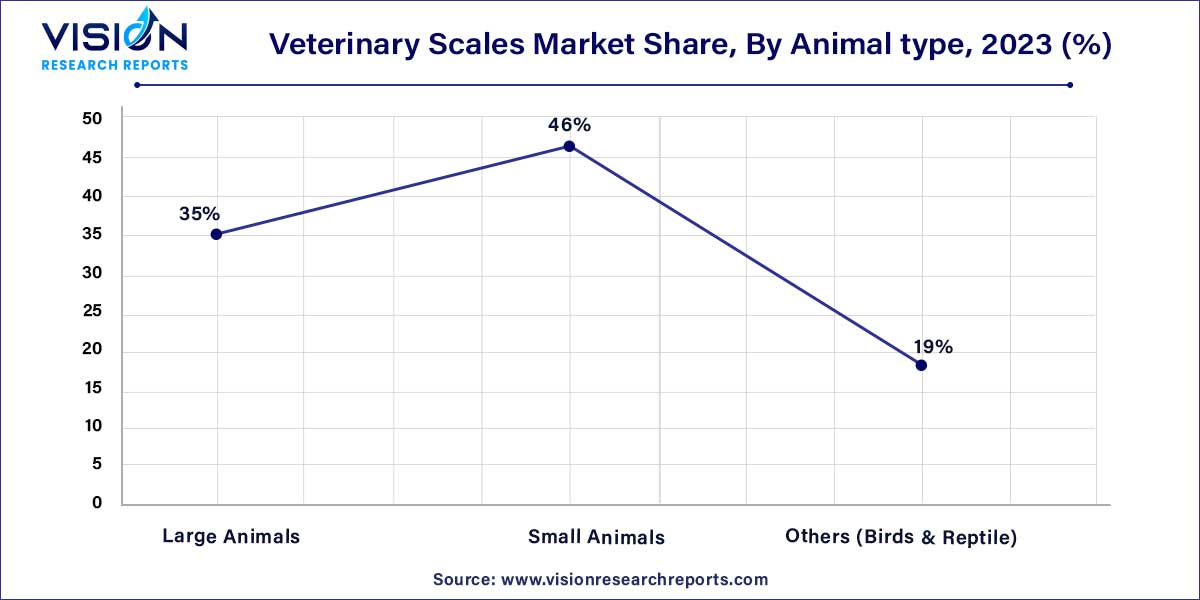
The large animals segment is estimated to witness the fastest CAGR of about 5.73% over the forecast period. The demand for large animal veterinary scales is increasing as the agriculture and livestock industries evolve and stakeholders recognize the importance of precise and efficient animal weight management in their operations.
The online segment contributed the largest market share of 60% in 2023 and is expected to grow at the fastest CAGR of 5.06% over the forecast period. The ease of purchasing veterinary scales online has made them more accessible to veterinary professionals and pet owners, further driving market growth. Online retailers typically provide detailed product information, specifications, and customer reviews, allowing veterinarians to make informed decisions about the scale's functionality, accuracy, and durability. For example, integrating advanced technology, such as digital displays, data storage, and connectivity features, in benchtop veterinary scales has increased their efficiency and convenience, making them more attractive to veterinarians and pet owners. Moreover, some veterinarians or clinics prefer the convenience and wider selection offered by online sales channels. In contrast, others may prioritize hands-on inspection, personalized assistance, and local support provided by offline retailers.
The veterinary hospitals & clinics segment held the highest market share of 34% in 2023. Veterinary scales are primarily used in vet hospitals and clinics to weigh animals during veterinary health management. Ordinary pet owners can also use veterinary scales to accurately determine the healthy weight of their cats, dogs, and other pets, and vets use them for medical purposes. Weight loss or gain in any animal could indicate a medical condition. Thus, taking measures of weight with this affordable method is crucial. Furthermore, regardless of the pet's size, pet owners must have access to a steady weight indication to provide the appropriate medical treatment.
The veterinary diagnostic centers segment is estimated to witness the fastest CAGR of about 6.04% over the forecast period. In veterinary diagnostic laboratories, precision and accuracy in measurements are essential for delivering reliable and accurate diagnostic results. Veterinary scales play a pivotal role in ensuring the quality and integrity of laboratory processes, making them indispensable tools in this setting. The need for accuracy, data reliability, and adherence to quality and safety standards in veterinary research and diagnostics drives the high demand for veterinary scales in diagnostic laboratories.
In terms of region, North America held the largest share of more than 40% in 2023. There is a growing need for pet care services and products in the region due to the increasing number of pet parents and their high pet expenditures. As per the American Pet Products Association's (APPA) 2021-2022 National Pet Owners Survey, around 70% of American homes had a pet in 2020, a rise from 67% in 2019.
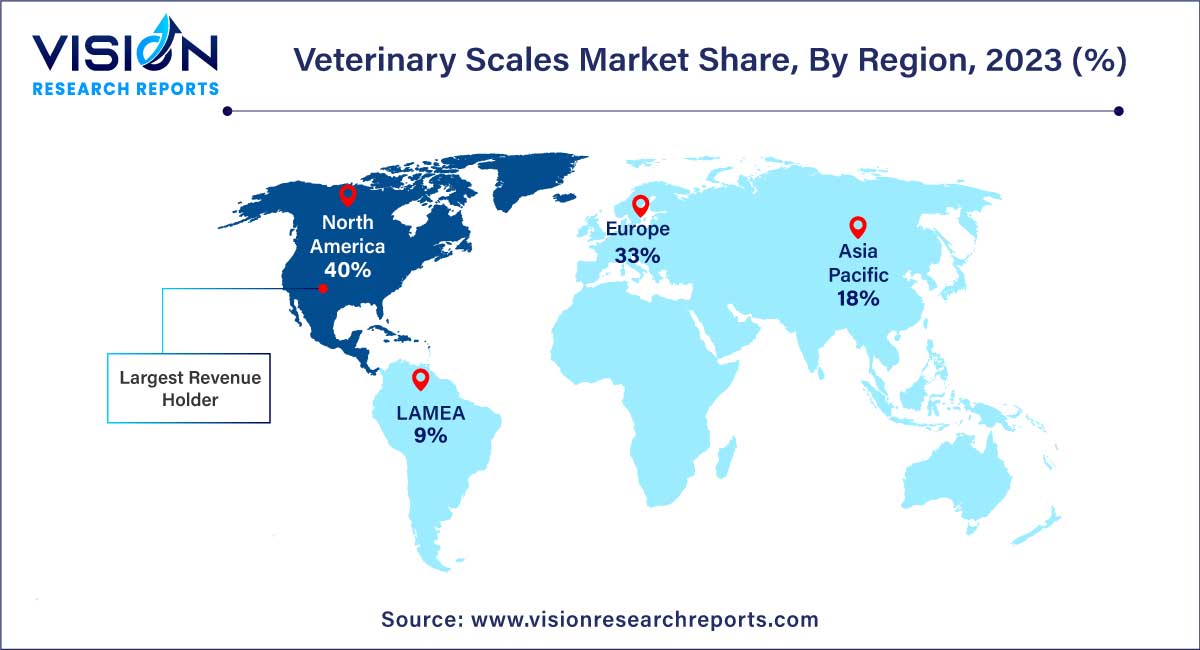
Asia Pacific region is estimated to grow at the fastest CAGR of more than 6.08% from 2024 to 2033. The growing awareness about pet health, increasing advancement in veterinary scales, and growing penetration of digital technology in pet health management are anticipated to drive the regional industry’s growth over the forecast period.
By Configuration
By Animal Type
By Purchasing Channel
By End-use
By Region
Chapter 1. Introduction
1.1. Research Objective
1.2. Scope of the Study
1.3. Definition
Chapter 2. Research Methodology
2.1. Research Approach
2.2. Data Sources
2.3. Assumptions & Limitations
Chapter 3. Executive Summary
3.1. Market Snapshot
Chapter 4. Market Variables and Scope
4.1. Introduction
4.2. Market Classification and Scope
4.3. Industry Value Chain Analysis
4.3.1. Raw Material Procurement Analysis
4.3.2. Sales and Distribution Channel Analysis
4.3.3. Downstream Buyer Analysis
Chapter 5. COVID 19 Impact on Veterinary Scales Market
5.1. COVID-19 Landscape: Veterinary Scales Industry Impact
5.2. COVID 19 - Impact Assessment for the Industry
5.3. COVID 19 Impact: Global Major Government Policy
5.4. Market Trends and Opportunities in the COVID-19 Landscape
Chapter 6. Market Dynamics Analysis and Trends
6.1. Market Dynamics
6.1.1. Market Drivers
6.1.2. Market Restraints
6.1.3. Market Opportunities
6.2. Porter’s Five Forces Analysis
6.2.1. Bargaining power of suppliers
6.2.2. Bargaining power of buyers
6.2.3. Threat of substitute
6.2.4. Threat of new entrants
6.2.5. Degree of competition
Chapter 7. Competitive Landscape
7.1.1. Company Market Share/Positioning Analysis
7.1.2. Key Strategies Adopted by Players
7.1.3. Vendor Landscape
7.1.3.1. List of Suppliers
7.1.3.2. List of Buyers
Chapter 8. Global Veterinary Scales Market, By Configuration
8.1. Veterinary Scales Market, by Configuration, 2024-2033
8.1.1. Platform
8.1.1.1. Market Revenue and Forecast (2021-2033)
8.1.2. Bench-top
8.1.2.1. Market Revenue and Forecast (2021-2033)
8.1.3. Portable
8.1.3.1. Market Revenue and Forecast (2021-2033)
8.1.4. Others (Floor scale, Hanging scale, Wheelchair Scales)
8.1.4.1. Market Revenue and Forecast (2021-2033)
Chapter 9. Global Veterinary Scales Market, By Animal Type
9.1. Veterinary Scales Market, by Animal Type, 2024-2033
9.1.1. Large Animals
9.1.1.1. Market Revenue and Forecast (2021-2033)
9.1.2. Small Animals
9.1.2.1. Market Revenue and Forecast (2021-2033)
9.1.3. Others (Birds & Reptile)
9.1.3.1. Market Revenue and Forecast (2021-2033)
Chapter 10. Global Veterinary Scales Market, By Purchasing Channel
10.1. Veterinary Scales Market, by Purchasing Channel, 2024-2033
10.1.1. Offline
10.1.1.1. Market Revenue and Forecast (2021-2033)
10.1.2. Online
10.1.2.1. Market Revenue and Forecast (2021-2033)
Chapter 11. Global Veterinary Scales Market, By End-use
11.1. Veterinary Scales Market, by End-use, 2024-2033
11.1.1. Veterinary Hospitals & Clinics
11.1.1.1. Market Revenue and Forecast (2021-2033)
11.1.2. Veterinary Diagnostic Centers
11.1.2.1. Market Revenue and Forecast (2021-2033)
11.1.3. Homecare Settings
11.1.3.1. Market Revenue and Forecast (2021-2033)
11.1.4. Others
11.1.4.1. Market Revenue and Forecast (2021-2033)
Chapter 12. Global Veterinary Scales Market, Regional Estimates and Trend Forecast
12.1. North America
12.1.1. Market Revenue and Forecast, by Configuration (2021-2033)
12.1.2. Market Revenue and Forecast, by Animal Type (2021-2033)
12.1.3. Market Revenue and Forecast, by Purchasing Channel (2021-2033)
12.1.4. Market Revenue and Forecast, by End-use (2021-2033)
12.1.5. U.S.
12.1.5.1. Market Revenue and Forecast, by Configuration (2021-2033)
12.1.5.2. Market Revenue and Forecast, by Animal Type (2021-2033)
12.1.5.3. Market Revenue and Forecast, by Purchasing Channel (2021-2033)
12.1.5.4. Market Revenue and Forecast, by End-use (2021-2033)
12.1.6. Rest of North America
12.1.6.1. Market Revenue and Forecast, by Configuration (2021-2033)
12.1.6.2. Market Revenue and Forecast, by Animal Type (2021-2033)
12.1.6.3. Market Revenue and Forecast, by Purchasing Channel (2021-2033)
12.1.6.4. Market Revenue and Forecast, by End-use (2021-2033)
12.2. Europe
12.2.1. Market Revenue and Forecast, by Configuration (2021-2033)
12.2.2. Market Revenue and Forecast, by Animal Type (2021-2033)
12.2.3. Market Revenue and Forecast, by Purchasing Channel (2021-2033)
12.2.4. Market Revenue and Forecast, by End-use (2021-2033)
12.2.5. UK
12.2.5.1. Market Revenue and Forecast, by Configuration (2021-2033)
12.2.5.2. Market Revenue and Forecast, by Animal Type (2021-2033)
12.2.5.3. Market Revenue and Forecast, by Purchasing Channel (2021-2033)
12.2.5.4. Market Revenue and Forecast, by End-use (2021-2033)
12.2.6. Germany
12.2.6.1. Market Revenue and Forecast, by Configuration (2021-2033)
12.2.6.2. Market Revenue and Forecast, by Animal Type (2021-2033)
12.2.6.3. Market Revenue and Forecast, by Purchasing Channel (2021-2033)
12.2.6.4. Market Revenue and Forecast, by End-use (2021-2033)
12.2.7. France
12.2.7.1. Market Revenue and Forecast, by Configuration (2021-2033)
12.2.7.2. Market Revenue and Forecast, by Animal Type (2021-2033)
12.2.7.3. Market Revenue and Forecast, by Purchasing Channel (2021-2033)
12.2.7.4. Market Revenue and Forecast, by End-use (2021-2033)
12.2.8. Rest of Europe
12.2.8.1. Market Revenue and Forecast, by Configuration (2021-2033)
12.2.8.2. Market Revenue and Forecast, by Animal Type (2021-2033)
12.2.8.3. Market Revenue and Forecast, by Purchasing Channel (2021-2033)
12.2.8.4. Market Revenue and Forecast, by End-use (2021-2033)
12.3. APAC
12.3.1. Market Revenue and Forecast, by Configuration (2021-2033)
12.3.2. Market Revenue and Forecast, by Animal Type (2021-2033)
12.3.3. Market Revenue and Forecast, by Purchasing Channel (2021-2033)
12.3.4. Market Revenue and Forecast, by End-use (2021-2033)
12.3.5. India
12.3.5.1. Market Revenue and Forecast, by Configuration (2021-2033)
12.3.5.2. Market Revenue and Forecast, by Animal Type (2021-2033)
12.3.5.3. Market Revenue and Forecast, by Purchasing Channel (2021-2033)
12.3.5.4. Market Revenue and Forecast, by End-use (2021-2033)
12.3.6. China
12.3.6.1. Market Revenue and Forecast, by Configuration (2021-2033)
12.3.6.2. Market Revenue and Forecast, by Animal Type (2021-2033)
12.3.6.3. Market Revenue and Forecast, by Purchasing Channel (2021-2033)
12.3.6.4. Market Revenue and Forecast, by End-use (2021-2033)
12.3.7. Japan
12.3.7.1. Market Revenue and Forecast, by Configuration (2021-2033)
12.3.7.2. Market Revenue and Forecast, by Animal Type (2021-2033)
12.3.7.3. Market Revenue and Forecast, by Purchasing Channel (2021-2033)
12.3.7.4. Market Revenue and Forecast, by End-use (2021-2033)
12.3.8. Rest of APAC
12.3.8.1. Market Revenue and Forecast, by Configuration (2021-2033)
12.3.8.2. Market Revenue and Forecast, by Animal Type (2021-2033)
12.3.8.3. Market Revenue and Forecast, by Purchasing Channel (2021-2033)
12.3.8.4. Market Revenue and Forecast, by End-use (2021-2033)
12.4. MEA
12.4.1. Market Revenue and Forecast, by Configuration (2021-2033)
12.4.2. Market Revenue and Forecast, by Animal Type (2021-2033)
12.4.3. Market Revenue and Forecast, by Purchasing Channel (2021-2033)
12.4.4. Market Revenue and Forecast, by End-use (2021-2033)
12.4.5. GCC
12.4.5.1. Market Revenue and Forecast, by Configuration (2021-2033)
12.4.5.2. Market Revenue and Forecast, by Animal Type (2021-2033)
12.4.5.3. Market Revenue and Forecast, by Purchasing Channel (2021-2033)
12.4.5.4. Market Revenue and Forecast, by End-use (2021-2033)
12.4.6. North Africa
12.4.6.1. Market Revenue and Forecast, by Configuration (2021-2033)
12.4.6.2. Market Revenue and Forecast, by Animal Type (2021-2033)
12.4.6.3. Market Revenue and Forecast, by Purchasing Channel (2021-2033)
12.4.6.4. Market Revenue and Forecast, by End-use (2021-2033)
12.4.7. South Africa
12.4.7.1. Market Revenue and Forecast, by Configuration (2021-2033)
12.4.7.2. Market Revenue and Forecast, by Animal Type (2021-2033)
12.4.7.3. Market Revenue and Forecast, by Purchasing Channel (2021-2033)
12.4.7.4. Market Revenue and Forecast, by End-use (2021-2033)
12.4.8. Rest of MEA
12.4.8.1. Market Revenue and Forecast, by Configuration (2021-2033)
12.4.8.2. Market Revenue and Forecast, by Animal Type (2021-2033)
12.4.8.3. Market Revenue and Forecast, by Purchasing Channel (2021-2033)
12.4.8.4. Market Revenue and Forecast, by End-use (2021-2033)
12.5. Latin America
12.5.1. Market Revenue and Forecast, by Configuration (2021-2033)
12.5.2. Market Revenue and Forecast, by Animal Type (2021-2033)
12.5.3. Market Revenue and Forecast, by Purchasing Channel (2021-2033)
12.5.4. Market Revenue and Forecast, by End-use (2021-2033)
12.5.5. Brazil
12.5.5.1. Market Revenue and Forecast, by Configuration (2021-2033)
12.5.5.2. Market Revenue and Forecast, by Animal Type (2021-2033)
12.5.5.3. Market Revenue and Forecast, by Purchasing Channel (2021-2033)
12.5.5.4. Market Revenue and Forecast, by End-use (2021-2033)
12.5.6. Rest of LATAM
12.5.6.1. Market Revenue and Forecast, by Configuration (2021-2033)
12.5.6.2. Market Revenue and Forecast, by Animal Type (2021-2033)
12.5.6.3. Market Revenue and Forecast, by Purchasing Channel (2021-2033)
12.5.6.4. Market Revenue and Forecast, by End-use (2021-2033)
Chapter 13. Company Profiles
13.1. Mettler-Toledo International Inc (OHAUS Corporation)
13.1.1. Company Overview
13.1.2. Product Offerings
13.1.3. Financial Performance
13.1.4. Recent Initiatives
13.2. Adam Equipment
13.2.1. Company Overview
13.2.2. Product Offerings
13.2.3. Financial Performance
13.2.4. Recent Initiatives
13.3. Rice Lake Weighing Systems
13.3.1. Company Overview
13.3.2. Product Offerings
13.3.3. Financial Performance
13.3.4. Recent Initiatives
13.4. Marsden Weighing Machine Group Ltd
13.4.1. Company Overview
13.4.2. Product Offerings
13.4.3. Financial Performance
13.4.4. Recent Initiatives
13.5. KERN & SOHN GmbH
13.5.1. Company Overview
13.5.2. Product Offerings
13.5.3. Financial Performance
13.5.4. Recent Initiatives
13.6. Avery Weigh-Tronix, LLC (Brecknell)
13.6.1. Company Overview
13.6.2. Product Offerings
13.6.3. Financial Performance
13.6.4. Recent Initiatives
13.7. A&D Company, Limited
13.7.1. Company Overview
13.7.2. Product Offerings
13.7.3. Financial Performance
13.7.4. Recent Initiatives
13.8. SR Instruments, Inc.
13.8.1. Company Overview
13.8.2. Product Offerings
13.8.3. Financial Performance
13.8.4. Recent Initiatives
13.9. Rusty's Weigh Scales & Service, Inc.
13.9.1. Company Overview
13.9.2. Product Offerings
13.9.3. Financial Performance
13.9.4. Recent Initiatives
13.10. Avante Animal Health.
13.10.1. Company Overview
13.10.2. Product Offerings
13.10.3. Financial Performance
13.10.4. Recent Initiatives
Chapter 14. Research Methodology
14.1. Primary Research
14.2. Secondary Research
14.3. Assumptions
Chapter 15. Appendix
15.1. About Us
15.2. Glossary of Terms
 Cross-segment Market Size and Analysis for
Mentioned Segments
Additional Company Profiles (Upto 5 With No Cost)
Additional Countries (Apart From Mentioned Countries)
Country/Region-specific Report
Go To Market Strategy
Region Specific Market DynamicsRegion Level Market Share Import Export AnalysisProduction AnalysisOthers
Cross-segment Market Size and Analysis for
Mentioned Segments
Additional Company Profiles (Upto 5 With No Cost)
Additional Countries (Apart From Mentioned Countries)
Country/Region-specific Report
Go To Market Strategy
Region Specific Market DynamicsRegion Level Market Share Import Export AnalysisProduction AnalysisOthers