Downstream Processing Market Size, Report 2025-2034
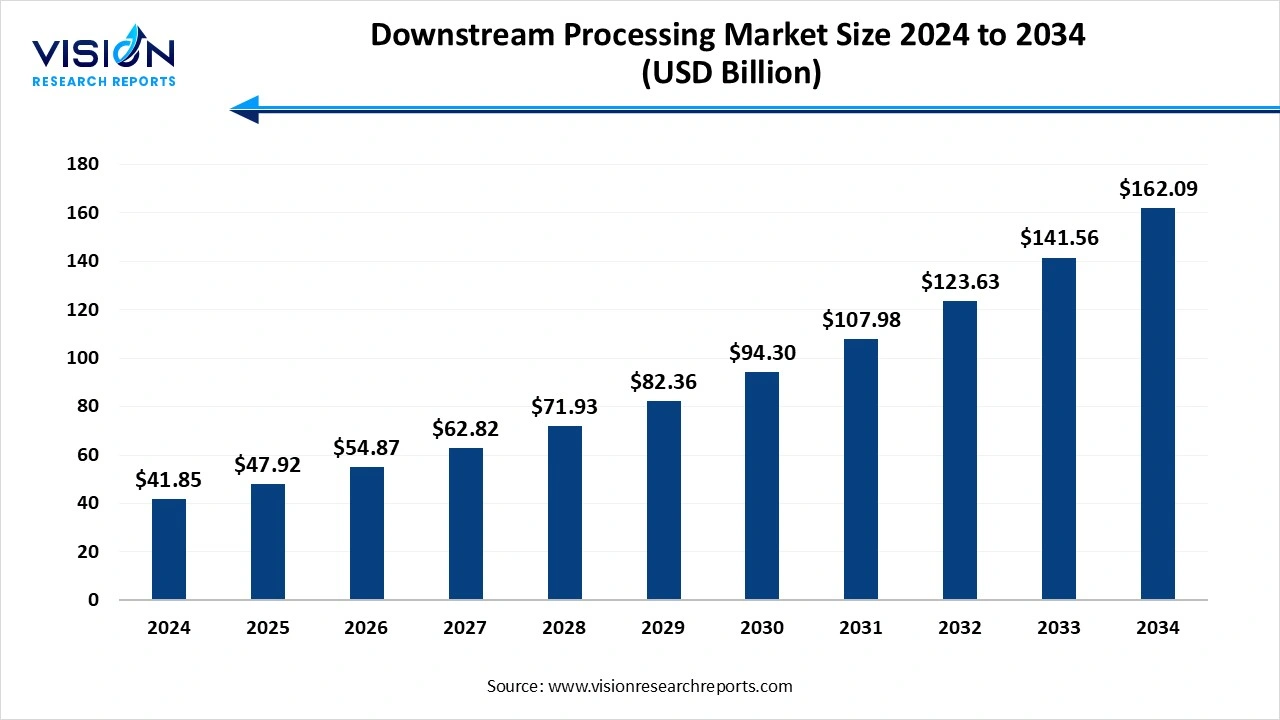
The global downstream processing market size stood at USD 41.85 billion in 2024 and is estimated to reach USD 47.92 billion in 2025. It is projected to surge past USD 162.09 billion by 2034, registering a robust CAGR of 14.5% from 2025 to 2034. The rising biopharmaceutical demands, innovations in research and development, and expansion of the biopharmaceutical sector drive the market growth.
Key Pointers
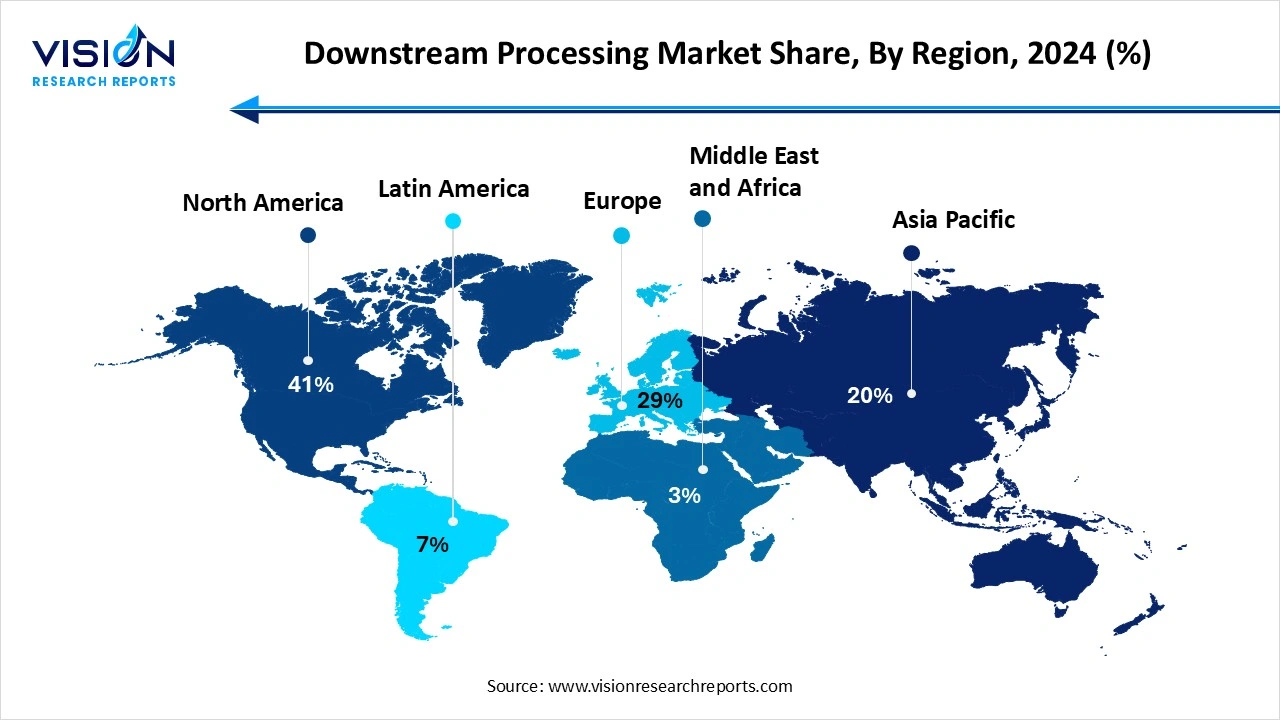
- By region, North America dominated the global market with highest share of 41% in 2024.
- By product, the chromatography systems segment contributed the largest market share of 42% in 2024.
- By product, the filters segment is expected to expand at the highest CAGR from 2025 to 2034.
- By technique, the purification by chromatography segment is generated the maximum market share of 42% in 2024.
- By technique, the solid-liquid separation segment is expected to grow at the notable CAGR during the forecast period.
- By application, the antibiotic production segment registered the maximum market share of 30% in 2024.
Downstream Processing Market Overview
A downstream process is defined as the recovery, purification, and packaging of a biosynthetic product, such as a pharmaceutical drug, from its natural source, like a fermentation broth. These processes are crucial for separating the target product from a complex mixture of contaminants, including cells, cell debris, and other impurities. The market growth is driven by the need for purifying and isolating complex biological products, such as monoclonal antibodies and vaccine, driving the need for these technologies as the biopharmaceutical industry expands. Innovation in biotechnology, the rapid adoption of single-use and disposable technologies, and increased investments in biopharmaceutical research and development, including efforts to modernize bioprocess technologies, are fueling demand for improved downstream processing solutions.
Advancements in Purification Processing Market Growth
The development of advanced resins and columns has improved the speed and capacity of chromatography, the standard purification method for most biologics. There is a market shift toward integrated and continuous DSP systems, which combine multiple purification steps into a more streamlined process. This approach reduces operational costs and time while improving overall process efficiency. Novel membrane filtration technologies have been developed to increase the efficiency of clarification and viral inactivation.
Report Scope of the Downstream Processing Market
| Report Coverage |
Details |
| Market Size in 2024 |
USD 17.73 billion |
| Revenue Forecast by 2034 |
USD 27.80 billion |
| Growth rate from 2025 to 2034 |
CAGR of 4.6% |
| Base Year |
2024 |
| Forecast Period |
2025 to 2034 |
| Regions |
North America, Europe, Asia Pacific, Latin America, Middle East & Africa |
| Companies Covered |
|
Downstream Processing Market Trends
- Technology Advancement: Continuous advancement of automation in processes such as chromatography, filtration, and drying reduces human error and improves consistency, while the application of AI and machine learning increases efficacy and product yield. The increasing single-use system adoption offers benefits, such as flexibility, reduced cleaning, and lower capital investment, especially for small-batch manufacturing. Shift towards a continuous manufacturing process, which improves productivity and offers significant advantages in large-scale biopharmaceutical production.
Downstream Processing Market Opportunity
Expansion in the Biopharmaceutical Sectors for the Downstream Processing Market
The demand for biopharmaceuticals, especially mAbs, has been on a steady rise to treat conditions like cancer and autoimmune diseases. As upstream processes have become more productive, resulting in higher concentrations of the desired product, the downstream purification process has become a bottleneck. This has driven the need for more advanced and high-throughput DSP solutions. Downstream processing is essential for purifying and isolating complex biological products, like monoclonal antibodies and vaccines, driving the need for these technologies as the biopharmaceutical industry expands.
Downstream Processing Market Challenge
High Cost in the Downstream Processing Market
The downstream processing requires specialized instruments and consumables, such as chromatography systems, filters, and resins, which come at a high price. Setting up downstream processing facilities requires considerable initial capital investment.
Regional Insights
Which Region Dominated the Downstream Processing Market?
North America led the downstream processing industry, accounting for the highest revenue share of 41% in 2024. The region has major biopharmaceutical industries and significant investment in innovative technologies, technological advancement in downstream processing, with a strong emphasis on research and development activities, which fuel the market growth. The increasing demand for biopharmaceuticals, such as biologics, personalized medicine, and biosimilars, creates more demand, well-established biopharmaceutical manufacturing facilities, and well-developed healthcare infrastructure drive the market growth.
United States Downstream Processing Market Trends
The adoption of single-use systems for their flexibility and cost-effectiveness, and a shift towards continuous processing to improve productivity and control. There is also an increase in outsourcing to Contract Manufacturing Organizations (CMOs) for their expertise and infrastructure, and a strong emphasis on regulatory compliance, which drives investment in advanced technologies. Technological advancements in chromatography and filtration are improving efficiency, and there is a focus on process intensification to optimize operations.
Why is the Asia Pacific Significantly Growing in the Downstream Processing Market?
The Asia Pacific unmanned systems industry is projected to register the highest compound annual growth rate (CAGR) of over 14.1% between 2025 and 2034. The rising demand in the region of biopharmaceuticals and vaccines, an increasing aging population, and chronic diseases necessitate efficient purification and separation processes. The growing private and government investment in biotechnology and pharmaceutical research and development is fuelling the market growth. The adoption of process intensification, automation, and single-use technologies in biomanufacturing increases efficiency, reduces the risk of cross-contamination, and lowers operational costs.
Segmental Insights
Products Insights
Why did the Chromatography Segment Dominate the Downstream Processing Market?
The chromatography systems segment led the downstream processing market, capturing the largest revenue share of 42% in 2024. It has high resolution and purification capabilities, which are essential for manufacturing safe and effective biopharmaceuticals. The technique's versatility allows for multi-step purification tailored to specific biomolecules, meeting stringent regulatory standards. Continued innovation in automation, resins, and single-use technologies further cemented its market dominance. As the biopharmaceutical sector grows, chromatography will remain a critical tool for isolating complex biologics with high purity.
The filters segment is the fastest-growing in the downstream processing market during the forecast period. The new development in membrane filtration and depth filtration, including an advanced tangential flow filtration system, improves efficacy and scalability. The rising trends towards single-use filters in biomanufacturing simplify processes, reduce cross-contamination risks, and increase production rate. The increasing demand for biologics, vaccines, and monoclonal antibodies requires advanced filtration solutions for drug development and manufacturing, fueling the market growth.
Technique Insights
How the Purification by Chromatography Segment hold the Largest Share in the Downstream Processing Market?
The purification by chromatography segment held the largest share of the downstream processing market, accounting for 42% of total revenue in 2024. The unmatched precision and reliability for isolating high-value biopharmaceuticals. It is essential for meeting the stringent purity requirements of modern biologics, like monoclonal antibodies and vaccines, driving market growth. With continuous innovation in single-use and automated systems, chromatography remains the most effective and adaptable solution for complex purification challenges. This technological superiority and its critical role in biomanufacturing secure its leading market position.
The solid-liquid separation segment is experiencing the fastest growth in the market during the forecast period. It is crucial for the separation of cells and insoluble components from the culture broth, a primary step in isolating the desired product. This method is more economical than other purification techniques. Solid-liquid separation techniques are well-suited for integration into continuous manufacturing processes, which enhance overall productivity and efficiency.
Application Insights
How the Antibiotic Production Segment hold the Largest Share in the Downstream Processing Market?
The antibiotic production segment led the downstream processing market, accounting for the highest revenue share of 30% in 2024. There is a high demand for antibiotics to combat infectious diseases, including those caused by antibiotic-resistant bacteria. Antibiotics are broadly used in both human medicine for various disorders and in agriculture, further contributing to their high consumption and, consequently, demand for downstream processing. The rising threat of antibiotic-resistant bacteria, which causes hundreds of thousands of deaths annually, drives continuous research and development into novel antibiotics. This fuels the demand for innovative and efficient downstream processing technologies to purify these new drug candidates.
The antibody production segment is experiencing the fastest growth in the market during the forecast period. The high demand for monoclonal antibodies used in targeted therapies. Technological advancements like single-use and continuous processing are addressing purification challenges from increased upstream production yields. Biopharmaceutical companies and contract manufacturers are investing significantly to reduce costs and accelerate time-to-market for complex biologics. This rising demand and technological support for monoclonal antibodies contribute to the segment's dominant growth in downstream processing.
The Downstream Processing Market-Value Chain Analysis
- R&D: The downstream processing market focuses on the recovery, purification, and formulation of biosynthetic products, such as pharmaceuticals and vaccines, from natural sources like fermentation broths or plant/animal tissues.
- Patient Support and Services: The downstream processing market involves the biopharmaceutical industry that deal with entirely separate parts of the product lifecycle.
- Distribution to Hospitals, Pharmacies: The Biopharmaceutical and biotech companies, Contract manufacturing organizations (CMOs), and Hospitals and pharmacies.
Recent Developments
- In January 2025, Bio-Rad Laboratories introduced CHT™ Foresight Pro Columns, developed for process-scale chromatography applications across all stages of biological drug manufacturing. (Source: The Scientist)
- In September 2025, Aptamer Group announced a partnership with Invizius to integrate its Optimer platform with Invizius’ H-Guard technology to develop highly specific binders for the complement system. (Source: aptamer group)
Top Companies in Downstream Processing Market
Market Segmentation
By Product
- Chromatography Systems
- Filters
- Evaporators
- Centrifuges
- Dryers
- Others
By Technique
- Cell Disruption
- Solid-liquid Separation
- Filtration
- Centrifugation
- Concentration
- Evaporation
- Membrane Filtration
- Purification By Chromatography
- Formulation
By Application
- Antibiotic Production
- Hormone Production
- Antibodies Production
- Enzyme Production
- Vaccine Production
By Regional
- North America
- Europe
- Germany
- UK
- France
- Italy
- Spain
- Denmark
- Sweden
- Norway
- Asia Pacific
- Japan
- China
- India
- South Korea
- Thailand
- Australia
- Latin America
- Middle East and Africa (MEA)
- South Africa
- Saudi Arabia
- UAE
- Kuwait
Frequently Asked Questions
The global downstream processing market size was reached at USD 41.85 billion in 2024 and it is projected to hit around USD 162.09 billion by 2034.
The global downstream processing market is growing at a compound annual growth rate (CAGR) of 14.50% from 2025 to 2034.
The North America region has accounted for the largest downstream processing market share in 2024.
Chapter 1. Introduction
1.1. Research Objective
1.2. Scope of the Study
1.3. Definition
Chapter 2. Research Methodology
2.1. Research Approach
2.2. Data Sources
2.3. Assumptions & Limitations
Chapter 3. Executive Summary
3.1. Market Snapshot
Chapter 4. Market Variables and Scope
4.1. Introduction
4.2. Market Classification and Scope
4.3. Industry Value Chain Analysis
4.3.1. Raw Material Procurement Analysis
4.3.2. Sales and Distribution Product Analysis
4.3.3. Downstream Buyer Analysis
Chapter 5. COVID 19 Impact on Downstream Processing Market
5.1. COVID-19 Landscape: Downstream Processing Industry Impact
5.2. COVID 19 - Impact Assessment for the Industry
5.3. COVID 19 Impact: Global Major Government Policy
5.4. Market Trends and Opportunities in the COVID-19 Landscape
Chapter 6. Market Dynamics Analysis and Trends
6.1. Market Dynamics
6.1.1. Market Drivers
6.1.2. Market Restraints
6.1.3. Market Opportunities
6.2. Porter’s Five Forces Analysis
6.2.1. Bargaining power of suppliers
6.2.2. Bargaining power of buyers
6.2.3. Threat of substitute
6.2.4. Threat of new entrants
6.2.5. Degree of competition
Chapter 7. Competitive Landscape
7.1.1. Company Market Share/Positioning Analysis
7.1.2. Key Strategies Adopted by Players
7.1.3. Vendor Landscape
7.1.3.1. List of Suppliers
7.1.3.2. List of Buyers
Chapter 8. Global Downstream Processing Market, By Product
8.1. Downstream Processing Market, by Product
8.1.1 Chromatography Systems
8.1.1.1. Market Revenue and Forecast
8.1.2. Filters
8.1.2.1. Market Revenue and Forecast
8.1.3. Evaporators
8.1.3.1. Market Revenue and Forecast
8.1.4. Centrifuges
8.1.4.1. Market Revenue and Forecast
8.1.5. Dryers
8.1.5.1. Market Revenue and Forecast
8.1.6. Others
8.1.6.1. Market Revenue and Forecast
Chapter 9. Global Downstream Processing Market, By Technique
9.1. Downstream Processing Market, by Technique
9.1.1. Cell Disruption
9.1.1.1. Market Revenue and Forecast
9.1.2. Solid-liquid Separation
9.1.2.1. Market Revenue and Forecast
9.1.3. Concentration
9.1.3.1. Market Revenue and Forecast
9.1.4. Purification By Chromatography
9.1.4.1. Market Revenue and Forecast
9.1.5. Formulation
9.1.5.1. Market Revenue and Forecast
Chapter 10. Global Downstream Processing Market, By Application
10.1. Downstream Processing Market, by Application
10.1.1. Antibiotic Production
10.1.1.1. Market Revenue and Forecast
10.1.2. Hormone Production
10.1.2.1. Market Revenue and Forecast
10.1.3. Antibodies Production
10.1.3.1. Market Revenue and Forecast
10.1.4. Enzyme Production
10.1.4.1. Market Revenue and Forecast
10.1.5. Vaccine Production
10.1.5.1. Market Revenue and Forecast
Chapter 11. Global Downstream Processing Market, Regional Estimates and Trend Forecast
11.1. North America
11.1.1. Market Revenue and Forecast, by Product
11.1.2. Market Revenue and Forecast, by Technique
11.1.3. Market Revenue and Forecast, by Application
11.1.4. U.S.
11.1.4.1. Market Revenue and Forecast, by Product
11.1.4.2. Market Revenue and Forecast, by Technique
11.1.4.3. Market Revenue and Forecast, by Application
11.1.5. Rest of North America
11.1.5.1. Market Revenue and Forecast, by Product
11.1.5.2. Market Revenue and Forecast, by Technique
11.1.5.3. Market Revenue and Forecast, by Application
11.2. Europe
11.2.1. Market Revenue and Forecast, by Product
11.2.2. Market Revenue and Forecast, by Technique
11.2.3. Market Revenue and Forecast, by Application
11.2.4. UK
11.2.4.1. Market Revenue and Forecast, by Product
11.2.4.2. Market Revenue and Forecast, by Technique
11.2.4.3. Market Revenue and Forecast, by Application
11.2.5. Germany
11.2.5.1. Market Revenue and Forecast, by Product
11.2.5.2. Market Revenue and Forecast, by Technique
11.2.5.3. Market Revenue and Forecast, by Application
11.2.6. France
11.2.6.1. Market Revenue and Forecast, by Product
11.2.6.2. Market Revenue and Forecast, by Technique
11.2.6.3. Market Revenue and Forecast, by Application
11.2.7. Rest of Europe
11.2.7.1. Market Revenue and Forecast, by Product
11.2.7.2. Market Revenue and Forecast, by Technique
11.2.7.3. Market Revenue and Forecast, by Application
11.3. APAC
11.3.1. Market Revenue and Forecast, by Product
11.3.2. Market Revenue and Forecast, by Technique
11.3.3. Market Revenue and Forecast, by Application
11.3.4. India
11.3.4.1. Market Revenue and Forecast, by Product
11.3.4.2. Market Revenue and Forecast, by Technique
11.3.4.3. Market Revenue and Forecast, by Application
11.3.5. China
11.3.5.1. Market Revenue and Forecast, by Product
11.3.5.2. Market Revenue and Forecast, by Technique
11.3.5.3. Market Revenue and Forecast, by Application
11.3.6. Japan
11.3.6.1. Market Revenue and Forecast, by Product
11.3.6.2. Market Revenue and Forecast, by Technique
11.3.6.3. Market Revenue and Forecast, by Application
11.3.7. Rest of APAC
11.3.7.1. Market Revenue and Forecast, by Product
11.3.7.2. Market Revenue and Forecast, by Technique
11.3.7.3. Market Revenue and Forecast, by Application
11.4. MEA
11.4.1. Market Revenue and Forecast, by Product
11.4.2. Market Revenue and Forecast, by Technique
11.4.3. Market Revenue and Forecast, by Application
11.4.4. GCC
11.4.4.1. Market Revenue and Forecast, by Product
11.4.4.2. Market Revenue and Forecast, by Technique
11.4.4.3. Market Revenue and Forecast, by Application
11.4.5. North Africa
11.4.5.1. Market Revenue and Forecast, by Product
11.4.5.2. Market Revenue and Forecast, by Technique
11.4.5.3. Market Revenue and Forecast, by Application
11.4.6. South Africa
11.4.6.1. Market Revenue and Forecast, by Product
11.4.6.2. Market Revenue and Forecast, by Technique
11.4.6.3. Market Revenue and Forecast, by Application
11.4.7. Rest of MEA
11.4.7.1. Market Revenue and Forecast, by Product
11.4.7.2. Market Revenue and Forecast, by Technique
11.4.7.3. Market Revenue and Forecast, by Application
11.5. Latin America
11.5.1. Market Revenue and Forecast, by Product
11.5.2. Market Revenue and Forecast, by Technique
11.5.3. Market Revenue and Forecast, by Application
11.5.4. Brazil
11.5.4.1. Market Revenue and Forecast, by Product
11.5.4.2. Market Revenue and Forecast, by Technique
11.5.4.3. Market Revenue and Forecast, by Application
11.5.5. Rest of LATAM
11.5.5.1. Market Revenue and Forecast, by Product
11.5.5.2. Market Revenue and Forecast, by Technique
11.5.5.3. Market Revenue and Forecast, by Application
Chapter 12. Company Profiles
12.1. Sartorius AG.
12.1.1. Company Overview
12.1.2. Product Offerings
12.1.3. Financial Performance
12.1.4. Recent Initiatives
12.2. Danaher Corporation (including Cytiva and Pall Corporation).
12.2.1. Company Overview
12.2.2. Product Offerings
12.2.3. Financial Performance
12.2.4. Recent Initiatives
12.3. Thermo Fisher Scientific Inc..
12.3.1. Company Overview
12.3.2. Product Offerings
12.3.3. Financial Performance
12.3.4. Recent Initiatives
12.4. Merck KGaA (Millipore Sigma in the U.S. and Canada).
12.4.1. Company Overview
12.4.2. Product Offerings
12.4.3. Financial Performance
12.4.4. Recent Initiatives
12.5. Repligen Corporation.
12.5.1. Company Overview
12.5.2. Product Offerings
12.5.3. Financial Performance
12.5.4. Recent Initiatives
12.6. 3M Company
12.6.1. Company Overview
12.6.2. Product Offerings
12.6.3. Financial Performance
12.6.4. Recent Initiatives
12.7. Eppendorf AG.
12.7.1. Company Overview
12.7.2. Product Offerings
12.7.3. Financial Performance
12.7.4. Recent Initiatives
12.8. GE Healthcare (part of Cytiva, now under Danaher)
12.8.1. Company Overview
12.8.2. Product Offerings
12.8.3. Financial Performance
12.8.4. Recent Initiatives
12.9. Waters Corporation.
12.9.1. Company Overview
12.9.2. Product Offerings
12.9.3. Financial Performance
12.9.4. Recent Initiatives
12.10. Lonza Group AG
12.10.1. Company Overview
12.10.2. Product Offerings
12.10.3. Financial Performance
12.10.4. Recent Initiatives
Chapter 13. Research Methodology
13.1. Primary Research
13.2. Secondary Research
13.3. Assumptions
Chapter 14. Appendix
14.1. About Us
14.2. Glossary of Terms

 Cross-segment Market Size and Analysis for
Mentioned Segments
Cross-segment Market Size and Analysis for
Mentioned Segments