The global blood cancer diagnostics market size surpassed at USD 10.95 billion in 2024 and is estimated to reach USD 11.71 billion in 2025. It is projected to hit USD 21.42 billion by 2034, growing at a CAGR of 6.94% from 2025 to 2034. The market Growth is driven by the rising prevalence of leukemia and lymphoma, advancements in molecular diagnostics and NGS technologies, increasing focus on personalized medicine, and expanding access to advanced testing in emerging regions.
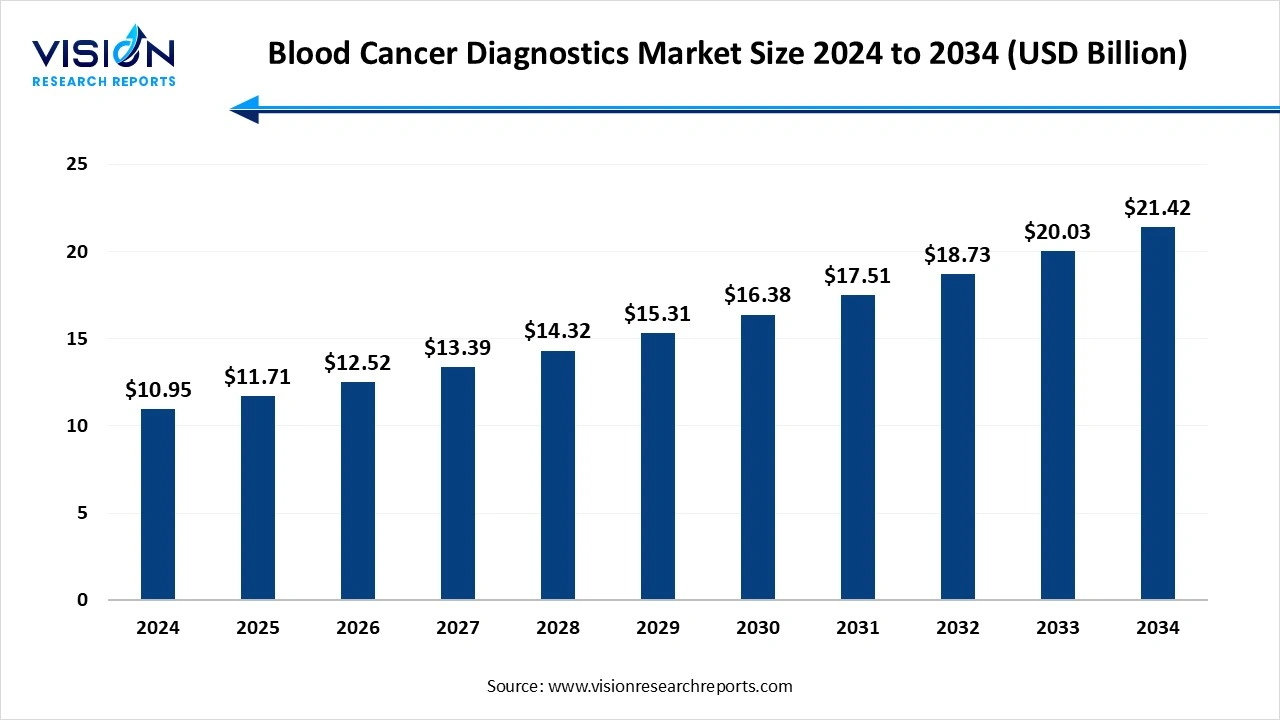
The blood cancer diagnostics market plays a crucial role in early disease detection and effective treatment planning for various hematologic malignancies, including leukemia, lymphoma, and myeloma. This market encompasses a wide range of diagnostic tools such as biopsy testing, flow cytometry, molecular diagnostics, immunohistochemistry, and next-generation sequencing (NGS). Rising global incidence of blood cancers, growing awareness regarding early diagnosis, and advancements in precision medicine are key drivers propelling market growth.
Additionally, continuous improvements in molecular profiling and biomarker discovery have enhanced diagnostic accuracy and personalized therapy selection. With increasing healthcare expenditure and expanding access to advanced testing in emerging economies, the blood cancer diagnostics market is expected to witness steady expansion over the coming years.
The blood cancer diagnostics market is experiencing robust growth driven by the rising global incidence of blood cancers such as leukemia, lymphoma, and myeloma is a primary catalyst, necessitating advanced diagnostic solutions for early detection and effective treatment. Technological advancements play a significant role, with innovations like next-generation sequencing (NGS), liquid biopsies, and artificial intelligence (AI)-driven tools enhancing diagnostic accuracy and efficiency. The increasing emphasis on personalized medicine further fuels market expansion, as tailored diagnostic approaches cater to individual genetic profiles, improving treatment outcomes.
| Report Coverage | Details |
| Market Size in 2024 | USD 10.95 Billion |
| Revenue Forecast by 2034 | USD 21.42 Billion |
| Growth rate from 2025 to 2034 | CAGR of 6.94% |
| Base Year | 2024 |
| Forecast Period | 2025 to 2034 |
| Regions | North America, Europe, Asia Pacific, Latin America, Middle East & Africa |
| Companies Covered | Quest Diagnostics, Illumina, InVivoScribe, Ipsogen (Qiagen), Asuragen (Bio-Techne), Danaher Corporation, Abbott, Sequenta (Adaptive Biotechnologies), SkylineDx, Bio-Rad Laboratories, Alercell, and Sophia Genetics. |
North America region led the global blood cancer diagnostics market with a 46% share in 2023. This dominance is driven by the presence of major global players such as Illumina, InVivoScribe, Danaher Corporation, and Abbott. Factors such as high prevalence rates, substantial R&D activities, and technological advancements in diagnostic methods contribute to market growth. Diagnostic tools and techniques like liquid biopsy, Positron Emission Tomography (PET), NGS testing solutions, and molecular testing are widely available.
Europe Blood Cancer Diagnostics Market Trends
Europe is a promising region for market growth, driven by increased awareness among healthcare professionals and patients. The European Cancer Information System (ECIS) reports around 467,733 new blood cancer cases annually, representing about 8.5% of all new cancer cases. In the UK, growth is expected due to rising cancer rates and supportive government initiatives. For instance, Thermo Fisher Scientific completed its acquisition of The Binding Site Group in January 2023, enhancing its portfolio of diagnostic reagents and kits for blood cancer detection.

Asia-Pacific Blood Cancer Diagnostics Market Trends
The Asia-Pacific region is anticipated to experience the fastest growth. Increased public awareness and research efforts are accelerating market expansion. Countries like China, Japan, and India are witnessing demographic shifts toward aging populations, driving demand for blood cancer diagnostics. Notable developments include Kura Oncology’s clinical trial for tipifarnib, targeting peripheral T-cell lymphoma. China’s booming medical tourism industry is also contributing to market growth by expanding oncological screening services.
In 2023, assay kits and reagents led the market, capturing a dominant 73% revenue share. This significant share is due to their role in detecting specific biomarkers, genetic mutations, and other indicators essential for effective diagnosis and treatment of blood cancers. The growing demand for precise and rapid diagnostic tests is driving the increased adoption of these products. Additionally, advancements in molecular diagnostics and emerging technologies, such as Next-Generation Sequencing (NGS), are expected to further propel market growth. The segment is forecasted to expand at the highest rate of 7.3% CAGR during the forecast period. Manufacturers are actively pursuing strategic initiatives like product approvals, expansions, and collaborations to enhance their offerings. For instance, Sysmex announced in December 2023 the launch of its HISCL β-Amyloid 1-42 and 1-40 assay kits in Europe, aimed at detecting Amyloid Beta accumulation in the brain.
Blood tests were the leading segment in 2023, holding a substantial 37% market share. The rising incidence of blood cancers and the need for early and accurate diagnosis are fueling the demand for blood tests. Complete Blood Count (CBC) tests are commonly used as initial diagnostic tools to detect irregularities in blood cell counts, which may indicate blood cancer. The advent of specialized blood tests, such as multicancer detection assays, has revolutionized the field. For example, the Galleri test by GRAIL, launched in 2021 and highlighted in a June 2023 NHS study, can identify over 50 types of cancer from a single blood sample with 51.5% sensitivity and 99.5% specificity.
The molecular tests segment is expected to grow at a robust 8.43% CAGR during the forecast period. Molecular diagnostics have transformed the management of blood cancers by detecting genetic abnormalities and molecular markers specific to various cancer types. Techniques such as PCR, Fluorescence in Situ Hybridization (FISH), and NGS are commonly used to identify genetic mutations and chromosomal abnormalities. In April 2024, OGT introduced the SureSeq Myeloid Fusion Panel, an RNA-based NGS technology designed to identify key fusion genes associated with Acute Myeloid Leukemia (AML), enhancing the precision of diagnosis and treatment.
Hospitals and clinics represented the largest market segment in 2023 with a 51% share. These facilities are preferred due to their comprehensive range of services under one roof. The National Cancer Institute reports approximately 3,000 new cases of Acute Lymphoblastic Leukemia (ALL) annually in the U.S., with a higher admission rate among children and young adults. Hospitals provide essential diagnostic tests even in emergencies, contributing to their dominant market position. The growing acceptance and integration of advanced cancer diagnostics within hospitals further drive their adoption. The development of on-site diagnostic laboratories and comprehensive diagnostic services, including blood tests, imaging, biopsy, and molecular testing, is crucial for enhancing diagnostic accuracy and prompt treatment.
By Product
By Test
By End Use
By Region
Chapter 1. Introduction
1.1. Research Objective
1.2. Scope of the Study
1.3. Definition
Chapter 2. Research Methodology
2.1. Research Approach
2.2. Data Sources
2.3. Assumptions & Limitations
Chapter 3. Executive Summary
3.1. Market Snapshot
Chapter 4. Market Variables and Scope
4.1. Introduction
4.2. Market Classification and Scope
4.3. Industry Value Chain Analysis
4.3.1. Raw Material Procurement Analysis
4.3.2. Sales and Distribution Product Analysis
4.3.3. Downstream Buyer Analysis
Chapter 5. COVID 19 Impact on Blood Cancer Diagnostics Market
5.1. COVID-19 Landscape: Blood Cancer Diagnostics Industry Impact
5.2. COVID 19 - Impact Assessment for the Industry
5.3. COVID 19 Impact: Global Major Government Policy
5.4. Market Trends and Opportunities in the COVID-19 Landscape
Chapter 6. Market Dynamics Analysis and Trends
6.1. Market Dynamics
6.1.1. Market Drivers
6.1.2. Market Restraints
6.1.3. Market Opportunities
6.2. Porter’s Five Forces Analysis
6.2.1. Bargaining power of suppliers
6.2.2. Bargaining power of buyers
6.2.3. Threat of substitute
6.2.4. Threat of new entrants
6.2.5. Degree of competition
Chapter 7. Competitive Landscape
7.1.1. Company Market Share/Positioning Analysis
7.1.2. Key Strategies Adopted by Players
7.1.3. Vendor Landscape
7.1.3.1. List of Suppliers
7.1.3.2. List of Buyers
Chapter 8. Global Blood Cancer Diagnostics Market, By Product
8.1. Blood Cancer Diagnostics Market, by Product,
8.1.1 Instruments
8.1.1.1. Market Revenue and Forecast
8.1.2. Assay Kits and Reagents
8.1.2.1. Market Revenue and Forecast
Chapter 9. Global Blood Cancer Diagnostics Market, By Test
9.1. Blood Cancer Diagnostics Market, by Test,
9.1.1. Blood Tests
9.1.1.1. Market Revenue and Forecast
9.1.2. Imaging Tests
9.1.2.1. Market Revenue and Forecast
9.1.3. Biopsy
9.1.3.1. Market Revenue and Forecast
9.1.4. Molecular Test
9.1.4.1. Market Revenue and Forecast
Chapter 10. Global Blood Cancer Diagnostics Market, By End Use
10.1. Blood Cancer Diagnostics Market, by End Use,
10.1.1. Hospitals and Clinics
10.1.1.1. Market Revenue and Forecast
10.1.2. Diagnostic Labs
10.1.2.1. Market Revenue and Forecast
10.1.3. Research Institutes
10.1.3.1. Market Revenue and Forecast
Chapter 11. Global Blood Cancer Diagnostics Market, Regional Estimates and Trend Forecast
11.1. North America
11.1.1. Market Revenue and Forecast, by Product
11.1.2. Market Revenue and Forecast, by Test
11.1.3. Market Revenue and Forecast, by End Use
11.1.4. U.S.
11.1.4.1. Market Revenue and Forecast, by Product
11.1.4.2. Market Revenue and Forecast, by Test
11.1.4.3. Market Revenue and Forecast, by End Use
11.1.5. Rest of North America
11.1.5.1. Market Revenue and Forecast, by Product
11.1.5.2. Market Revenue and Forecast, by Test
11.1.5.3. Market Revenue and Forecast, by End Use
11.2. Europe
11.2.1. Market Revenue and Forecast, by Product
11.2.2. Market Revenue and Forecast, by Test
11.2.3. Market Revenue and Forecast, by End Use
11.2.4. UK
11.2.4.1. Market Revenue and Forecast, by Product
11.2.4.2. Market Revenue and Forecast, by Test
11.2.4.3. Market Revenue and Forecast, by End Use
11.2.5. Germany
11.2.5.1. Market Revenue and Forecast, by Product
11.2.5.2. Market Revenue and Forecast, by Test
11.2.5.3. Market Revenue and Forecast, by End Use
11.2.6. France
11.2.6.1. Market Revenue and Forecast, by Product
11.2.6.2. Market Revenue and Forecast, by Test
11.2.6.3. Market Revenue and Forecast, by End Use
11.2.7. Rest of Europe
11.2.7.1. Market Revenue and Forecast, by Product
11.2.7.2. Market Revenue and Forecast, by Test
11.2.7.3. Market Revenue and Forecast, by End Use
11.3. APAC
11.3.1. Market Revenue and Forecast, by Product
11.3.2. Market Revenue and Forecast, by Test
11.3.3. Market Revenue and Forecast, by End Use
11.3.4. India
11.3.4.1. Market Revenue and Forecast, by Product
11.3.4.2. Market Revenue and Forecast, by Test
11.3.4.3. Market Revenue and Forecast, by End Use
11.3.5. China
11.3.5.1. Market Revenue and Forecast, by Product
11.3.5.2. Market Revenue and Forecast, by Test
11.3.5.3. Market Revenue and Forecast, by End Use
11.3.6. Japan
11.3.6.1. Market Revenue and Forecast, by Product
11.3.6.2. Market Revenue and Forecast, by Test
11.3.6.3. Market Revenue and Forecast, by End Use
11.3.7. Rest of APAC
11.3.7.1. Market Revenue and Forecast, by Product
11.3.7.2. Market Revenue and Forecast, by Test
11.3.7.3. Market Revenue and Forecast, by End Use
11.4. MEA
11.4.1. Market Revenue and Forecast, by Product
11.4.2. Market Revenue and Forecast, by Test
11.4.3. Market Revenue and Forecast, by End Use
11.4.4. GCC
11.4.4.1. Market Revenue and Forecast, by Product
11.4.4.2. Market Revenue and Forecast, by Test
11.4.4.3. Market Revenue and Forecast, by End Use
11.4.5. North Africa
11.4.5.1. Market Revenue and Forecast, by Product
11.4.5.2. Market Revenue and Forecast, by Test
11.4.5.3. Market Revenue and Forecast, by End Use
11.4.6. South Africa
11.4.6.1. Market Revenue and Forecast, by Product
11.4.6.2. Market Revenue and Forecast, by Test
11.4.6.3. Market Revenue and Forecast, by End Use
11.4.7. Rest of MEA
11.4.7.1. Market Revenue and Forecast, by Product
11.4.7.2. Market Revenue and Forecast, by Test
11.4.7.3. Market Revenue and Forecast, by End Use
11.5. Latin America
11.5.1. Market Revenue and Forecast, by Product
11.5.2. Market Revenue and Forecast, by Test
11.5.3. Market Revenue and Forecast, by End Use
11.5.4. Brazil
11.5.4.1. Market Revenue and Forecast, by Product
11.5.4.2. Market Revenue and Forecast, by Test
11.5.4.3. Market Revenue and Forecast, by End Use
11.5.5. Rest of LATAM
11.5.5.1. Market Revenue and Forecast, by Product
11.5.5.2. Market Revenue and Forecast, by Test
11.5.5.3. Market Revenue and Forecast, by End Use
Chapter 12. Company Profiles
12.1. Quest Diagnostics.
12.1.1. Company Overview
12.1.2. Product Offerings
12.1.3. Financial Performance
12.1.4. Recent Initiatives
12.2. Illumina.
12.2.1. Company Overview
12.2.2. Product Offerings
12.2.3. Financial Performance
12.2.4. Recent Initiatives
12.3. InVivoScribe.
12.3.1. Company Overview
12.3.2. Product Offerings
12.3.3. Financial Performance
12.3.4. Recent Initiatives
12.4. Ipsogen (Qiagen).
12.4.1. Company Overview
12.4.2. Product Offerings
12.4.3. Financial Performance
12.4.4. Recent Initiatives
12.5. Asuragen(Bio-Techne).
12.5.1. Company Overview
12.5.2. Product Offerings
12.5.3. Financial Performance
12.5.4. Recent Initiatives
12.6. Danaher Corporation
12.6.1. Company Overview
12.6.2. Product Offerings
12.6.3. Financial Performance
12.6.4. Recent Initiatives
12.7. Abbott.
12.7.1. Company Overview
12.7.2. Product Offerings
12.7.3. Financial Performance
12.7.4. Recent Initiatives
12.8. Sequenta (Adaptive biotechnologies)
12.8.1. Company Overview
12.8.2. Product Offerings
12.8.3. Financial Performance
12.8.4. Recent Initiatives
12.9. SkylineDx.
12.9.1. Company Overview
12.9.2. Product Offerings
12.9.3. Financial Performance
12.9.4. Recent Initiatives
12.10. Bio-Rad Laboratories
12.10.1. Company Overview
12.10.2. Product Offerings
12.10.3. Financial Performance
12.10.4. Recent Initiatives
Chapter 13. Research Methodology
13.1. Primary Research
13.2. Secondary Research
13.3. Assumptions
Chapter 14. Appendix
14.1. About Us
14.2. Glossary of Terms
 Cross-segment Market Size and Analysis for
Mentioned Segments
Additional Company Profiles (Upto 5 With No Cost)
Additional Countries (Apart From Mentioned Countries)
Country/Region-specific Report
Go To Market Strategy
Region Specific Market DynamicsRegion Level Market Share Import Export AnalysisProduction AnalysisOthers
Cross-segment Market Size and Analysis for
Mentioned Segments
Additional Company Profiles (Upto 5 With No Cost)
Additional Countries (Apart From Mentioned Countries)
Country/Region-specific Report
Go To Market Strategy
Region Specific Market DynamicsRegion Level Market Share Import Export AnalysisProduction AnalysisOthers